

Agua salada, ¿nueva fuente de energía? Una empresa francesa acepta el desafío
Redacción Enerzine 15/07/2024
La empresa francesa Sweetch Energy anunció recientemente una importante innovación en el campo de la energía osmótica, ofreciendo una solución sostenible para la producción de electricidad a partir de agua salada. La tecnología podría transformar el panorama energético al explotar un recurso natural abundante y renovable.
Sweetch Energy, empresa francesa especializada en tecnologías energéticas, ha desarrollado un nuevo método de producción de electricidad basado en energía osmótica. El sistema utiliza la diferencia de salinidad entre el agua dulce y salada para generar electricidad de forma continua y predecible.
El proceso se basa en el uso de membranas nanoestructuradas y electrodos específicos que permiten aprovechar eficazmente el gradiente de salinidad. Esta tecnología, denominada INOD™ (Ionic Nano Osmotic Diffusion), representa un avance significativo en el campo de las energías renovables.
Rendimiento notable
Las pruebas realizadas por Sweetch Energy han demostrado resultados impresionantes. La tecnología INOD™ ha logrado una densidad de potencia de 4,3 vatios por metro cuadrado, superando el rendimiento de tecnologías osmóticas anteriores. Esta notable mejora allana el camino para la explotación a gran escala de la energía osmótica.
Nicolas Heuzé, director ejecutivo y cofundador de Sweetch Energy, brindó su visión: “Estamos encantados de anunciar este importante paso en el desarrollo de nuestra tecnología INOD™. Estos resultados validan nuestro enfoque único y confirman el potencial de la energía osmótica como fuente de energía renovable confiable y competitiva.»
Considerable potencial energético
La energía osmótica representa un potencial energético global estimado en 27.000 TWh al año. Este recurso equivale al consumo eléctrico anual de China y podría cubrir hasta el 40% de las necesidades energéticas europeas. La explotación de esta fuente de energía renovable contribuiría significativamente a la reducción de las emisiones de gases de efecto invernadero.
La tecnología desarrollada por Sweetch Energy destaca por su capacidad de producir electricidad de forma continua y predecible, a diferencia de otras fuentes de la energía solar o eólica. Esta solución se vuelve especialmente atractiva para la estabilidad de las redes eléctricas.
La innovación de Sweetch Energy ha sido elogiada por la comunidad científica internacional. Los resultados de su investigación fueron publicados en la revista Nature Nanotechnology, confirmando la validez e importancia de su trabajo en el campo de las energías renovables.
El profesor Alexander van Oudenhoven de la Universidad Tecnológica de Delft (Países Bajos) comentó: “Los resultados obtenidos por Sweetch Energy son realmente impresionantes. Demuestran que la energía osmótica ahora puede considerarse una opción viable para la producción de electricidad renovable a gran escala.»
Perspectivas de futuro
Sobre la base de estos resultados prometedores, Sweetch Energy planea continuar el desarrollo de su tecnología INOD™. La compañía planea construir una planta piloto de 1 MW para 2027, seguida de una planta comercial de 10 MW para 2030.
https://www.enerzine.com/leau-salee-nou ... 18-2024-07
Notas de energías renovables
Re: Notas de energías renovables
Scientists find biology hack to quadruple electric aircraft battery life
Ameya Paleja, 12/07/2024

Representational image of an electric aircraft that will be powered by the improved battery.
Researchers at the Lawrence Berkeley National Laboratory and the University of Michigan turned to modern biology laboratories to seek methods to improve battery performance in electric aircraft. Technology helping us better understand our cells could also unlock a future of emission-free air travel.
The types of batteries we have developed thus far have made electrification of road-based transport relatively easy. These batteries can deliver sustained energy for prolonged periods, helping cars and trucks move over increased distances.
Flying, though, presents a different type of challenge. An aircraft requires intense power during takeoff and landing while demanding sustained power for the duration of the flight. For air travel to attain sustainability through the use of battery technology, a battery needs to perform this dual role.
According to Youngmin Ko, a postdoctoral researcher at Berkeley Lab, conventional batteries are not designed to fulfill this dual role. This is partly due to our lack of understanding of how complex reactions work at the anode, cathode, and between the electrolyte.
How can omics help?
Biologists have been trying to understand the role of cell components and their complex interactions for centuries. Researchers have taken a broader approach in the past few decades and studied them along with other components instead of working in isolation.
In biology, this is referred to as omics—the sum of the constituents of the cell—and has helped researchers better understand the roles of the genome (genomics), proteins (proteomics), and metabolites (metabolomics).
Researchers at Berkeley and the University of Michigan also used this approach to understand the reactions between the multiple components of the electric battery.
They focused their attention on lithium-ion batteries, which are extensively used in the market today but have yet to be able to address long-haul transportation demands.
Improvements in battery
Using the omics approach, the researchers determined that the inability of lithium batteries to provide high power for sustained periods was not a problem of the anode, as believed. Instead, it was the cathode that was the root cause.
Battery better suited for electric aircraft.
Tested at the single-cell level, the new electrolyte developed at Lawrence Berkeley National Laboratory maintains the power-to-energy ratio needed to support electric flight for four times longer than conventional batteries. Image credit: (And Battery Aero)
The researchers found that when certain salts were mixed in the electrolyte, they formed a protective coating around the cathode, making it resistant to corrosion and improving its performance.
“We found that mixing salts in the electrolyte could suppress the reactivity of typically reactive species, which formed a stabilizing, corrosion-resistant coating,” added Ko in a press release.
For this project, the researchers partnered with the industry. They used their new knowledge to design a new battery for electric aircraft. The team found their new battery design was four times better than conventional batteries in terms of how many cycles it could maintain the power-to-energy ratio needed for flight.
The team is now working to build a battery capacity of 100 kWh to carry out a test flight of an electric vertical takeoff and landing (eVTOL) aircraft as early as 2025.
“Heavy transport sectors, including aviation, have been underexplored in electrification,” said Brett Helms, a staff scientist at the Berkeley Lab. “Our work redefines what’s possible, pushing the boundaries of battery technology to enable deeper decarbonization.”
The researchers will also continue to use the omics approach to explore interactions of other battery components and improve battery performance in the future.
The research findings were published in the journal Joule (NB! Por subscripción).
https://interestingengineering.com/ener ... c-aircraft
Ameya Paleja, 12/07/2024
Representational image of an electric aircraft that will be powered by the improved battery.
Researchers at the Lawrence Berkeley National Laboratory and the University of Michigan turned to modern biology laboratories to seek methods to improve battery performance in electric aircraft. Technology helping us better understand our cells could also unlock a future of emission-free air travel.
The types of batteries we have developed thus far have made electrification of road-based transport relatively easy. These batteries can deliver sustained energy for prolonged periods, helping cars and trucks move over increased distances.
Flying, though, presents a different type of challenge. An aircraft requires intense power during takeoff and landing while demanding sustained power for the duration of the flight. For air travel to attain sustainability through the use of battery technology, a battery needs to perform this dual role.
According to Youngmin Ko, a postdoctoral researcher at Berkeley Lab, conventional batteries are not designed to fulfill this dual role. This is partly due to our lack of understanding of how complex reactions work at the anode, cathode, and between the electrolyte.
How can omics help?
Biologists have been trying to understand the role of cell components and their complex interactions for centuries. Researchers have taken a broader approach in the past few decades and studied them along with other components instead of working in isolation.
In biology, this is referred to as omics—the sum of the constituents of the cell—and has helped researchers better understand the roles of the genome (genomics), proteins (proteomics), and metabolites (metabolomics).
Researchers at Berkeley and the University of Michigan also used this approach to understand the reactions between the multiple components of the electric battery.
They focused their attention on lithium-ion batteries, which are extensively used in the market today but have yet to be able to address long-haul transportation demands.
Improvements in battery
Using the omics approach, the researchers determined that the inability of lithium batteries to provide high power for sustained periods was not a problem of the anode, as believed. Instead, it was the cathode that was the root cause.
Battery better suited for electric aircraft.
Tested at the single-cell level, the new electrolyte developed at Lawrence Berkeley National Laboratory maintains the power-to-energy ratio needed to support electric flight for four times longer than conventional batteries. Image credit: (And Battery Aero)
The researchers found that when certain salts were mixed in the electrolyte, they formed a protective coating around the cathode, making it resistant to corrosion and improving its performance.
“We found that mixing salts in the electrolyte could suppress the reactivity of typically reactive species, which formed a stabilizing, corrosion-resistant coating,” added Ko in a press release.
For this project, the researchers partnered with the industry. They used their new knowledge to design a new battery for electric aircraft. The team found their new battery design was four times better than conventional batteries in terms of how many cycles it could maintain the power-to-energy ratio needed for flight.
The team is now working to build a battery capacity of 100 kWh to carry out a test flight of an electric vertical takeoff and landing (eVTOL) aircraft as early as 2025.
“Heavy transport sectors, including aviation, have been underexplored in electrification,” said Brett Helms, a staff scientist at the Berkeley Lab. “Our work redefines what’s possible, pushing the boundaries of battery technology to enable deeper decarbonization.”
The researchers will also continue to use the omics approach to explore interactions of other battery components and improve battery performance in the future.
The research findings were published in the journal Joule (NB! Por subscripción).
https://interestingengineering.com/ener ... c-aircraft
Re: Notas de energías renovables
Otra nota de prensa interesante.
Revolutionary grid-scale wave energy generator deployed in Hawaii
David Szondy, 26/07/2024
https://assets.newatlas.com/dims4/defau ... -1-1-1.jpg
The OE-35 uses a Wells turbine Ocean Energy
Ocean Energy has deployed its 826-tonne wave energy converter buoy OE-35 at the US Navy's Wave Energy Test Site off the coast of the island of Oahu ahead of it being hooked up to Hawaii's electricity grid.
Measuring 125 x 59 ft (38 x 18 m) with a draft of 31 ft (9 m), the OE-35 was already a familiar sight in Kaneohe Bay on the Windward side of Oahu. Fixed just north of Mōkapu Peninsula, which is home to a US Marine Corps base that I became very familiar with years ago when its F-18 fighters used to go blasting over my anchored boat in the early morning.
The system has not only been tested in Hawaii, but also in Scotland as part of a US$12-million project funded by the US Department of Energy's office of Energy Efficiency and Renewable Energy and the Sustainable Energy Authority of Ireland (SEAI). With a potential output of 1.25 MW, OE-35 harnesses energy from the waves using a remarkable double-flow air system.
OE-35
Some wave power systems work by using passing waves to compress a column of air that drives a turbine as the wave passes and the air expands. However, these usually work like a piston engine, with a power stroke followed by a dead period while air is vented and the system resets itself in anticipation of the next wave.
OE-35 is different in that it uses a turbine that works on the principle of the Wells turbine that was invented by Alan Arthur Wells of Queen's University Belfast in the late 1970s. This is a low-pressure air turbine that rotates continuously in one direction independent of the direction of the air flow. In other words, as the wave compresses the air in three chambers inside the buoy, the turbine spins. Then the air expands and the flow reverses but the turbine still spins in exactly the same direction. This eliminates the need for complex mechanisms and valves to deal with the bidirectional air flow.
It's not the most efficient way of generating power because the turbine blades have a higher drag coefficient than conventional turbines and the system is prone to stall. However, it works well enough that the subsidiary of Ocean Energy Group Ireland expects to soon commission the OE-35 following final tests and the system will be connected by undersea cable to the state's electricity grid.

OE-35 on stationOcean Energy
At 1.25 MW, it isn't much against a state that consumes many orders of magnitude more, but it could be a harbinger of things to come.
"Following over a decade and a half of design, trials, testing and building, we are excited finally to be able to take this major step towards commercialization with our world-class OE-35 device," said Professor Tony Lewis, Ocean Energy's Chief Technology Officer. "This internationally significant project couldn't come online at a more critical time for the US and Ireland as the world needs to accelerate the pace of decarbonization with new and innovative technologies."
Source: Ocean Energy
https://newatlas.com/energy/revolutiona ... ii-energy/
Revolutionary grid-scale wave energy generator deployed in Hawaii
David Szondy, 26/07/2024
https://assets.newatlas.com/dims4/defau ... -1-1-1.jpg
The OE-35 uses a Wells turbine Ocean Energy
Ocean Energy has deployed its 826-tonne wave energy converter buoy OE-35 at the US Navy's Wave Energy Test Site off the coast of the island of Oahu ahead of it being hooked up to Hawaii's electricity grid.
Measuring 125 x 59 ft (38 x 18 m) with a draft of 31 ft (9 m), the OE-35 was already a familiar sight in Kaneohe Bay on the Windward side of Oahu. Fixed just north of Mōkapu Peninsula, which is home to a US Marine Corps base that I became very familiar with years ago when its F-18 fighters used to go blasting over my anchored boat in the early morning.
The system has not only been tested in Hawaii, but also in Scotland as part of a US$12-million project funded by the US Department of Energy's office of Energy Efficiency and Renewable Energy and the Sustainable Energy Authority of Ireland (SEAI). With a potential output of 1.25 MW, OE-35 harnesses energy from the waves using a remarkable double-flow air system.
OE-35
Some wave power systems work by using passing waves to compress a column of air that drives a turbine as the wave passes and the air expands. However, these usually work like a piston engine, with a power stroke followed by a dead period while air is vented and the system resets itself in anticipation of the next wave.
OE-35 is different in that it uses a turbine that works on the principle of the Wells turbine that was invented by Alan Arthur Wells of Queen's University Belfast in the late 1970s. This is a low-pressure air turbine that rotates continuously in one direction independent of the direction of the air flow. In other words, as the wave compresses the air in three chambers inside the buoy, the turbine spins. Then the air expands and the flow reverses but the turbine still spins in exactly the same direction. This eliminates the need for complex mechanisms and valves to deal with the bidirectional air flow.
It's not the most efficient way of generating power because the turbine blades have a higher drag coefficient than conventional turbines and the system is prone to stall. However, it works well enough that the subsidiary of Ocean Energy Group Ireland expects to soon commission the OE-35 following final tests and the system will be connected by undersea cable to the state's electricity grid.
OE-35 on stationOcean Energy
At 1.25 MW, it isn't much against a state that consumes many orders of magnitude more, but it could be a harbinger of things to come.
"Following over a decade and a half of design, trials, testing and building, we are excited finally to be able to take this major step towards commercialization with our world-class OE-35 device," said Professor Tony Lewis, Ocean Energy's Chief Technology Officer. "This internationally significant project couldn't come online at a more critical time for the US and Ireland as the world needs to accelerate the pace of decarbonization with new and innovative technologies."
Source: Ocean Energy
https://newatlas.com/energy/revolutiona ... ii-energy/
Re: Notas de energías renovables
Microwave technique recovers 87% of batteries' lithium in 15 minutes
Michael Franco, 30/07/2024
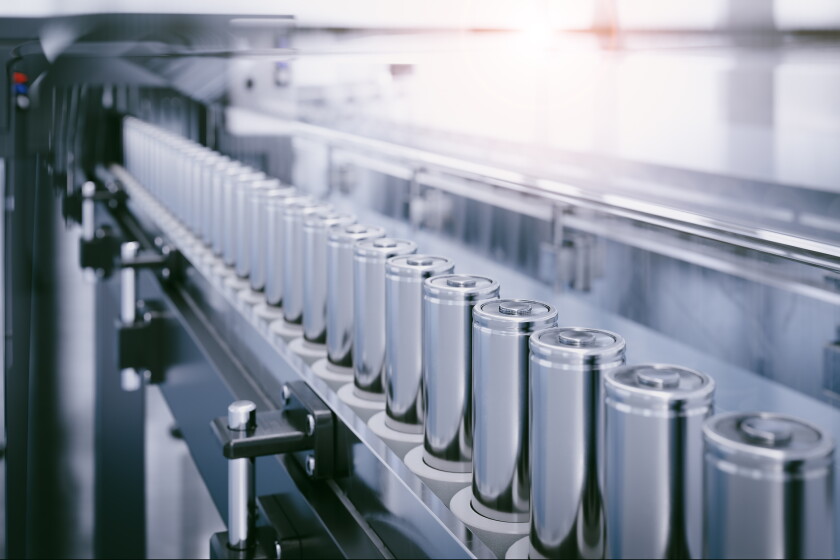
Freeing lithium from the very batteries they power could go a long way toward meeting an ever-increasing demand for the element - Depositphotos
Lithium is a finite resource, and the more we lock inside rechargeable batteries, the less we have to use. A new speedy method to free the element from such sources could be a game changer in terms of the material's availability.
Thanks to our modern day way of purchasing rechargeable everything – including cars – the demand for the lithium-ion batteries that power much of our consumer technology has been skyrocketing. Currently valued at approximately $65 billion, the market for lithium-ion batteries is expected to grow by 23% in the next eight years.
As a relatively lightweight material with the ability to store a lot of energy, the value of lithium is clear. But mining the element can be environmentally destructive, and geopolitical concerns in several of the areas where it is plentiful can threaten supply chains. Plus we've previously reported that there are predictions that current lithium mines will only be able to produce half of what's needed to satisfy demand by 2030.
Taking those factors into account, it's important to either find ways to produce lithium-free battery technologies, look to new methods and sources for extracting it, or find ways to recycle the lithium stored in used up batteries. Yet recycling lithium can be time consuming, use harsh chemicals, and lead to the recovery of less than 5% of the total amount of the element originally used.
Nuking it
So researchers at Rice University came up with a better solution. They started by using chemicals known as deep eutectic solvents (DES), which are eco-friendly liquids that can precipitate lithium and other metals out of a solution.
“The recovery rate is so low because lithium is usually precipitated last after all other metals, so our goal was to figure out how we can target lithium specifically,” said Salma Alhashim, a Rice doctoral alumna who is one of the study’s lead authors. “Here we used a DES that is a mixture of choline chloride and ethylene glycol, knowing from our previous work that during leaching in this DES, lithium gets surrounded by chloride ions from the choline chloride and is leached out into solution.”
Normally a compound needs to be heated in order to force metals to precipitate out and in the case of lithium-containing compounds, an oil bath usually provides that heat source. But the process takes a fair bit of time during which the lithium compounds can begin to degrade.
To speed things up, the Rice team decided to give microwaves a try, knowing that the choline chloride that leads to the isolation of the lithium is very good at absorbing microwave radiation.
15-minute milestone
The speed boost was impressive. The researchers were able to precipitate out the lithium almost 100 times faster than an oil bath. In fact, it took them just 15 minutes to get back 87% of the lithium – a process that would take 12 hours using an oil bath.
“This allowed us to leach lithium selectively over other metals,” said Sohini Bhattacharyya, one of the other lead authors and a postdoctoral fellow in the Nanomaterials Laboratory. “Using microwave radiation for this process is akin to how a kitchen microwave heats food quickly. The energy is transferred directly to the molecules, making the reaction occur much faster than conventional heating methods.”
The researchers say the method can also be tailored to target other elements by tuning the DES composition, so it could have the ability to recover other metals like cobalt or nickel from batteries. The team also highlights the eco-friendly benefits of its approach.
“This method not only enhances the recovery rate but also minimizes environmental impact, which makes it a promising step toward deploying DES-based recycling systems at scale for selective metal recovery,” said Pulickel Ajayan, the corresponding author on the study and department chair of materials science and nanoengineering.
The work has been published in the journal Advanced Functional Materials (NB! Por subscripción)
Source: Rice University
https://newatlas.com/energy/microwave-l ... recycling/
Michael Franco, 30/07/2024
Freeing lithium from the very batteries they power could go a long way toward meeting an ever-increasing demand for the element - Depositphotos
Lithium is a finite resource, and the more we lock inside rechargeable batteries, the less we have to use. A new speedy method to free the element from such sources could be a game changer in terms of the material's availability.
Thanks to our modern day way of purchasing rechargeable everything – including cars – the demand for the lithium-ion batteries that power much of our consumer technology has been skyrocketing. Currently valued at approximately $65 billion, the market for lithium-ion batteries is expected to grow by 23% in the next eight years.
As a relatively lightweight material with the ability to store a lot of energy, the value of lithium is clear. But mining the element can be environmentally destructive, and geopolitical concerns in several of the areas where it is plentiful can threaten supply chains. Plus we've previously reported that there are predictions that current lithium mines will only be able to produce half of what's needed to satisfy demand by 2030.
Taking those factors into account, it's important to either find ways to produce lithium-free battery technologies, look to new methods and sources for extracting it, or find ways to recycle the lithium stored in used up batteries. Yet recycling lithium can be time consuming, use harsh chemicals, and lead to the recovery of less than 5% of the total amount of the element originally used.
Nuking it
So researchers at Rice University came up with a better solution. They started by using chemicals known as deep eutectic solvents (DES), which are eco-friendly liquids that can precipitate lithium and other metals out of a solution.
“The recovery rate is so low because lithium is usually precipitated last after all other metals, so our goal was to figure out how we can target lithium specifically,” said Salma Alhashim, a Rice doctoral alumna who is one of the study’s lead authors. “Here we used a DES that is a mixture of choline chloride and ethylene glycol, knowing from our previous work that during leaching in this DES, lithium gets surrounded by chloride ions from the choline chloride and is leached out into solution.”
Normally a compound needs to be heated in order to force metals to precipitate out and in the case of lithium-containing compounds, an oil bath usually provides that heat source. But the process takes a fair bit of time during which the lithium compounds can begin to degrade.
To speed things up, the Rice team decided to give microwaves a try, knowing that the choline chloride that leads to the isolation of the lithium is very good at absorbing microwave radiation.
15-minute milestone
The speed boost was impressive. The researchers were able to precipitate out the lithium almost 100 times faster than an oil bath. In fact, it took them just 15 minutes to get back 87% of the lithium – a process that would take 12 hours using an oil bath.
“This allowed us to leach lithium selectively over other metals,” said Sohini Bhattacharyya, one of the other lead authors and a postdoctoral fellow in the Nanomaterials Laboratory. “Using microwave radiation for this process is akin to how a kitchen microwave heats food quickly. The energy is transferred directly to the molecules, making the reaction occur much faster than conventional heating methods.”
The researchers say the method can also be tailored to target other elements by tuning the DES composition, so it could have the ability to recover other metals like cobalt or nickel from batteries. The team also highlights the eco-friendly benefits of its approach.
“This method not only enhances the recovery rate but also minimizes environmental impact, which makes it a promising step toward deploying DES-based recycling systems at scale for selective metal recovery,” said Pulickel Ajayan, the corresponding author on the study and department chair of materials science and nanoengineering.
The work has been published in the journal Advanced Functional Materials (NB! Por subscripción)
Source: Rice University
https://newatlas.com/energy/microwave-l ... recycling/
Re: Notas de energías renovables
Rice lab finds faster, cleaner way to extract lithium from battery waste
Microwave-based process boasts 50% recovery rate in 30 seconds
The “white gold” of clean energy, lithium is a key ingredient in batteries large and small, from those powering phones and laptops to grid-scale energy storage systems.
Though relatively abundant, the silvery-white metal could soon be in short supply due to a complex sourcing landscape impacted by the electric vehicle (EV) boom, net-zero goals and geopolitical factors. Valued at over $65 billion in 2023, the lithium-ion battery (LIB) global market is expected to grow by over 23% in the next eight years, likely heightening existing challenges in lithium supply.
What’s more, recovering lithium from spent batteries is environmentally taxing and highly inefficient ⎯ something a team of Rice University researchers led by Pulickel Ajayan is working to change.
In their latest study published in Advanced Functional Materials, the researchers describe a rapid, efficient and environmentally friendly method for selective lithium recovery using microwave radiation and a readily biodegradable solvent. Findings show the new process can retrieve as much as 50% of the lithium in spent LIB cathodes in as little as 30 seconds, overcoming a significant bottleneck in LIB recycling technology.
“We’ve seen a colossal growth in LIB use in recent years, which inevitably raises concerns as to the availability of critical metals like lithium, cobalt and nickel that are used in the cathodes,” said Sohini Bhattacharyya, one of the two lead authors on the study and a Rice Academy Postdoctoral Fellow in the Nanomaterials Laboratory run by Ajayan. “It’s therefore really important to recycle spent LIBs to recover these metals.”
Conventional recycling methods often involve harsh acids, while alternative eco-friendly solvents like deep eutectic solvents (DESs) have struggled with efficiency and economic viability. Moreover, current recycling methods recover less than 5% of lithium, largely due to contamination and loss during the process as well as the energy intensive nature of recovery.
“The recovery rate is so low because lithium is usually precipitated last after all other metals, so our goal was to figure out how we can target lithium specifically,” said Salma Alhashim, a Rice doctoral alumna who is the study’s other lead author. “Here we used a DES that is a mixture of choline chloride and ethylene glycol, knowing from our previous work that during leaching in this DES, lithium gets surrounded by chloride ions from the choline chloride and is leached out into solution.”
In order to leach other metals like cobalt or nickel, both the choline chloride and the ethylene glycol have to be involved in the process. Knowing that of the two substances only choline chloride is good at absorbing microwaves, the researchers submerged the battery waste material in the solvent and blasted it with microwave radiation.
“This allowed us to leach lithium selectively over other metals,” Bhattacharyya said. “Using microwave radiation for this process is akin to how a kitchen microwave heats food quickly. The energy is transferred directly to the molecules, making the reaction occur much faster than conventional heating methods.”
Compared to conventional heating methods like an oil bath, microwave-assisted heating can achieve similar efficiencies almost 100 times faster. For example, using the microwave-based process, the team found that it took 15 minutes to leach 87% of the lithium as opposed to the 12 hours needed to obtain the same recovery rate via oil bath heating.
“This also shows that selectivity towards specific elements can be achieved simply by tuning the DES composition,” Alhashim said. “Another advantage is solvent stability: Because the oil bath method takes so much longer, the solvent begins to decompose, whereas this does not happen with the short heating cycles of a microwave.”
This breakthrough method could dramatically improve the economics and environmental impact of LIB recycling, providing a sustainable solution to a growing global issue.
“This method not only enhances the recovery rate but also minimizes environmental impact, which makes it a promising step toward deploying DES-based recycling systems at scale for selective metal recovery,” said Ajayan, the corresponding author on the study and Rice’s Benjamin M. and Mary Greenwood Anderson Professor of Engineering and professor and department chair of materials science and nanoengineering.
https://news.rice.edu/news/2024/rice-la ... tery-waste
Microwave-based process boasts 50% recovery rate in 30 seconds
The “white gold” of clean energy, lithium is a key ingredient in batteries large and small, from those powering phones and laptops to grid-scale energy storage systems.
Though relatively abundant, the silvery-white metal could soon be in short supply due to a complex sourcing landscape impacted by the electric vehicle (EV) boom, net-zero goals and geopolitical factors. Valued at over $65 billion in 2023, the lithium-ion battery (LIB) global market is expected to grow by over 23% in the next eight years, likely heightening existing challenges in lithium supply.
What’s more, recovering lithium from spent batteries is environmentally taxing and highly inefficient ⎯ something a team of Rice University researchers led by Pulickel Ajayan is working to change.
In their latest study published in Advanced Functional Materials, the researchers describe a rapid, efficient and environmentally friendly method for selective lithium recovery using microwave radiation and a readily biodegradable solvent. Findings show the new process can retrieve as much as 50% of the lithium in spent LIB cathodes in as little as 30 seconds, overcoming a significant bottleneck in LIB recycling technology.
“We’ve seen a colossal growth in LIB use in recent years, which inevitably raises concerns as to the availability of critical metals like lithium, cobalt and nickel that are used in the cathodes,” said Sohini Bhattacharyya, one of the two lead authors on the study and a Rice Academy Postdoctoral Fellow in the Nanomaterials Laboratory run by Ajayan. “It’s therefore really important to recycle spent LIBs to recover these metals.”
Conventional recycling methods often involve harsh acids, while alternative eco-friendly solvents like deep eutectic solvents (DESs) have struggled with efficiency and economic viability. Moreover, current recycling methods recover less than 5% of lithium, largely due to contamination and loss during the process as well as the energy intensive nature of recovery.
“The recovery rate is so low because lithium is usually precipitated last after all other metals, so our goal was to figure out how we can target lithium specifically,” said Salma Alhashim, a Rice doctoral alumna who is the study’s other lead author. “Here we used a DES that is a mixture of choline chloride and ethylene glycol, knowing from our previous work that during leaching in this DES, lithium gets surrounded by chloride ions from the choline chloride and is leached out into solution.”
In order to leach other metals like cobalt or nickel, both the choline chloride and the ethylene glycol have to be involved in the process. Knowing that of the two substances only choline chloride is good at absorbing microwaves, the researchers submerged the battery waste material in the solvent and blasted it with microwave radiation.
“This allowed us to leach lithium selectively over other metals,” Bhattacharyya said. “Using microwave radiation for this process is akin to how a kitchen microwave heats food quickly. The energy is transferred directly to the molecules, making the reaction occur much faster than conventional heating methods.”
Compared to conventional heating methods like an oil bath, microwave-assisted heating can achieve similar efficiencies almost 100 times faster. For example, using the microwave-based process, the team found that it took 15 minutes to leach 87% of the lithium as opposed to the 12 hours needed to obtain the same recovery rate via oil bath heating.
“This also shows that selectivity towards specific elements can be achieved simply by tuning the DES composition,” Alhashim said. “Another advantage is solvent stability: Because the oil bath method takes so much longer, the solvent begins to decompose, whereas this does not happen with the short heating cycles of a microwave.”
This breakthrough method could dramatically improve the economics and environmental impact of LIB recycling, providing a sustainable solution to a growing global issue.
“This method not only enhances the recovery rate but also minimizes environmental impact, which makes it a promising step toward deploying DES-based recycling systems at scale for selective metal recovery,” said Ajayan, the corresponding author on the study and Rice’s Benjamin M. and Mary Greenwood Anderson Professor of Engineering and professor and department chair of materials science and nanoengineering.
https://news.rice.edu/news/2024/rice-la ... tery-waste
Re: Notas de energías renovables
La 'superbatería' belga combina la mejor tecnología de dos mundos
Andre Oerlemans, Change Inc, 06-Dic-2024
La empresa belga For-E ha desarrollado un supercondensador híbrido que combina tecnología de batería y supercondensador. Esto crea un nuevo tipo de batería que puede almacenar y devolver grandes cantidades de energía verde de manera sostenible y segura. “Pero oficialmente no es una batería”.

La empresa For-E suministra sistemas de almacenamiento de energía en forma de baterías domésticas y en grandes contenedores. Crédito: FoR-E
La empresa suministra sus baterías en seis países europeos, incluidos Alemania y Bélgica. Como baterías domésticas para residencias, pero también como contenedores almacenamiento a escala industrial para empresas. “Varios competidores están investigando la misma tecnología de supercondensadores, pero aún no tienen un sistema en funcionamiento. “Somos los únicos en este sentido”, afirman el ingeniero jefe Eli De Mul y el desarrollador comercial Frédéric Haven de For-E.
Baterías indispensables
Las baterías son indispensables para pasar de combustibles fósiles a energía verde. Pueden almacenar excedentes de electricidad para superar los períodos oscuros y sin viento, conocidos como débil y oscuro (“dunkelflaute”). Además, pueden reducir el desbalance en la red eléctrica al absorber los picos y valles en la producción de energía verde. Actualmente, el 99,9 por ciento de todas las baterías en uso son baterías de iones de litio, según el primer Informe de tendencias de almacenamiento inteligente (“Smart Storage Trendrepport”). Pero ese tipo de baterías presenta riesgos de incendio, la extracción de litio contamina el medio ambiente y los componentes de las baterías y materiales críticos como el cobalto, el manganeso, el litio o el cobre suelen proceder de países donde los derechos humanos y la conservación de la naturaleza son una baja prioridad. Además, estas baterías tienen una vida útil relativamente corta.
Supercondensadores
Por eso las empresas están buscando alternativas de almacenamiento de energía. Se están desarrollando baterías de sal, baterías de flujo y baterías de estado sólido como alternativas a las baterías de iones de litio. Esta búsqueda incluye el supercondensador, que tiene muchas ventajas sobre las baterías: puede almacenar mucha energía durante largos períodos de tiempo, se fabrica con materiales relativamente simples, inofensivos y fáciles de encontrar, y puede cargarse y descargarse con suma rapidez. En la práctica se usa en aplicaciones que requieren mucha energía rápidamente, por ejemplo, en minería, donde las grúas tienen que levantar pesadas cargas o los camiones grandes en pendientes pronunciadas.
Tensión inconstante
La rápida carga y descarga también es desventajosa para usos en la transición energética. Esto no sucede en una batería, que tiene un voltaje constante y estable. Por eso, los supercondensadores aún no son adecuados para almacenar energía verde solar o eólica, porque los inversores requeridos se apagarían inmediatamente debido a las fluctuaciones de tensión. Esto también los vuelve inadecuados para estabilizar el voltaje en la red eléctrica.
Técnicas combinadas
Hasta hace poco, claro. La empresa belga For-E ha encontrado una solución a este inconveniente y lanza al mercado un supercondensador híbrido en el que se emplea algunas técnicas de las baterías. “Hemos combinado las ventajas de ambas tecnologías. Nuestro primer desafío fue mantener la tensión estable. “De lo contrario, los inversores se apagan y no se pueden utilizar como batería”, explica De Mul, cofundador de For-E.
Video: funcionamiento de la batería For-E:
Litio en el ánodo
For-E resolvió el problema adaptando el supercondensador. Simplemente, consta de dos electrodos (placas) con una carga positiva y negativa entre ellos. Funciona según un proceso electrostático, sin generación de calor, y no según un proceso químico. Para ello, la empresa utiliza células de grafeno, un material que puede almacenar más energía. En el ánodo de la célula de grafeno se aplica entre un 10 y un 12 por ciento de litio, no para reaccionar con otros metales, como en una batería, sino solamente para estabilizar el voltaje. Esto crea una celda de supercondensador híbrido. Para esta celda adaptada, la empresa ha desarrollado especialmente un sistema de gestión de batería híbrido (BMS), de nuevo una combinación de sistemas de batería y supercondensadores. Los resultados de las pruebas muestran que después de 32.000 ciclos de carga a plena carga y alta velocidad, la batería híbrida todavía tiene el 80 por ciento de su capacidad restante. Por lo tanto, dura mucho más que los 5.000 a 8.000 ciclos de carga de las baterías tradicionales.
Proyecto piloto en Dinamarca
El voltaje ahora es estable. Esto hace que el supercondensador híbrido sea adecuado para almacenar grandes cantidades de energía verde y comercializarlas en el mercado no balanceado. Próximamente se iniciará un proyecto piloto en Dinamarca en un parque solar, donde For-E colocará dos contenedores de veinte pies con una capacidad de 5 megavatios hora, que almacenan el exceso de energía solar y lo suministran en las horas pico, ofreciendo un sistema de almacenamiento de energía durante los valles y picos en el suministro.
Sistema modular
El sistema es modular, lo que permite fabricar la 'superbatería' del tamaño deseado. La capacidad puede variar de 6 a 60 kilovatios hora, de 30 a 250 kilovatios hora y de 100 a 500 kilovatios hora. For-E puede ajustar el BMS para cargar y descargar a velocidades hasta veinte veces más rápidas que las baterías de litio. Esto permite que una batería más pequeña de 100 kilovatios-hora suministre tanta potencia como una batería de iones de litio de 1 megavatio-hora. El sistema también se suministra en contenedores con una capacidad de 1 megavatio hora. “Podemos almacenar 2,6 megavatios hora en un contenedor”, dice De Mul.

Los contenedores pueden contener 2,6 megavatios de capacidad de batería | Crédito: FoR-E
Todavía no en Holanda
For-E ya ha entregado cientos de baterías domésticas con esta tecnología, principalmente en Alemania y Bélgica. En la sucursal belga de Procter & Gamble se utiliza un sistema híbrido industrial como suministro de energía de reserva para los servidores. La empresa desarrolló un modelo móvil para la OTAN que puede utilizarse en zonas de crisis. “Las baterías no deben suponer ningún peligro de incendio o explosión allí”, afirma Haven. La empresa aún no ha instalado ningún sistema en los Países Bajos.
Doble seguridad contra incendios
La batería híbrida no contiene sustancias nocivas ni metales preciosos. Otra ventaja sobre las baterías de iones de litio es que no hay peligro de que el supercondensador híbrido se incendie. “Nuestra seguridad contra incendios es doble”, explica Haven. “No hay peligro de combustión espontánea, como ocurre con el litio. Con nosotros esto no es posible porque no hay desarrollo de calor. El grafeno que utilizamos también tiene la propiedad de extraer oxígeno en caso de incendio. Así que, incluso si hay un incendio cerca, se extinguirá solo”.
No es una batería
Dado que el sistema no convierte energía química en electricidad, no entra en la definición de batería según las autoridades belgas. Por ello, los instaladores y clientes de instalaciones For-E no tienen que pagar ninguna contribución de procesamiento al Bebat belga, que recoge y recicla las baterías. Esto supone un ahorro de decenas de miles de euros por contenedor. “Oficialmente no es una batería. Bebat no lo ve como una célula de batería, sino como una célula electrónica”, afirma Haven.
https://www.change.inc/energie/belgisch ... lden-41387
Andre Oerlemans, Change Inc, 06-Dic-2024
La empresa belga For-E ha desarrollado un supercondensador híbrido que combina tecnología de batería y supercondensador. Esto crea un nuevo tipo de batería que puede almacenar y devolver grandes cantidades de energía verde de manera sostenible y segura. “Pero oficialmente no es una batería”.
La empresa For-E suministra sistemas de almacenamiento de energía en forma de baterías domésticas y en grandes contenedores. Crédito: FoR-E
La empresa suministra sus baterías en seis países europeos, incluidos Alemania y Bélgica. Como baterías domésticas para residencias, pero también como contenedores almacenamiento a escala industrial para empresas. “Varios competidores están investigando la misma tecnología de supercondensadores, pero aún no tienen un sistema en funcionamiento. “Somos los únicos en este sentido”, afirman el ingeniero jefe Eli De Mul y el desarrollador comercial Frédéric Haven de For-E.
Baterías indispensables
Las baterías son indispensables para pasar de combustibles fósiles a energía verde. Pueden almacenar excedentes de electricidad para superar los períodos oscuros y sin viento, conocidos como débil y oscuro (“dunkelflaute”). Además, pueden reducir el desbalance en la red eléctrica al absorber los picos y valles en la producción de energía verde. Actualmente, el 99,9 por ciento de todas las baterías en uso son baterías de iones de litio, según el primer Informe de tendencias de almacenamiento inteligente (“Smart Storage Trendrepport”). Pero ese tipo de baterías presenta riesgos de incendio, la extracción de litio contamina el medio ambiente y los componentes de las baterías y materiales críticos como el cobalto, el manganeso, el litio o el cobre suelen proceder de países donde los derechos humanos y la conservación de la naturaleza son una baja prioridad. Además, estas baterías tienen una vida útil relativamente corta.
Supercondensadores
Por eso las empresas están buscando alternativas de almacenamiento de energía. Se están desarrollando baterías de sal, baterías de flujo y baterías de estado sólido como alternativas a las baterías de iones de litio. Esta búsqueda incluye el supercondensador, que tiene muchas ventajas sobre las baterías: puede almacenar mucha energía durante largos períodos de tiempo, se fabrica con materiales relativamente simples, inofensivos y fáciles de encontrar, y puede cargarse y descargarse con suma rapidez. En la práctica se usa en aplicaciones que requieren mucha energía rápidamente, por ejemplo, en minería, donde las grúas tienen que levantar pesadas cargas o los camiones grandes en pendientes pronunciadas.
Tensión inconstante
La rápida carga y descarga también es desventajosa para usos en la transición energética. Esto no sucede en una batería, que tiene un voltaje constante y estable. Por eso, los supercondensadores aún no son adecuados para almacenar energía verde solar o eólica, porque los inversores requeridos se apagarían inmediatamente debido a las fluctuaciones de tensión. Esto también los vuelve inadecuados para estabilizar el voltaje en la red eléctrica.
Técnicas combinadas
Hasta hace poco, claro. La empresa belga For-E ha encontrado una solución a este inconveniente y lanza al mercado un supercondensador híbrido en el que se emplea algunas técnicas de las baterías. “Hemos combinado las ventajas de ambas tecnologías. Nuestro primer desafío fue mantener la tensión estable. “De lo contrario, los inversores se apagan y no se pueden utilizar como batería”, explica De Mul, cofundador de For-E.
Video: funcionamiento de la batería For-E:
Litio en el ánodo
For-E resolvió el problema adaptando el supercondensador. Simplemente, consta de dos electrodos (placas) con una carga positiva y negativa entre ellos. Funciona según un proceso electrostático, sin generación de calor, y no según un proceso químico. Para ello, la empresa utiliza células de grafeno, un material que puede almacenar más energía. En el ánodo de la célula de grafeno se aplica entre un 10 y un 12 por ciento de litio, no para reaccionar con otros metales, como en una batería, sino solamente para estabilizar el voltaje. Esto crea una celda de supercondensador híbrido. Para esta celda adaptada, la empresa ha desarrollado especialmente un sistema de gestión de batería híbrido (BMS), de nuevo una combinación de sistemas de batería y supercondensadores. Los resultados de las pruebas muestran que después de 32.000 ciclos de carga a plena carga y alta velocidad, la batería híbrida todavía tiene el 80 por ciento de su capacidad restante. Por lo tanto, dura mucho más que los 5.000 a 8.000 ciclos de carga de las baterías tradicionales.
Proyecto piloto en Dinamarca
El voltaje ahora es estable. Esto hace que el supercondensador híbrido sea adecuado para almacenar grandes cantidades de energía verde y comercializarlas en el mercado no balanceado. Próximamente se iniciará un proyecto piloto en Dinamarca en un parque solar, donde For-E colocará dos contenedores de veinte pies con una capacidad de 5 megavatios hora, que almacenan el exceso de energía solar y lo suministran en las horas pico, ofreciendo un sistema de almacenamiento de energía durante los valles y picos en el suministro.
Sistema modular
El sistema es modular, lo que permite fabricar la 'superbatería' del tamaño deseado. La capacidad puede variar de 6 a 60 kilovatios hora, de 30 a 250 kilovatios hora y de 100 a 500 kilovatios hora. For-E puede ajustar el BMS para cargar y descargar a velocidades hasta veinte veces más rápidas que las baterías de litio. Esto permite que una batería más pequeña de 100 kilovatios-hora suministre tanta potencia como una batería de iones de litio de 1 megavatio-hora. El sistema también se suministra en contenedores con una capacidad de 1 megavatio hora. “Podemos almacenar 2,6 megavatios hora en un contenedor”, dice De Mul.
Los contenedores pueden contener 2,6 megavatios de capacidad de batería | Crédito: FoR-E
Todavía no en Holanda
For-E ya ha entregado cientos de baterías domésticas con esta tecnología, principalmente en Alemania y Bélgica. En la sucursal belga de Procter & Gamble se utiliza un sistema híbrido industrial como suministro de energía de reserva para los servidores. La empresa desarrolló un modelo móvil para la OTAN que puede utilizarse en zonas de crisis. “Las baterías no deben suponer ningún peligro de incendio o explosión allí”, afirma Haven. La empresa aún no ha instalado ningún sistema en los Países Bajos.
Doble seguridad contra incendios
La batería híbrida no contiene sustancias nocivas ni metales preciosos. Otra ventaja sobre las baterías de iones de litio es que no hay peligro de que el supercondensador híbrido se incendie. “Nuestra seguridad contra incendios es doble”, explica Haven. “No hay peligro de combustión espontánea, como ocurre con el litio. Con nosotros esto no es posible porque no hay desarrollo de calor. El grafeno que utilizamos también tiene la propiedad de extraer oxígeno en caso de incendio. Así que, incluso si hay un incendio cerca, se extinguirá solo”.
No es una batería
Dado que el sistema no convierte energía química en electricidad, no entra en la definición de batería según las autoridades belgas. Por ello, los instaladores y clientes de instalaciones For-E no tienen que pagar ninguna contribución de procesamiento al Bebat belga, que recoge y recicla las baterías. Esto supone un ahorro de decenas de miles de euros por contenedor. “Oficialmente no es una batería. Bebat no lo ve como una célula de batería, sino como una célula electrónica”, afirma Haven.
https://www.change.inc/energie/belgisch ... lden-41387
Re: Notas de energías renovables
No usa metales escasos, sino plástico: el primer electrolizador con pilas de plástico se puede ver en Kootwijkerbroek
Teun Schröder, 10-Dic-2024
El lunes pasado, Sophie Hermans, Ministra de Clima y Crecimiento Verde, inauguró el Centro de Experiencia H2 en Kootwijkerbroek. En el centro se presentará un electrolizador especial del fabricante holandés XINTC. Esta empresa desarrolló un módulo de hidrógeno enteramente de plástico, sin metales, membranas ni sellos especiales.

El electrolizador XINTC está construido con pilas de plástico modulares. | Crédito: XINTC
La producción de hidrógeno mediante electrólisis sigue siendo cara, en parte a que estos sistemas contienen metales raros y caros, como iridio y platino. Por ello, la empresa XINTC ha desarrollado un electrolizador que no depende de estas materias primas. Esta empresa afirma haber desarrollado el primer módulo de hidrógeno (también llamado pila), que consta enteramente de piezas de plástico. La pila de un electrolizador es el componente principal donde el agua se separa en hidrógeno y oxígeno mediante electricidad (sostenible).
Hidrógeno en el parque solar
XINTC trabajó en esta innovación durante más de diez años. La empresa recibió ayuda de GroenvermogenNL, un programa de transición del Fondo de Crecimiento Nacional que gestiona un presupuesto de 838 millones de euros. Las dos organizaciones han trabajado juntas para garantizar que el sistema electrolizador esté conectado a un parque solar de Energeion en Kootwijkerbroek. El electrolizador está alojado en el H2 Experience Center, donde los interesados pueden ver la tecnología en operación. El centro fue inaugurado el lunes por la Ministra Hermans y el alcalde de Barneveld, Jacco van der Tak.
Posibilidades de producción en masa
“Se trata de un desarrollo fantástico e innovador y de un diseño de electrolizador holandés único con el que damos un paso importante hacia la economía del hidrógeno verde”, afirma Annemarie Manger, miembro del consejo de administración de GroenvermogenNL. “Normalmente, los electrolizadores se fabrican según las especificaciones del cliente, utilizando componentes caros, lo que encarece la producción de hidrógeno. “Las pilas totalmente de plástico, la posibilidad de producción en masa y el hecho de que las pilas prácticamente no requieren mantenimiento implican que los costes son significativamente más bajos”.
Hidrógeno para la movilidad
Gracias a la electrónica inteligente, el electrolizador controla de cerca el rendimiento del parque solar. El sistema luego produce hidrógeno cuando el parque solar suministra energía excesiva a la red. Según Manger, este método puede incrementar en una cuarta parte el rendimiento energético de un campo solar.
La cantidad limitada de hidrógeno que se produce actualmente en el H2 Experience Center se utilizará para hacer que la movilidad sea más sostenible. En última instancia, la ambición es aumentar la capacidad a 2,4 megavatios.
https://www.change.inc/energie/geen-sch ... roek-41394
Teun Schröder, 10-Dic-2024
El lunes pasado, Sophie Hermans, Ministra de Clima y Crecimiento Verde, inauguró el Centro de Experiencia H2 en Kootwijkerbroek. En el centro se presentará un electrolizador especial del fabricante holandés XINTC. Esta empresa desarrolló un módulo de hidrógeno enteramente de plástico, sin metales, membranas ni sellos especiales.
El electrolizador XINTC está construido con pilas de plástico modulares. | Crédito: XINTC
La producción de hidrógeno mediante electrólisis sigue siendo cara, en parte a que estos sistemas contienen metales raros y caros, como iridio y platino. Por ello, la empresa XINTC ha desarrollado un electrolizador que no depende de estas materias primas. Esta empresa afirma haber desarrollado el primer módulo de hidrógeno (también llamado pila), que consta enteramente de piezas de plástico. La pila de un electrolizador es el componente principal donde el agua se separa en hidrógeno y oxígeno mediante electricidad (sostenible).
Hidrógeno en el parque solar
XINTC trabajó en esta innovación durante más de diez años. La empresa recibió ayuda de GroenvermogenNL, un programa de transición del Fondo de Crecimiento Nacional que gestiona un presupuesto de 838 millones de euros. Las dos organizaciones han trabajado juntas para garantizar que el sistema electrolizador esté conectado a un parque solar de Energeion en Kootwijkerbroek. El electrolizador está alojado en el H2 Experience Center, donde los interesados pueden ver la tecnología en operación. El centro fue inaugurado el lunes por la Ministra Hermans y el alcalde de Barneveld, Jacco van der Tak.
Posibilidades de producción en masa
“Se trata de un desarrollo fantástico e innovador y de un diseño de electrolizador holandés único con el que damos un paso importante hacia la economía del hidrógeno verde”, afirma Annemarie Manger, miembro del consejo de administración de GroenvermogenNL. “Normalmente, los electrolizadores se fabrican según las especificaciones del cliente, utilizando componentes caros, lo que encarece la producción de hidrógeno. “Las pilas totalmente de plástico, la posibilidad de producción en masa y el hecho de que las pilas prácticamente no requieren mantenimiento implican que los costes son significativamente más bajos”.
Hidrógeno para la movilidad
Gracias a la electrónica inteligente, el electrolizador controla de cerca el rendimiento del parque solar. El sistema luego produce hidrógeno cuando el parque solar suministra energía excesiva a la red. Según Manger, este método puede incrementar en una cuarta parte el rendimiento energético de un campo solar.
La cantidad limitada de hidrógeno que se produce actualmente en el H2 Experience Center se utilizará para hacer que la movilidad sea más sostenible. En última instancia, la ambición es aumentar la capacidad a 2,4 megavatios.
https://www.change.inc/energie/geen-sch ... roek-41394
Re: Notas de energías renovables
Recycling lithium-ion batteries delivers significant environmental benefits
Standford Report, January 31st, 2025
According to new research, greenhouse gas emissions, energy consumption, and water usage are all meaningfully reduced when – instead of mining for new metals – batteries are recycled.
Compared with mining and processing new chemicals, the battery recycling process analyzed in the study:
Lithium-ion battery recyclers source materials from two main streams: defective scrap material from battery manufacturers, and so-called “dead” batteries, mostly collected from workplaces. The recycling process extracts lithium, nickel, cobalt, copper, manganese, and aluminum from these sources.
The study quantified the environmental footprint of this recycling process, and found it emits less than half the greenhouse gases (GHGs) of conventional mining and refinement of these metals and uses about one-fourth of the water and energy of mining new metals. The environmental benefits are even greater for the scrap stream, which comprised about 90% of the recycled supply studied, coming in at: 19% of the GHG emissions of mining and processing, 12% of the water use, and 11% of the energy use. While it was not specifically measured, reduced energy use also correlates with less air pollutants like soot and sulfur.
“Recently, I was in an Uber electric vehicle. The driver asked me if EVs really are ‘good’ for the environment because he recently had read that maybe they aren’t. All he knew was that I was faculty at Stanford,” William Tarpeh, assistant professor of chemical engineering in the School of Engineering and the study’s senior author, recalled with a chuckle.
“I told him that EVs definitely are good for the environment, and we’re now finding new ways to make them even more so,” said Tarpeh. “This study, I think, tells us that we can design the future of battery recycling to optimize the environmental benefits. We can write the script.”
Location, location
Battery recycling’s environmental impacts depend heavily on the processing facility’s location and electricity source.
“A battery recycling plant in regions that rely heavily on electricity generated by burning coal would see a diminished climate advantage,” said Samantha Bunke, a PhD student at Stanford and one of the study’s three lead investigators.
“On the other hand, fresh-water shortages in regions with cleaner electricity are a great concern,” added Bunke.
Most of the study’s data for battery recycling came from Redwood Materials in Nevada – North America’s largest industrial-scale lithium-ion battery recycling facility – which benefits from the western U.S.’s cleaner energy mix, which includes hydropower, geothermal, and solar.
Transportation is also a crucial factor. In the mining and processing of cobalt, for example, 80% of the global supply is mined in the Democratic Republic of the Congo. Then, 75% of the cobalt supply for batteries travels by road, rail, and sea to China for refining. Meanwhile, most of the global supply of lithium is mined in Australia and Chile. Most of that supply also makes its way to China. The equivalent process for battery recycling is collecting used batteries and scrap, which must then be transported to the recycler.
“We determined that the total transport distance for conventional mining and refining of just the active metals in a battery averages about 35,000 miles (57,000 kilometers). That’s like going around the world one and a half times,” said Michael Machala, PhD ’17, also a lead author of the study.
“Our estimated total transport of used batteries from your cell phone or an EV to a hypothetical refinement facility in California was around 140 miles (225 kilometers),” added Machala, who was a postdoctoral scholar at Stanford’s Precourt Institute for Energy at the time of research and is now a staff scientist for the Toyota Research Institute. This distance was based on presumed optimal locations for future refining facilities amid ample U.S. recyclable batteries.
Redwood’s environmental outcomes do not represent the nascent battery recycling industry’s overall environmental performance for recycling used batteries. Conventional pyrometallurgy, a key refining step, is very energy intensive, usually requiring temperatures of more than 2,550 degrees Fahrenheit (1,400 degrees Celsius).
Redwood, however, has patented a process called “reductive calcination,” which requires considerably lower temperatures, does not use fossil fuels, and yields more lithium than conventional methods.
“Other pyrometallurgical processes similar to Redwood’s are emerging in labs that also operate at moderate temperatures and don’t burn fossil fuels,” said the third lead author, Xi Chen, a postdoctoral scholar at Stanford during the time of research and now an assistant professor at City University of Hong Kong.
“Every time we spoke about our research, companies would ask us questions and incorporate what we were finding into more efficient practices,” added Chen. “This study can inform the scale-up of battery recycling companies, like the importance of picking good locations for new facilities. California doesn’t have a monopoly on aging lithium-ion batteries from cell phones and EVs.”
Looking ahead
Industrial-scale battery recycling is growing, but not quickly enough, according to senior author Tarpeh.
“We’re forecast to run out of new cobalt, nickel, and lithium in the next decade. We’ll probably just mine lower-grade minerals for a while, but 2050 and the goals we have for that year are not far away,” he said.
While the U.S. now recycles about 50% of available lithium-ion batteries, it has successfully recycled 99% of lead-acid batteries for decades. Given that used lithium-ion batteries contain materials with up to 10 times higher economic value, the opportunity is significant, Tarpeh said.
“For a future with a greatly increased supply of used batteries, we need to design and prepare a recycling system today from collection to processing back into new batteries with minimal environmental impact,” he added. “Hopefully, battery manufacturers will consider recyclability more in their future designs, too.”
https://news.stanford.edu/stories/2025/ ... pply-chain
Standford Report, January 31st, 2025
According to new research, greenhouse gas emissions, energy consumption, and water usage are all meaningfully reduced when – instead of mining for new metals – batteries are recycled.
Compared with mining and processing new chemicals, the battery recycling process analyzed in the study:
- Emitted 58% to 81% less greenhouse gas emissions
- Used 72% to 88% less water
- And used 77% to 89% less energy
- Carbon emissions aside, energy use correlates with air pollutants like soot and sulfur
Lithium-ion battery recyclers source materials from two main streams: defective scrap material from battery manufacturers, and so-called “dead” batteries, mostly collected from workplaces. The recycling process extracts lithium, nickel, cobalt, copper, manganese, and aluminum from these sources.
The study quantified the environmental footprint of this recycling process, and found it emits less than half the greenhouse gases (GHGs) of conventional mining and refinement of these metals and uses about one-fourth of the water and energy of mining new metals. The environmental benefits are even greater for the scrap stream, which comprised about 90% of the recycled supply studied, coming in at: 19% of the GHG emissions of mining and processing, 12% of the water use, and 11% of the energy use. While it was not specifically measured, reduced energy use also correlates with less air pollutants like soot and sulfur.
“Recently, I was in an Uber electric vehicle. The driver asked me if EVs really are ‘good’ for the environment because he recently had read that maybe they aren’t. All he knew was that I was faculty at Stanford,” William Tarpeh, assistant professor of chemical engineering in the School of Engineering and the study’s senior author, recalled with a chuckle.
“I told him that EVs definitely are good for the environment, and we’re now finding new ways to make them even more so,” said Tarpeh. “This study, I think, tells us that we can design the future of battery recycling to optimize the environmental benefits. We can write the script.”
Location, location
Battery recycling’s environmental impacts depend heavily on the processing facility’s location and electricity source.
“A battery recycling plant in regions that rely heavily on electricity generated by burning coal would see a diminished climate advantage,” said Samantha Bunke, a PhD student at Stanford and one of the study’s three lead investigators.
“On the other hand, fresh-water shortages in regions with cleaner electricity are a great concern,” added Bunke.
Most of the study’s data for battery recycling came from Redwood Materials in Nevada – North America’s largest industrial-scale lithium-ion battery recycling facility – which benefits from the western U.S.’s cleaner energy mix, which includes hydropower, geothermal, and solar.
Transportation is also a crucial factor. In the mining and processing of cobalt, for example, 80% of the global supply is mined in the Democratic Republic of the Congo. Then, 75% of the cobalt supply for batteries travels by road, rail, and sea to China for refining. Meanwhile, most of the global supply of lithium is mined in Australia and Chile. Most of that supply also makes its way to China. The equivalent process for battery recycling is collecting used batteries and scrap, which must then be transported to the recycler.
“We determined that the total transport distance for conventional mining and refining of just the active metals in a battery averages about 35,000 miles (57,000 kilometers). That’s like going around the world one and a half times,” said Michael Machala, PhD ’17, also a lead author of the study.
“Our estimated total transport of used batteries from your cell phone or an EV to a hypothetical refinement facility in California was around 140 miles (225 kilometers),” added Machala, who was a postdoctoral scholar at Stanford’s Precourt Institute for Energy at the time of research and is now a staff scientist for the Toyota Research Institute. This distance was based on presumed optimal locations for future refining facilities amid ample U.S. recyclable batteries.
Patent advantageAcademia/industry cooperation
This study is the first known lifecycle analysis of lithium-ion battery recycling based on data from an industrial-scale recycling facility.
“We are grateful for the data supplied by Redwood Materials from the largest industrial-scale lithium-ion battery recycling facility in North America, which was needed for this research,” said senior author William Tarpeh.
Redwood, which has since broken ground on a new facility in South Carolina, was one of the first to apply the lessons of this project to their own operations and environmental footprint.
Said company founder and chief executive, JB Straubel: “The insights of this research have played a key role in refining Redwood’s battery recycling processes.” Straubel earned his undergraduate and graduate degrees from Stanford.
“Thanks to the researchers’ observations,” said Straubel, “we have further reduced our environmental footprint, while also advancing both resource efficiency and process scalability.”
Redwood’s environmental outcomes do not represent the nascent battery recycling industry’s overall environmental performance for recycling used batteries. Conventional pyrometallurgy, a key refining step, is very energy intensive, usually requiring temperatures of more than 2,550 degrees Fahrenheit (1,400 degrees Celsius).
Redwood, however, has patented a process called “reductive calcination,” which requires considerably lower temperatures, does not use fossil fuels, and yields more lithium than conventional methods.
“Other pyrometallurgical processes similar to Redwood’s are emerging in labs that also operate at moderate temperatures and don’t burn fossil fuels,” said the third lead author, Xi Chen, a postdoctoral scholar at Stanford during the time of research and now an assistant professor at City University of Hong Kong.
“Every time we spoke about our research, companies would ask us questions and incorporate what we were finding into more efficient practices,” added Chen. “This study can inform the scale-up of battery recycling companies, like the importance of picking good locations for new facilities. California doesn’t have a monopoly on aging lithium-ion batteries from cell phones and EVs.”
Looking ahead
Industrial-scale battery recycling is growing, but not quickly enough, according to senior author Tarpeh.
“We’re forecast to run out of new cobalt, nickel, and lithium in the next decade. We’ll probably just mine lower-grade minerals for a while, but 2050 and the goals we have for that year are not far away,” he said.
While the U.S. now recycles about 50% of available lithium-ion batteries, it has successfully recycled 99% of lead-acid batteries for decades. Given that used lithium-ion batteries contain materials with up to 10 times higher economic value, the opportunity is significant, Tarpeh said.
“For a future with a greatly increased supply of used batteries, we need to design and prepare a recycling system today from collection to processing back into new batteries with minimal environmental impact,” he added. “Hopefully, battery manufacturers will consider recyclability more in their future designs, too.”
https://news.stanford.edu/stories/2025/ ... pply-chain
Re: Notas de energías renovables
Tiny copper 'flowers' bloom on artificial leaves for clean fuel production
Date: February 3, 2025
Source: University of Cambridge
Summary:
Tiny copper 'nano-flowers' have been attached to an artificial leaf to produce clean fuels and chemicals that are the backbone of modern energy and manufacturing.
Tiny copper 'nano-flowers' have been attached to an artificial leaf to produce clean fuels and chemicals that are the backbone of modern energy and manufacturing.
The researchers, from the University of Cambridge and the University of California, Berkeley, developed a practical way to make hydrocarbons -- molecules made of carbon and hydrogen -- powered solely by the sun.
The device they developed combines a light absorbing 'leaf' made from a high-efficiency solar cell material called perovskite, with a copper nanoflower catalyst, to convert carbon dioxide into useful molecules. Unlike most metal catalysts, which can only convert CO₂ into single-carbon molecules, the copper flowers enable the formation of more complex hydrocarbons with two carbon atoms, such as ethane and ethylene -- key building blocks for liquid fuels, chemicals and plastics.
Almost all hydrocarbons currently stem from fossil fuels, but the method developed by the Cambridge-Berkeley team results in clean chemicals and fuels made from CO2, water and glycerol -- a common organic compound -- without any additional carbon emissions. The results are reported in the journal Nature Catalysis.
The study builds on the team's earlier work on artificial leaves, which take their inspiration from photosynthesis: the process by which plants convert sunlight into food. "We wanted to go beyond basic carbon dioxide reduction and produce more complex hydrocarbons, but that requires significantly more energy," said Dr Virgil Andrei from Cambridge's Yusuf Hamied Department of Chemistry, the study's lead author.
Andrei, a Research Fellow of St John's College, Cambridge, carried out the work as part of the Winton Cambridge-Kavli ENSI Exchange programme in the lab of Professor Peidong Yang at University of California, Berkeley.
By coupling a perovskite light absorber with the copper nanoflower catalyst, the team was able to produce more complex hydrocarbons. To further improve efficiency and overcome the energy limits of splitting water, the team added silicon nanowire electrodes that can oxidise glycerol instead. This new platform produces hydrocarbons much more effectively -- 200 times better than earlier systems for splitting water and carbon dioxide.
The reaction not only boosts CO₂ reduction performance, but also produces high-value chemicals such as glycerate, lactate, and formate, which have applications in pharmaceuticals, cosmetics, and chemical synthesis.
"Glycerol is typically considered waste, but here it plays a crucial role in improving the reaction rate," said Andrei. "This demonstrates we can apply our platform to a wide range of chemical processes beyond just waste conversion. By carefully designing the catalyst's surface area, we can influence what products we generate, making the process more selective."
While current CO₂-to-hydrocarbon selectivity remains around 10%, the researchers are optimistic about improving catalyst design to increase efficiency. The team envisions applying their platform to even more complex organic reactions, opening doors for innovation in sustainable chemical production. With continued improvements, this research could accelerate the transition to a circular, carbon-neutral economy.
"This project is an excellent example of how global research partnerships can lead to impactful scientific advancements," said Andrei. "By combining expertise from Cambridge and Berkeley, we've developed a system that may reshape the way we produce fuels and valuable chemicals sustainably."
The research was supported in part by the Winton Programme for the Physics of Sustainability, St John's College, the US Department of Energy, the European Research Council, and UK Research and Innovation (UKRI).
https://www.sciencedaily.com/releases/2 ... 142505.htm
Artículo técnico (acceso abierto): https://www.nature.com/articles/s41929-025-01292-y
Date: February 3, 2025
Source: University of Cambridge
Summary:
Tiny copper 'nano-flowers' have been attached to an artificial leaf to produce clean fuels and chemicals that are the backbone of modern energy and manufacturing.
Tiny copper 'nano-flowers' have been attached to an artificial leaf to produce clean fuels and chemicals that are the backbone of modern energy and manufacturing.
The researchers, from the University of Cambridge and the University of California, Berkeley, developed a practical way to make hydrocarbons -- molecules made of carbon and hydrogen -- powered solely by the sun.
The device they developed combines a light absorbing 'leaf' made from a high-efficiency solar cell material called perovskite, with a copper nanoflower catalyst, to convert carbon dioxide into useful molecules. Unlike most metal catalysts, which can only convert CO₂ into single-carbon molecules, the copper flowers enable the formation of more complex hydrocarbons with two carbon atoms, such as ethane and ethylene -- key building blocks for liquid fuels, chemicals and plastics.
Almost all hydrocarbons currently stem from fossil fuels, but the method developed by the Cambridge-Berkeley team results in clean chemicals and fuels made from CO2, water and glycerol -- a common organic compound -- without any additional carbon emissions. The results are reported in the journal Nature Catalysis.
The study builds on the team's earlier work on artificial leaves, which take their inspiration from photosynthesis: the process by which plants convert sunlight into food. "We wanted to go beyond basic carbon dioxide reduction and produce more complex hydrocarbons, but that requires significantly more energy," said Dr Virgil Andrei from Cambridge's Yusuf Hamied Department of Chemistry, the study's lead author.
Andrei, a Research Fellow of St John's College, Cambridge, carried out the work as part of the Winton Cambridge-Kavli ENSI Exchange programme in the lab of Professor Peidong Yang at University of California, Berkeley.
By coupling a perovskite light absorber with the copper nanoflower catalyst, the team was able to produce more complex hydrocarbons. To further improve efficiency and overcome the energy limits of splitting water, the team added silicon nanowire electrodes that can oxidise glycerol instead. This new platform produces hydrocarbons much more effectively -- 200 times better than earlier systems for splitting water and carbon dioxide.
The reaction not only boosts CO₂ reduction performance, but also produces high-value chemicals such as glycerate, lactate, and formate, which have applications in pharmaceuticals, cosmetics, and chemical synthesis.
"Glycerol is typically considered waste, but here it plays a crucial role in improving the reaction rate," said Andrei. "This demonstrates we can apply our platform to a wide range of chemical processes beyond just waste conversion. By carefully designing the catalyst's surface area, we can influence what products we generate, making the process more selective."
While current CO₂-to-hydrocarbon selectivity remains around 10%, the researchers are optimistic about improving catalyst design to increase efficiency. The team envisions applying their platform to even more complex organic reactions, opening doors for innovation in sustainable chemical production. With continued improvements, this research could accelerate the transition to a circular, carbon-neutral economy.
"This project is an excellent example of how global research partnerships can lead to impactful scientific advancements," said Andrei. "By combining expertise from Cambridge and Berkeley, we've developed a system that may reshape the way we produce fuels and valuable chemicals sustainably."
The research was supported in part by the Winton Programme for the Physics of Sustainability, St John's College, the US Department of Energy, the European Research Council, and UK Research and Innovation (UKRI).
https://www.sciencedaily.com/releases/2 ... 142505.htm
Artículo técnico (acceso abierto): https://www.nature.com/articles/s41929-025-01292-y
Re: Notas de energías renovables
Borrado (duplicado)
Última edición por Fermat el Vie Feb 07, 2025 9:47 am, editado 1 vez en total.
Re: Notas de energías renovables
Pioneering New Solutions to Recycle Solar Panels
Silje Grytli Tveten, 30. January 2025, Norwegianscitechnews.com
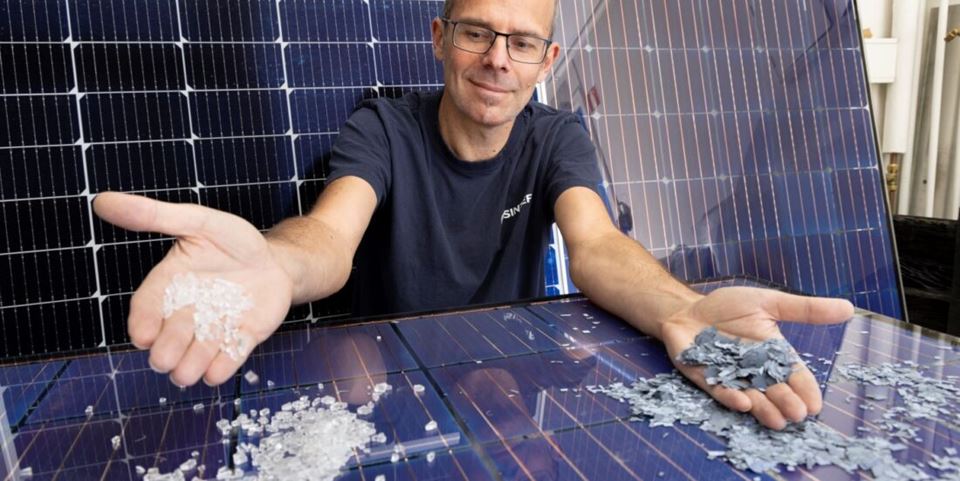
A lab full of sunshine: Martin Bellman of SINTEF has researched solar panels for years. Now he's coordinating the project that will allow us to recycle the materials they use. Photo: Thor Nielsen
Solar panels contain many valuable materials. Still, most of them end up discarded after use. Now researchers are investigating new ways of recycling.
Solar panels, vital to the renewable energy revolution, contain valuable materials such as silicon, aluminium, copper, silver, glass, and polymers. Yet, at the end of their lifespan—typically 25-30 years—most panels are discarded in landfills, wasting these critical resources. Researchers are now stepping up to address this growing environmental challenge.
Coordinated by SINTEF, an EU-funded research project called QUASAR aims to revolutionize the recycling of solar panels, ensuring that more materials can be recovered and reused in the solar cell industry and beyond. With a focus on advancing circularity, the project is developing cutting-edge technologies to recycle 70-90% of key materials, including silicon, metals, glass, and polymers, at high purity levels.
Recycling Beyond Aluminium and Glass
Currently, recycling efforts for solar panels mainly recover aluminium frames and glass, while other materials—such as silicon, silver, and polymers—are largely discarded.
“Today, only aluminium and glass are commonly recycled. Silicon, silver, and polymer fractions often end up as waste,” says Martin Bellmann, Senior Business Developer at SINTEF and coordinator of the QUASAR project. “Our goal is to change that by creating technologies that unlock access to these valuable materials.”
The encapsulated structure of solar panels and the evolving design of newer models present significant challenges for recycling. Panels differ in size, material composition, and properties, making it difficult to create a one-size-fits-all recycling solution. QUASAR addresses these issues with innovative approaches.
Digital Passports, AI, and Circular Solutions
The QUASAR project integrates advanced tools to achieve full circularity of solar panel materials. Key initiatives include:
The QUASAR project is funded under the European Union’s HORIZON – Sustainable, secure, and competitive energy supply program (grant agreement number 101122298). Launched in September 2023, the project will run until November 2027, bringing together experts and stakeholders to pave the way for a greener, more sustainable solar energy industry.
By implementing these innovative recycling solutions, the QUASAR team is contributing to a more sustainable and resource-efficient future, ensuring that the solar panels powering the renewable energy transition leave behind a smaller environmental footprint.
For more information about the QUASAR project, visit the official website: https://quasar-project.eu/.
Follow the project’s updates on LinkedIn: QUASAR LinkedIn Page.
https://www.sintef.no/en/latest-news/20 ... ar-panels/
Silje Grytli Tveten, 30. January 2025, Norwegianscitechnews.com
A lab full of sunshine: Martin Bellman of SINTEF has researched solar panels for years. Now he's coordinating the project that will allow us to recycle the materials they use. Photo: Thor Nielsen
Solar panels contain many valuable materials. Still, most of them end up discarded after use. Now researchers are investigating new ways of recycling.
Solar panels, vital to the renewable energy revolution, contain valuable materials such as silicon, aluminium, copper, silver, glass, and polymers. Yet, at the end of their lifespan—typically 25-30 years—most panels are discarded in landfills, wasting these critical resources. Researchers are now stepping up to address this growing environmental challenge.
Coordinated by SINTEF, an EU-funded research project called QUASAR aims to revolutionize the recycling of solar panels, ensuring that more materials can be recovered and reused in the solar cell industry and beyond. With a focus on advancing circularity, the project is developing cutting-edge technologies to recycle 70-90% of key materials, including silicon, metals, glass, and polymers, at high purity levels.
Recycling Beyond Aluminium and Glass
Currently, recycling efforts for solar panels mainly recover aluminium frames and glass, while other materials—such as silicon, silver, and polymers—are largely discarded.
“Today, only aluminium and glass are commonly recycled. Silicon, silver, and polymer fractions often end up as waste,” says Martin Bellmann, Senior Business Developer at SINTEF and coordinator of the QUASAR project. “Our goal is to change that by creating technologies that unlock access to these valuable materials.”
The encapsulated structure of solar panels and the evolving design of newer models present significant challenges for recycling. Panels differ in size, material composition, and properties, making it difficult to create a one-size-fits-all recycling solution. QUASAR addresses these issues with innovative approaches.
Digital Passports, AI, and Circular Solutions
The QUASAR project integrates advanced tools to achieve full circularity of solar panel materials. Key initiatives include:
- Innovative Recycling Technologies: Developing methods to efficiently separate and process materials from decommissioned panels.
- Digital Product Passports: Leveraging digital twin technology, these passports will track and manage solar panels throughout their lifecycle, providing key information on production, material composition, and condition.
- Artificial Intelligence: AI-driven solutions will assess the condition of used panels, determining whether they can be reused, repaired, or recycled. The combination of these technologies aims to optimize resource recovery, minimize waste, and improve cost efficiency for the solar industry.
The QUASAR project is funded under the European Union’s HORIZON – Sustainable, secure, and competitive energy supply program (grant agreement number 101122298). Launched in September 2023, the project will run until November 2027, bringing together experts and stakeholders to pave the way for a greener, more sustainable solar energy industry.
By implementing these innovative recycling solutions, the QUASAR team is contributing to a more sustainable and resource-efficient future, ensuring that the solar panels powering the renewable energy transition leave behind a smaller environmental footprint.
For more information about the QUASAR project, visit the official website: https://quasar-project.eu/.
Follow the project’s updates on LinkedIn: QUASAR LinkedIn Page.
https://www.sintef.no/en/latest-news/20 ... ar-panels/
Re: Notas de energías renovables
The Birmingham Blade: the world's first geographically tailored urban wind turbine designed by AI
28 November 2024University of Birmigham,
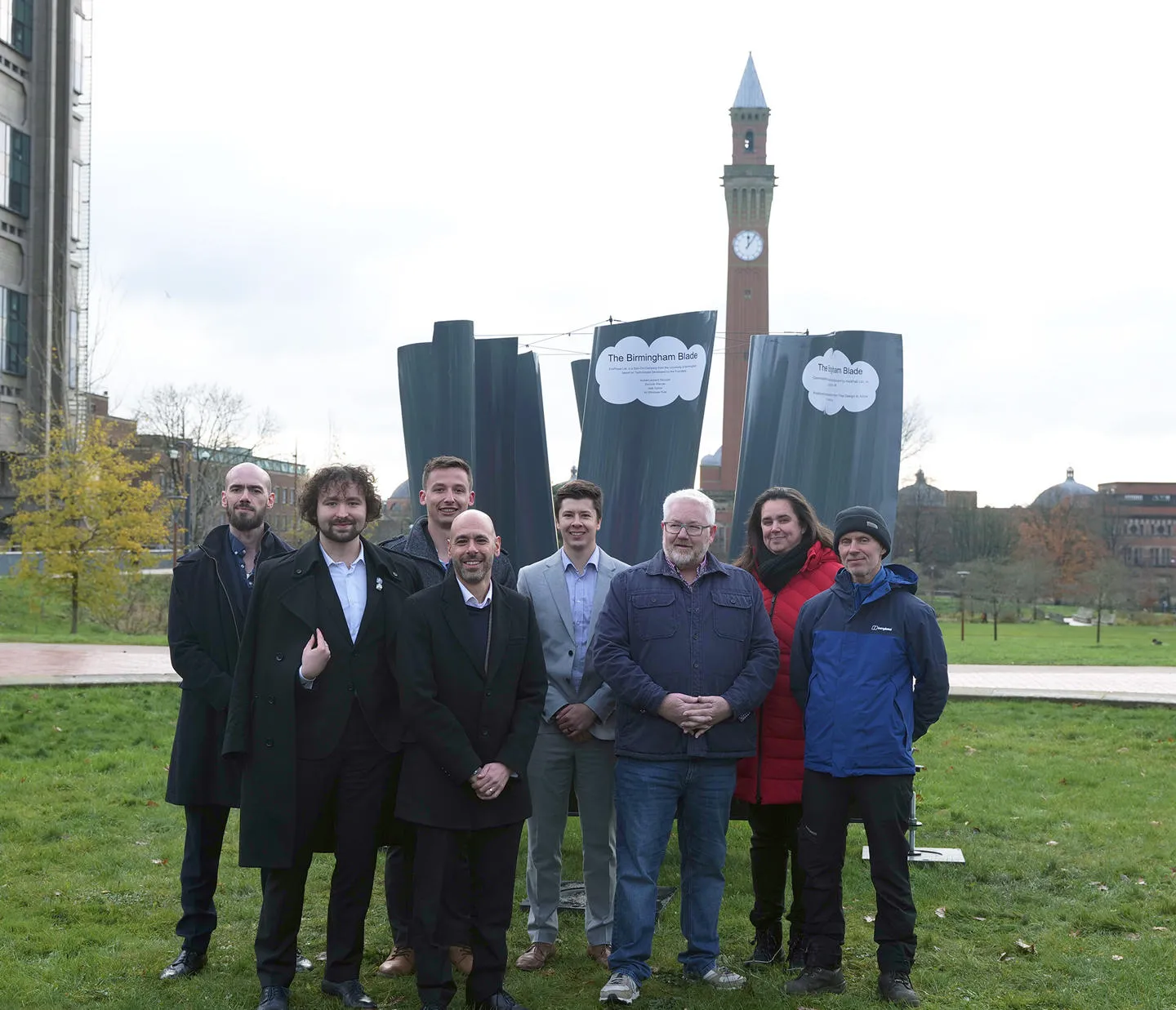
Birmingham Blade launch event - prototype and people
Dr Kit Windows Yule, University of Birmingham, and Chief Scientific Officer, EvoPhase; Leonard Nicusan, Chief Technology Officer, EvoPhase; Dominik Werner, CEO, EvoPhase; David Coleman, CEO, University of Birmingham Enterprise; Jack Sykes, Chief Operating Officer, EvoPhase; John Cook, Entrepreneur-in-Residence, University of Birmingham Enterprise; Laura Bond, Entrepreneur-in-Residence, University of Birmingham Enterprise; Paul Jarvis, Managing Director, Kwik Fab Ltd
AI design specialists EvoPhase and precision metal fabricators KwikFab have unveiled the world’s first urban wind turbine designed by AI, and tailored to the unique wind conditions of a specific geographic area. The team has called it the Birmingham Blade.
The collaboration between EvoPhase and KwikFab provides a solution to one of the most pressing issues in the green energy landscape – how to produce small-scale, affordable, generators of clean wind energy.
EvoPhase used its AI-driven design process to generate and test designs for their efficiency at wind speeds found in Birmingham, which, at 3.6 m/s are substantially lower than the 10 metres per second rating for most turbines.
“We needed a turbine that could capture Birmingham’s relatively low wind speeds while managing turbulence caused by surrounding buildings,” explained Leonard Nicusan, Chief Technology Officer of EvoPhase. “The design also had to be compact and lightweight to suit rooftop installations."
EvoPhase found the optimal design for curved blades which spin around a central point, and confirmed that that it will be up to seven times more efficient than existing designs used in the Birmingham area.
“Our evolutionary simulations have confirmed the Birmingham Blade is up to seven times more efficient than existing designs in Birmingham’s wind speeds and urban environment. The final design is not just a prototype — it is a predictive solution that is ready for real-world use.”
Developed by a research group led by Dr Kit Windows-Yule at the University of Birmingham, EvoPhase’s AI-led evolutionary design process mimics natural selection, this approach allows for simultaneous optimisation of many different parameters, avoiding traditional trade-offs between performance factors.
KwikFab produced the first iteration of the Birmingham Blade to demonstrate the feasibility of manufacturing the design. An aluminium version will be sited on a roof space in Birmingham for evaluation and testing, and the final product is expected to be available by late 2025.
The EvoPhase – KwikFab collaboration provides a rapid design and prototyping service, and the team is now working on another design for the very different conditions in Edinburgh.
Paul Jarvis from KwikFab is confident that there is sufficient talent and space in Birmingham to deliver quick turnaround from design to prototyping for wind turbines that are geographically tailored to specific local conditions around the rest of the world.
We can take a complex design, and manufacture and ship a prototype for testing within weeks. We’d like to work with organisations that want to make the most of wind power, a source of sustainable energy that is free, and present in every country.
Paul Jarvis, KwikFab Ltd
Since its launch in 2023, EvoPhase has expanded its AI-powered evolutionary design approach to industries beyond wind energy, including the optimisation of equipment for mixing, blending, and storing granular materials in the food, pharmaceutical, and chemical manufacturing sectors.EvoPhase’s collaboration with KwikFab demonstrates the broad applicability of their predictive designs.
It was made possible in part by the Manchester Prize which named the team as a finalist in the inaugural year of the prize in May 2024. The Manchester Prize is a multi-million-pound challenge prize from the UK’s Department for Science, Innovation and Technology to reward UK-led breakthroughs in artificial intelligence for public good.
https://www.birmingham.ac.uk/news/2024/ ... gned-by-ai
Video:
28 November 2024University of Birmigham,
Birmingham Blade launch event - prototype and people
Dr Kit Windows Yule, University of Birmingham, and Chief Scientific Officer, EvoPhase; Leonard Nicusan, Chief Technology Officer, EvoPhase; Dominik Werner, CEO, EvoPhase; David Coleman, CEO, University of Birmingham Enterprise; Jack Sykes, Chief Operating Officer, EvoPhase; John Cook, Entrepreneur-in-Residence, University of Birmingham Enterprise; Laura Bond, Entrepreneur-in-Residence, University of Birmingham Enterprise; Paul Jarvis, Managing Director, Kwik Fab Ltd
AI design specialists EvoPhase and precision metal fabricators KwikFab have unveiled the world’s first urban wind turbine designed by AI, and tailored to the unique wind conditions of a specific geographic area. The team has called it the Birmingham Blade.
The collaboration between EvoPhase and KwikFab provides a solution to one of the most pressing issues in the green energy landscape – how to produce small-scale, affordable, generators of clean wind energy.
EvoPhase used its AI-driven design process to generate and test designs for their efficiency at wind speeds found in Birmingham, which, at 3.6 m/s are substantially lower than the 10 metres per second rating for most turbines.
“We needed a turbine that could capture Birmingham’s relatively low wind speeds while managing turbulence caused by surrounding buildings,” explained Leonard Nicusan, Chief Technology Officer of EvoPhase. “The design also had to be compact and lightweight to suit rooftop installations."
EvoPhase found the optimal design for curved blades which spin around a central point, and confirmed that that it will be up to seven times more efficient than existing designs used in the Birmingham area.
Leonard Nicusan, Chief Technology Officer, EvoPhaseUsing AI was essential for breaking free from the long-standing biases that have influenced turbine designs for the past century. AI allowed us to explore design possibilities beyond the scope of traditional human experimentation. We were able to generate, test, and refine over 2,000 wind turbine designs in just a few weeks, significantly accelerating our development process and achieving what would have taken years and millions of pounds through conventional methods.
“Our evolutionary simulations have confirmed the Birmingham Blade is up to seven times more efficient than existing designs in Birmingham’s wind speeds and urban environment. The final design is not just a prototype — it is a predictive solution that is ready for real-world use.”
Developed by a research group led by Dr Kit Windows-Yule at the University of Birmingham, EvoPhase’s AI-led evolutionary design process mimics natural selection, this approach allows for simultaneous optimisation of many different parameters, avoiding traditional trade-offs between performance factors.
KwikFab produced the first iteration of the Birmingham Blade to demonstrate the feasibility of manufacturing the design. An aluminium version will be sited on a roof space in Birmingham for evaluation and testing, and the final product is expected to be available by late 2025.
The EvoPhase – KwikFab collaboration provides a rapid design and prototyping service, and the team is now working on another design for the very different conditions in Edinburgh.
Paul Jarvis from KwikFab is confident that there is sufficient talent and space in Birmingham to deliver quick turnaround from design to prototyping for wind turbines that are geographically tailored to specific local conditions around the rest of the world.
We can take a complex design, and manufacture and ship a prototype for testing within weeks. We’d like to work with organisations that want to make the most of wind power, a source of sustainable energy that is free, and present in every country.
Paul Jarvis, KwikFab Ltd
Since its launch in 2023, EvoPhase has expanded its AI-powered evolutionary design approach to industries beyond wind energy, including the optimisation of equipment for mixing, blending, and storing granular materials in the food, pharmaceutical, and chemical manufacturing sectors.EvoPhase’s collaboration with KwikFab demonstrates the broad applicability of their predictive designs.
It was made possible in part by the Manchester Prize which named the team as a finalist in the inaugural year of the prize in May 2024. The Manchester Prize is a multi-million-pound challenge prize from the UK’s Department for Science, Innovation and Technology to reward UK-led breakthroughs in artificial intelligence for public good.
https://www.birmingham.ac.uk/news/2024/ ... gned-by-ai
Video:
Re: Notas de energías renovables
Nueva capa protectora hace que las baterías sean más eficientes
Andreas Lorenz-Meyer, PSI, 06.01.2025
Un equipo de investigación del Instituto Paul Scherrer (PSI) ha desarrollado un método nuevo y sostenible que puede aumentar el rendimiento electroquímico de las baterías de iones de litio. Las primeras pruebas realizadas con acumuladores de alto voltaje modificados de esta manera han resultado concluyentes. Las baterías de iones de litio para vehículos eléctricos, por ejemplo, podrían volverse significativamente más eficientes.

Junto con su equipo, Mario El Kazzi ha desarrollado un innovador recubrimiento para la superficie del cátodo. Permite tensiones de funcionamiento de hasta 4,8 voltios. © Instituto Paul Scherrer PSI/Mahir Dzambegovic
Las baterías de iones de litio se consideran una tecnología clave para la descarbonización. Por ello, científicos de todo el mundo trabajan continuamente para mejorar su rendimiento, entre otras cosas aumentando su densidad energética. "Una posibilidad para lograrlo es aumentar la tensión de funcionamiento", explica Mario El Kazzi, del Centro de Ciencias Energéticas y Medioambientales del Instituto Paul Scherrer (PSI). “Si el voltaje aumenta, la densidad de energía también aumenta”.
Pero hay un problema: tensiones de funcionamiento superiores a 4,3 voltios inducen importantes procesos de degradación química y electroquímica en la unión del cátodo (polo positivo) y el electrolito (medio conductor). La superficie de los materiales del cátodo se daña gravemente por la liberación de oxígeno, la disolución de los metales de transición y la reconstrucción estructural, lo que resulta en un aumento continuo de la resistencia celular y una disminución de la capacidad. Por esta razón, las celdas de baterías comerciales, como las de los coches eléctricos, hoy en día funcionan con un voltaje máximo de 4,3 voltios.
Para solucionar este problema, Mario El Kazzi y su equipo desarrollaron un nuevo método, que permite estabilizar la superficie del cátodo cubriéndola con una capa protectora fina uniforme. Los científicos informan sobre su descubrimiento en un estudio publicado en la revista ChemSusChem (Wiley) (NB! Ver abajo).
El proceso gira en torno a un gas que se forma como subproducto durante la producción de plásticos como PTFE, PVDF y espuma plástica: el trifluorometano, cuya fórmula química es CHF3. En su laboratorio, Mario El Kazzi y su equipo indujeron, a una temperatura de 300 grados centígrados, una reacción entre el CHF3 y la fina capa de carbonato de litio que recubre el cátodo. El litio luego se transforma en fluoruro de litio (LiF) en la capa límite. Dato importante: los átomos de litio en el material del cátodo permanecen en forma de iones, es decir, partículas con carga positiva. De hecho, estos iones de litio deben ser capaces de moverse entre cátodo y ánodo (polo negativo) durante la carga y descarga, para que la capacidad del acumulador no se reduzca durante el uso.
Como siguiente paso, los científicos comprobaron la eficacia de la capa protectora realizando pruebas electroquímicas a altos voltajes. El resultado fue satisfactorio: la capa protectora se mantuvo estable incluso con voltajes elevados, y protegió tan bien el material del cátodo que fueron posibles voltajes desde 4,5 hasta 4,8 voltios.
En comparación con las baterías con cátodos sin protección, aquellas con recubrimiento tuvieron un rendimiento significativamente mejor en el conjunto de parámetros. Así, después de 100 ciclos de carga y descarga, la impedancia (resistencia de los iones de litio en la interfaz del cátodo), era cerca de 30 por ciento menor que la de las baterías con cátodo sin protección. "Esto indica claramente que nuestra capa protectora reduce el aumento de la resistencia por las reacciones que normalmente ocurren en las interfaces", afirma Mario El Kazzi.
También se comparó la retención de capacidad, que es la cantidad de iones de litio que pueden migrar del cátodo al ánodo después de un cierto número de ciclos de carga y descarga. Cuanto más cerca esté este valor del 100 por ciento, menor será la caída de capacidad. También en este caso la batería con revestimiento catódico demostró ser superior en las pruebas: la retención de capacidad fue del 94 por ciento después de 100 ciclos de carga y descarga, sin disminución en la velocidad de carga, mientras que la batería sin revestimiento solo alcanzó el 80 por ciento.
Una solución universal que protege indirectamente el clima
El proceso de recubrimiento desarrollado en PSI abre nuevas posibilidades para aumentar la densidad energética de diferentes tipos de baterías: "Podemos asumir que nuestra capa protectora de fluoruro de litio (LiF) es universalmente aplicable a la mayoría de los materiales del cátodo", enfatiza Mario El Kazzi. También funciona con baterías de alto voltaje ricas en níquel y litio, por ejemplo".
Otro aspecto importante del método: el trifluorometano es un potente gas de efecto invernadero y más de 10.000 veces más dañino para el clima que el dióxido de carbono. Por lo tanto, no debe liberarse a la atmósfera bajo ninguna circunstancia. Para Mario El Kazzi, su conversión en una fina capa uniforme de LiF aplicada a la superficie de los materiales catódicos representa una solución eficaz para monetizar este gas integrándolo en una economía circular. El nuevo proceso de recubrimiento permite reciclar el CHF3 y fijarlo permanentemente como capa protectora en los cátodos de alto voltaje.
https://www.psi.ch/fr/news/communiques- ... rformantes
Artículo mencionado (por subscripción):
Converting the CHF3 Greenhouse Gas into Nanometer-Thick LiF Coating for High-Voltage Cathode Li-ion Batteries Materials
Andreas Lorenz-Meyer, PSI, 06.01.2025
Un equipo de investigación del Instituto Paul Scherrer (PSI) ha desarrollado un método nuevo y sostenible que puede aumentar el rendimiento electroquímico de las baterías de iones de litio. Las primeras pruebas realizadas con acumuladores de alto voltaje modificados de esta manera han resultado concluyentes. Las baterías de iones de litio para vehículos eléctricos, por ejemplo, podrían volverse significativamente más eficientes.
Junto con su equipo, Mario El Kazzi ha desarrollado un innovador recubrimiento para la superficie del cátodo. Permite tensiones de funcionamiento de hasta 4,8 voltios. © Instituto Paul Scherrer PSI/Mahir Dzambegovic
Las baterías de iones de litio se consideran una tecnología clave para la descarbonización. Por ello, científicos de todo el mundo trabajan continuamente para mejorar su rendimiento, entre otras cosas aumentando su densidad energética. "Una posibilidad para lograrlo es aumentar la tensión de funcionamiento", explica Mario El Kazzi, del Centro de Ciencias Energéticas y Medioambientales del Instituto Paul Scherrer (PSI). “Si el voltaje aumenta, la densidad de energía también aumenta”.
Pero hay un problema: tensiones de funcionamiento superiores a 4,3 voltios inducen importantes procesos de degradación química y electroquímica en la unión del cátodo (polo positivo) y el electrolito (medio conductor). La superficie de los materiales del cátodo se daña gravemente por la liberación de oxígeno, la disolución de los metales de transición y la reconstrucción estructural, lo que resulta en un aumento continuo de la resistencia celular y una disminución de la capacidad. Por esta razón, las celdas de baterías comerciales, como las de los coches eléctricos, hoy en día funcionan con un voltaje máximo de 4,3 voltios.
Para solucionar este problema, Mario El Kazzi y su equipo desarrollaron un nuevo método, que permite estabilizar la superficie del cátodo cubriéndola con una capa protectora fina uniforme. Los científicos informan sobre su descubrimiento en un estudio publicado en la revista ChemSusChem (Wiley) (NB! Ver abajo).
Voltajes de funcionamiento de hasta 4,8 voltiosUna breve guía sobre las baterías
Las baterías de iones de litio se encuentran en teléfonos móviles, ordenadores portátiles, herramientas eléctricas, coches eléctricos y dispositivos de almacenamiento de energía estacionarios. Estos acumuladores versátiles de nuestra vida diaria se llaman así porque son iones de litio que migran de un electrodo a otro (cátodo y ánodo) durante la carga y la descarga. Al hacerlo, estos iones pasan a través del electrolito líquido y del separador que separa los electrodos. Mientras que el ánodo (polo negativo) suele estar compuesto de grafito o silicio, el cátodo (polo positivo) tiene composiciones químicas muy diversas. Si está compuesta, por ejemplo, de níquel, cobalto y manganeso además de litio, se denomina batería NCM. Si el cátodo es fosfato de hierro y litio, es una batería LFP.
El proceso gira en torno a un gas que se forma como subproducto durante la producción de plásticos como PTFE, PVDF y espuma plástica: el trifluorometano, cuya fórmula química es CHF3. En su laboratorio, Mario El Kazzi y su equipo indujeron, a una temperatura de 300 grados centígrados, una reacción entre el CHF3 y la fina capa de carbonato de litio que recubre el cátodo. El litio luego se transforma en fluoruro de litio (LiF) en la capa límite. Dato importante: los átomos de litio en el material del cátodo permanecen en forma de iones, es decir, partículas con carga positiva. De hecho, estos iones de litio deben ser capaces de moverse entre cátodo y ánodo (polo negativo) durante la carga y descarga, para que la capacidad del acumulador no se reduzca durante el uso.
Como siguiente paso, los científicos comprobaron la eficacia de la capa protectora realizando pruebas electroquímicas a altos voltajes. El resultado fue satisfactorio: la capa protectora se mantuvo estable incluso con voltajes elevados, y protegió tan bien el material del cátodo que fueron posibles voltajes desde 4,5 hasta 4,8 voltios.
En comparación con las baterías con cátodos sin protección, aquellas con recubrimiento tuvieron un rendimiento significativamente mejor en el conjunto de parámetros. Así, después de 100 ciclos de carga y descarga, la impedancia (resistencia de los iones de litio en la interfaz del cátodo), era cerca de 30 por ciento menor que la de las baterías con cátodo sin protección. "Esto indica claramente que nuestra capa protectora reduce el aumento de la resistencia por las reacciones que normalmente ocurren en las interfaces", afirma Mario El Kazzi.
También se comparó la retención de capacidad, que es la cantidad de iones de litio que pueden migrar del cátodo al ánodo después de un cierto número de ciclos de carga y descarga. Cuanto más cerca esté este valor del 100 por ciento, menor será la caída de capacidad. También en este caso la batería con revestimiento catódico demostró ser superior en las pruebas: la retención de capacidad fue del 94 por ciento después de 100 ciclos de carga y descarga, sin disminución en la velocidad de carga, mientras que la batería sin revestimiento solo alcanzó el 80 por ciento.
Una solución universal que protege indirectamente el clima
El proceso de recubrimiento desarrollado en PSI abre nuevas posibilidades para aumentar la densidad energética de diferentes tipos de baterías: "Podemos asumir que nuestra capa protectora de fluoruro de litio (LiF) es universalmente aplicable a la mayoría de los materiales del cátodo", enfatiza Mario El Kazzi. También funciona con baterías de alto voltaje ricas en níquel y litio, por ejemplo".
Otro aspecto importante del método: el trifluorometano es un potente gas de efecto invernadero y más de 10.000 veces más dañino para el clima que el dióxido de carbono. Por lo tanto, no debe liberarse a la atmósfera bajo ninguna circunstancia. Para Mario El Kazzi, su conversión en una fina capa uniforme de LiF aplicada a la superficie de los materiales catódicos representa una solución eficaz para monetizar este gas integrándolo en una economía circular. El nuevo proceso de recubrimiento permite reciclar el CHF3 y fijarlo permanentemente como capa protectora en los cátodos de alto voltaje.
https://www.psi.ch/fr/news/communiques- ... rformantes
Artículo mencionado (por subscripción):
Converting the CHF3 Greenhouse Gas into Nanometer-Thick LiF Coating for High-Voltage Cathode Li-ion Batteries Materials
Re: Notas de energías renovables
Un tanto como una nota de prensa, pero en todo caso interesante.
¿El fin del monopolio chino sobre la energía solar? NexWafe lanza el desafío
Enerzine, 18-Dic-2024
La industria fotovoltaica se encuentra en un punto de inflexión en el que las innovaciones tecnológicas determinan no sólo la eficiencia sino también la viabilidad económica y ambiental de la producción de energía solar. NexWafe GmbH, una empresa alemana, reveló recientemente avances significativos en la fabricación de sus placas solares, prometiendo redefinir los estándares de la industria. Abajo se describe como estos avances podrían influir en el futuro de la energía fotovoltaica.
NexWafe GmbH anunció que sus placas solares EpiNex han alcanzado una eficiencia del 24,4 % en una línea celular de heterounión (HUN) tipo M6 comercial, igualando el rendimiento de las placas Czochralski (CZ) tradicionales. Los módulos fabricados con células solares TopCon y HUN igualan o superan el rendimiento de aquellos que utilizan placas CZ. Estos resultados confirman la capacidad de la tecnología EpiNex para reemplazar sin problemas las placas CZ en los procesos de producción, al mismo tiempo que proporciona posibles ahorros de costos a través de un menor desperdicio de material, un consumo de energía un 40% menor y la eliminación de la etapa de grabado del daño por el corte en la producción de celdas.
La tecnología EpiNex también permite satisfacer los requisitos de células solares de próxima generación para aplicaciones espaciales y celdas unidas en tándem. Estas aplicaciones requieren placas más delgadas con mayor estabilidad térmica, planitud precisa y calidad de material superior, lo que el proceso EpiNex está diseñado para ofrecer. En particular, el contenido de oxígeno de las placas EpiNex es 20 veces menor que las placas CZ convencionales, lo que promueve la estabilidad térmica y mejora el rendimiento celular en condiciones de alta temperatura.
NexWafe utilizó sus placas EpiNex para desarrollar células ultradelgadas de 70 μm, satisfaciendo la creciente demanda de energía para satélites de órbita baja. Estas celdas exhiben un rendimiento de radiación comparable a las obleas CZ PERC convencionales y ofrecen una significativa relación potencia-peso, lo que las hace ideales para aplicaciones espaciales.
Células de unidas en tándem
En colaboración con el Centro Suizo de Electrónica y Microtecnología S.A. (CSEM), NexWafe ha logrado avances notables en aplicaciones celulares de próxima generación. Las células tándem de perovskita de dos uniones que utilizan sus obleas EpiNex lograron una eficiencia del 28,9%, lo que destaca su potencial para tecnologías solares avanzadas. Con una suavidad superior a escala nanométrica, las placas EpiNex proporcionan una plataforma ideal para la próxima generación de células tándem de perovskita de bajo costo tratadas en solución.
En la actualidad, China controla el 99% de la capacidad mundial de producción de placas CZ y de recorte, lo que genera vulnerabilidades significativas en la cadena de suministro. Para competir, repatriar la fabricación requiere ganancias continuas tanto en costos como en eficiencia celular. La tecnología patentada de NexWafe hace que estos objetivos sean alcanzables. Al reducir el desperdicio de materiales y el consumo de energía, NexWafe reposiciona la fabricación de placas en una nueva curva de costos, sumado a un rendimiento superior.
“Estos resultados recientes transforman la fabricación de placas fotovoltaicas. EpiNex tiene el potencial de revolucionar la industria solar de una manera similar al cambio histórico de los lingotes policristalinos al silicio monocristalino. “Así como esta transición llevó a toda la industria a reevaluar sus procesos, desbloqueando eficiencias significativas y preparando el escenario para la tecnología solar de alto rendimiento actual, EpiNex impulsará una transformación comparable”, dijo Davor Sutija, director ejecutivo de NexWafe. “La tecnología ofrece una oportunidad para que los fabricantes regionales compitan con China, permitiendo un salto en rendimiento y costos, al tiempo que reducen significativamente la huella de carbono. »
Listo para la producción a escala de gigavatios
Además de eso, NexWafe está desarrollando su herramienta ProCon 2.5, que se espera que esté terminada en junio de 2025. Este innovador sistema utiliza sistemas de calentamiento avanzados y deposición química de vapor a presión atmosférica para depositar silicio monocristalino sobre una superficie de 1,3 m x 50 cm, equivalente a más de catorce placas G12 en una sola pasada, lo que representa la superficie más grande jamás lograda para la deposición epitaxial de silicio. Con tasas de deposición demostradas de 5 μm por minuto y uniformidad de temperatura que logra una variación de espesor total (TTV) inferior al 40 %, la plataforma ProCon marca un salto significativo en hacer escalable la fabricación.
NexWafe ha conseguido órdenes de compra condicionales para la producción a escala de gigavatios, apuntando tanto al mercado tradicional a gran escala como a aplicaciones espaciales. Estos acuerdos demuestran la preparación comercial de NexWafe y su potencial para repatriar la fabricación a India, América del Norte y Europa, con ahorros significativos en términos de gastops de capital y de operaciones por gigavatio. A gran escala, las placas EpiNex también reducen las emisiones de CO2 en un 40%, alineándose con los objetivos de descarbonización de la industria.
“Estamos viendo un gran interés por parte de los fabricantes de células solares, especialmente en Estados Unidos y la India, que buscan el suministro interno de placas. “Hemos asegurado más de 5 GW en acuerdos de suministro condicional para los principales mercados solares y 250 MW de células ultradelgadas para aplicaciones especiales, incluidas espaciales”, dijo Jonathan Pickering, vicepresidente de desarrollo comercial de NexWafe en EE. UU.
https://www.enerzine.com/la-fin-du-mono ... 59-2024-12
En la página web de la compañia:
https://www.nexwafe.com/epinex-wafers
¿El fin del monopolio chino sobre la energía solar? NexWafe lanza el desafío
Enerzine, 18-Dic-2024
La industria fotovoltaica se encuentra en un punto de inflexión en el que las innovaciones tecnológicas determinan no sólo la eficiencia sino también la viabilidad económica y ambiental de la producción de energía solar. NexWafe GmbH, una empresa alemana, reveló recientemente avances significativos en la fabricación de sus placas solares, prometiendo redefinir los estándares de la industria. Abajo se describe como estos avances podrían influir en el futuro de la energía fotovoltaica.
NexWafe GmbH anunció que sus placas solares EpiNex han alcanzado una eficiencia del 24,4 % en una línea celular de heterounión (HUN) tipo M6 comercial, igualando el rendimiento de las placas Czochralski (CZ) tradicionales. Los módulos fabricados con células solares TopCon y HUN igualan o superan el rendimiento de aquellos que utilizan placas CZ. Estos resultados confirman la capacidad de la tecnología EpiNex para reemplazar sin problemas las placas CZ en los procesos de producción, al mismo tiempo que proporciona posibles ahorros de costos a través de un menor desperdicio de material, un consumo de energía un 40% menor y la eliminación de la etapa de grabado del daño por el corte en la producción de celdas.
La tecnología EpiNex también permite satisfacer los requisitos de células solares de próxima generación para aplicaciones espaciales y celdas unidas en tándem. Estas aplicaciones requieren placas más delgadas con mayor estabilidad térmica, planitud precisa y calidad de material superior, lo que el proceso EpiNex está diseñado para ofrecer. En particular, el contenido de oxígeno de las placas EpiNex es 20 veces menor que las placas CZ convencionales, lo que promueve la estabilidad térmica y mejora el rendimiento celular en condiciones de alta temperatura.
NexWafe utilizó sus placas EpiNex para desarrollar células ultradelgadas de 70 μm, satisfaciendo la creciente demanda de energía para satélites de órbita baja. Estas celdas exhiben un rendimiento de radiación comparable a las obleas CZ PERC convencionales y ofrecen una significativa relación potencia-peso, lo que las hace ideales para aplicaciones espaciales.
Células de unidas en tándem
En colaboración con el Centro Suizo de Electrónica y Microtecnología S.A. (CSEM), NexWafe ha logrado avances notables en aplicaciones celulares de próxima generación. Las células tándem de perovskita de dos uniones que utilizan sus obleas EpiNex lograron una eficiencia del 28,9%, lo que destaca su potencial para tecnologías solares avanzadas. Con una suavidad superior a escala nanométrica, las placas EpiNex proporcionan una plataforma ideal para la próxima generación de células tándem de perovskita de bajo costo tratadas en solución.
En la actualidad, China controla el 99% de la capacidad mundial de producción de placas CZ y de recorte, lo que genera vulnerabilidades significativas en la cadena de suministro. Para competir, repatriar la fabricación requiere ganancias continuas tanto en costos como en eficiencia celular. La tecnología patentada de NexWafe hace que estos objetivos sean alcanzables. Al reducir el desperdicio de materiales y el consumo de energía, NexWafe reposiciona la fabricación de placas en una nueva curva de costos, sumado a un rendimiento superior.
“Estos resultados recientes transforman la fabricación de placas fotovoltaicas. EpiNex tiene el potencial de revolucionar la industria solar de una manera similar al cambio histórico de los lingotes policristalinos al silicio monocristalino. “Así como esta transición llevó a toda la industria a reevaluar sus procesos, desbloqueando eficiencias significativas y preparando el escenario para la tecnología solar de alto rendimiento actual, EpiNex impulsará una transformación comparable”, dijo Davor Sutija, director ejecutivo de NexWafe. “La tecnología ofrece una oportunidad para que los fabricantes regionales compitan con China, permitiendo un salto en rendimiento y costos, al tiempo que reducen significativamente la huella de carbono. »
Listo para la producción a escala de gigavatios
Además de eso, NexWafe está desarrollando su herramienta ProCon 2.5, que se espera que esté terminada en junio de 2025. Este innovador sistema utiliza sistemas de calentamiento avanzados y deposición química de vapor a presión atmosférica para depositar silicio monocristalino sobre una superficie de 1,3 m x 50 cm, equivalente a más de catorce placas G12 en una sola pasada, lo que representa la superficie más grande jamás lograda para la deposición epitaxial de silicio. Con tasas de deposición demostradas de 5 μm por minuto y uniformidad de temperatura que logra una variación de espesor total (TTV) inferior al 40 %, la plataforma ProCon marca un salto significativo en hacer escalable la fabricación.
NexWafe ha conseguido órdenes de compra condicionales para la producción a escala de gigavatios, apuntando tanto al mercado tradicional a gran escala como a aplicaciones espaciales. Estos acuerdos demuestran la preparación comercial de NexWafe y su potencial para repatriar la fabricación a India, América del Norte y Europa, con ahorros significativos en términos de gastops de capital y de operaciones por gigavatio. A gran escala, las placas EpiNex también reducen las emisiones de CO2 en un 40%, alineándose con los objetivos de descarbonización de la industria.
“Estamos viendo un gran interés por parte de los fabricantes de células solares, especialmente en Estados Unidos y la India, que buscan el suministro interno de placas. “Hemos asegurado más de 5 GW en acuerdos de suministro condicional para los principales mercados solares y 250 MW de células ultradelgadas para aplicaciones especiales, incluidas espaciales”, dijo Jonathan Pickering, vicepresidente de desarrollo comercial de NexWafe en EE. UU.
https://www.enerzine.com/la-fin-du-mono ... 59-2024-12
En la página web de la compañia:
https://www.nexwafe.com/epinex-wafers
Re: Notas de energías renovables
UNSW Achieves World Record in Kesterite Solar Efficiency
UNSW Sydney, Jan 28 2025
Engineers at UNSW have broken the world record for a specific type of solar cell that has been touted as a potential long-term improvement in photovoltaic technology.

UNSW research team with the record-breaking kesterite solar cell. Pictured are Dr Jialiang Huang, Dr Kaiwen Sun, Scientia Professor Xiaojing Hao and Mr Ao Wang. Image Credit: UNSW Sydney
PV researchers around the world are working to find the best material to combine with traditional silicon cells to form a tandem solar cell, which can boost efficiency compared to single junction solar cell.
Scientia Professor Xiaojing Hao and her team from UNSW’s School of Photovoltaic and Renewable Energy Engineering have achieved a best-ever efficiency of 13.2% for high bandgap kesterite solar cells, which had been enhanced with hydrogen.
Kesterite is naturally occurring mineral but can also be artificially created at low cost by combining copper, zinc, tin and sulphur – which are not only all hugely abundant, but are also non-toxic.
The names of the component parts are why, in its synthesised form, kesterite is known as CZTS.
CZTS is a promising material for future generations of solar cells because it is environmentally friendly, cost-effective to manufacture, and is known to maintain its photovoltaic performance over a long period of time.
However, its efficiency has been long-hampered, largely by the number of defects created within CZTS during production, which are hard to avoid.
The UNSW team, including Dr Kaiwen Sun and Dr Jialiang Huang, say they have helped to solve this problem by annealing, or heat-treating, the CZTS solar cell device in a hydrogen-containing atmosphere.
The fundamental research behind the record-breaking efficiencies, which first achieved 11.4% after six years of stagnation for CZTS, has now been published in the Nature Energy journal.
“The big picture here is that we ultimately want to make electricity cheaper and greener to generate,” says Prof. Hao.
“Silicon modules have almost reached the limit of their theoretical efficiency, so what we are trying to do is answer the question coming from the PV industry as to what the next generation of cells will be made of.
“And as well as that, how can we make solar panels less expensive to manufacture, and how can we get more electricity per area so the panels can be particularly beneficial for area-limited PV applications?”
Passivation Process
Prof. Hao says that her work on CZTS solar cells has been based on a bottom-to-top approach, whereby all the best attributes required have been taken into consideration first in order to try to identify the perfect material.
The maximum photovoltaic efficiency of CZTS had been stuck at 11% for the past six years, but Prof. Hao and her team’s introduction of hydrogen to help eliminate some of the defects during production now promises even more advancements.
“In basic terms, to create CZTS you take copper, tin, zinc and sulphur and ‘cook’ them all together at a certain temperature which turns it into a material you can use as a semiconductor,” she says.
“The tricky part is controlling the defects that are introduced during that process. What we have shown in this work is that introducing hydrogen can ensure those defects have less of an impact – which is known as passivation.
“Because hydrogen is modulating the defects within CZTS, that’s what helps increase its efficiency in terms of converting sunlight into electricity.”
The use of CZTS could be best implemented in what are known as tandem solar cells, which combine two or more solar cells to capture and convert more of the solar spectrum into electricity, improving overall efficiency.
Prof. Hao says she is hopeful the new breakthrough will accelerate the chances of CZTS reaching 15% efficiency within the next year, and expects its commercialisation by 2030.
“There is still work to be done to find ways to further reduce the defects we find in CZTS, either during the fabrication or via post-fabrication treatments,” she says.
“But we know that this is a good material. When we consider the requirements from the bottom up, we know that we need something that is widely abundant, that is environmentally friendly, that has good optoelectronic properties and can last a long time – and CZTS fits the bill.”
Other Tandem Options
Prof. Hao and her team at UNSW are also conducting extensive research into another potential material that could partner with silicon, perovskite.
Perovskite is more efficient (close to 27% in small-area examples) in converting the sun’s energy into electricity, but also degrades quickly and contains highly toxic components which can dissolve in water such as lead.
“When you go the other way, from the top to the bottom, maybe with something like perovskite, you can get really high performance and high efficiency at the beginning, but it’s much less stable and the panels might only last for one year so it’s not sustainable,” she says.
“It can take a long time to solve those problems, whereas with CZTS if we can get it to 20% efficiency then I think it will really take off because there are no other limitations since it meets all the criteria for the type of material we want to be using.
“Overall, I think we should be looking into all different types of materials for the top layer of tandem cells. That’s the only way we can maximise our chances of success and accelerate the speed towards obtaining highly efficient tandems that we can use long into the future.”
https://www.azocleantech.com/news.aspx?newsID=35501
UNSW Sydney, Jan 28 2025
Engineers at UNSW have broken the world record for a specific type of solar cell that has been touted as a potential long-term improvement in photovoltaic technology.
UNSW research team with the record-breaking kesterite solar cell. Pictured are Dr Jialiang Huang, Dr Kaiwen Sun, Scientia Professor Xiaojing Hao and Mr Ao Wang. Image Credit: UNSW Sydney
PV researchers around the world are working to find the best material to combine with traditional silicon cells to form a tandem solar cell, which can boost efficiency compared to single junction solar cell.
Scientia Professor Xiaojing Hao and her team from UNSW’s School of Photovoltaic and Renewable Energy Engineering have achieved a best-ever efficiency of 13.2% for high bandgap kesterite solar cells, which had been enhanced with hydrogen.
Kesterite is naturally occurring mineral but can also be artificially created at low cost by combining copper, zinc, tin and sulphur – which are not only all hugely abundant, but are also non-toxic.
The names of the component parts are why, in its synthesised form, kesterite is known as CZTS.
CZTS is a promising material for future generations of solar cells because it is environmentally friendly, cost-effective to manufacture, and is known to maintain its photovoltaic performance over a long period of time.
However, its efficiency has been long-hampered, largely by the number of defects created within CZTS during production, which are hard to avoid.
The UNSW team, including Dr Kaiwen Sun and Dr Jialiang Huang, say they have helped to solve this problem by annealing, or heat-treating, the CZTS solar cell device in a hydrogen-containing atmosphere.
The fundamental research behind the record-breaking efficiencies, which first achieved 11.4% after six years of stagnation for CZTS, has now been published in the Nature Energy journal.
“The big picture here is that we ultimately want to make electricity cheaper and greener to generate,” says Prof. Hao.
“Silicon modules have almost reached the limit of their theoretical efficiency, so what we are trying to do is answer the question coming from the PV industry as to what the next generation of cells will be made of.
“And as well as that, how can we make solar panels less expensive to manufacture, and how can we get more electricity per area so the panels can be particularly beneficial for area-limited PV applications?”
Passivation Process
Prof. Hao says that her work on CZTS solar cells has been based on a bottom-to-top approach, whereby all the best attributes required have been taken into consideration first in order to try to identify the perfect material.
The maximum photovoltaic efficiency of CZTS had been stuck at 11% for the past six years, but Prof. Hao and her team’s introduction of hydrogen to help eliminate some of the defects during production now promises even more advancements.
“In basic terms, to create CZTS you take copper, tin, zinc and sulphur and ‘cook’ them all together at a certain temperature which turns it into a material you can use as a semiconductor,” she says.
“The tricky part is controlling the defects that are introduced during that process. What we have shown in this work is that introducing hydrogen can ensure those defects have less of an impact – which is known as passivation.
“Because hydrogen is modulating the defects within CZTS, that’s what helps increase its efficiency in terms of converting sunlight into electricity.”
The use of CZTS could be best implemented in what are known as tandem solar cells, which combine two or more solar cells to capture and convert more of the solar spectrum into electricity, improving overall efficiency.
Prof. Hao says she is hopeful the new breakthrough will accelerate the chances of CZTS reaching 15% efficiency within the next year, and expects its commercialisation by 2030.
“There is still work to be done to find ways to further reduce the defects we find in CZTS, either during the fabrication or via post-fabrication treatments,” she says.
“But we know that this is a good material. When we consider the requirements from the bottom up, we know that we need something that is widely abundant, that is environmentally friendly, that has good optoelectronic properties and can last a long time – and CZTS fits the bill.”
Other Tandem Options
Prof. Hao and her team at UNSW are also conducting extensive research into another potential material that could partner with silicon, perovskite.
Perovskite is more efficient (close to 27% in small-area examples) in converting the sun’s energy into electricity, but also degrades quickly and contains highly toxic components which can dissolve in water such as lead.
“When you go the other way, from the top to the bottom, maybe with something like perovskite, you can get really high performance and high efficiency at the beginning, but it’s much less stable and the panels might only last for one year so it’s not sustainable,” she says.
“It can take a long time to solve those problems, whereas with CZTS if we can get it to 20% efficiency then I think it will really take off because there are no other limitations since it meets all the criteria for the type of material we want to be using.
“Overall, I think we should be looking into all different types of materials for the top layer of tandem cells. That’s the only way we can maximise our chances of success and accelerate the speed towards obtaining highly efficient tandems that we can use long into the future.”
https://www.azocleantech.com/news.aspx?newsID=35501
Re: Notas de energías renovables
The next-generation solar cell is fully recyclable
Anders Törneholm, 12-Feb-2025
In a study published in Nature, researchers at Linköping University have developed a method to recycle all parts of a solar cell repeatedly without environmentally hazardous solvents. The recycled solar cell has the same efficiency as the original one. The solar cell is made of perovskite and the main solvent is water.
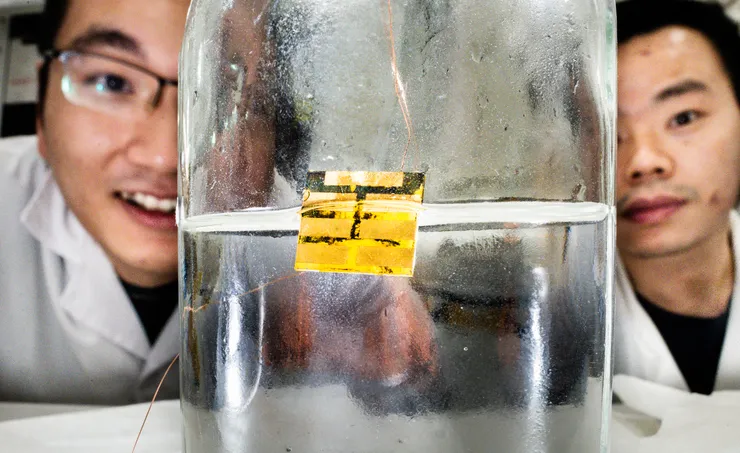
One of the most promising technologies for next-generation solar cells involves perovskite. Now researchers at Linköping University have developed a method to recycle all parts of a perovskite solar cell repeatedly using water as the main solvent. Photographer:Thor Balkhed
Electricity use is expected to increase drastically in the coming years with the development of AI and the transition to electrified transport, among other things. In order for the change to not drive climate change, different sustainable energy sources need to work together.
Solar energy has long been considered to have great potential and solar panels based on silicon have been on the market for over 30 years. But first-generation silicon solar panels are at the end of their life cycle, which has created an unexpected problem.
“There is currently no efficient technology to deal with the waste of silicon panels. That’s why old solar panels end up in the landfill. Huge mountains of electronic waste that you can’t do anything with,” says Xun Xiao, postdoc at the Department of Physics, Chemistry and Biology (IFM) at Linköping University (LiU).
Feng Gao, professor of optoelectronics at the same department, adds:
“We need to take recycling into consideration when developing emerging solar cell technologies. If we don’t know how to recycle them, maybe we shouldn’t put them on the market at all.”
Avoid another landfill
One of the most promising technologies for next-generation solar cells involves perovskite. They are not only relatively inexpensive and easy to manufacture but also lightweight, flexible and transparent. Thanks to these properties, perovskite solar cells can be placed on many different surfaces, even on windows. Also, they can convert up to 25 per cent of the solar energy into electricity, which can be comparable to today’s silicon solar cells.
“There are many companies that want to get perovskite solar cells on the market right now, but we’d like to avoid another landfill. In this project, we’ve developed a method where all parts can be reused in a new perovskite solar cell without compromising performance in the new one,” says Niansheng Xu, postdoc at LiU.
However, given that perovskite solar cells currently have a shorter life span than silicon solar cells it is important that perovskite solar cell recycling is efficient and environmentally friendly. Perovskite solar cells also contain a small amount of lead that is necessary for high efficiency, but this also places great demands on a functioning recycling process.
In addition, there are also legal requirements in large parts of the world for producers to collect and recycle end-of-life solar cells in a sustainable way.
Water as the solvent
There are already methods for dismantling perovskite solar cells. This mostly involves using a substance called dimethylformamide, a common ingredient in paint solvents. It is toxic, environmentally hazardous and potentially carcinogenic. What the Linköping researchers have now done is to instead develop a technology where water can be used as a solvent in dismantling the degraded perovskites. And more importantly, high-quality perovskites can be recycled from the water solution.

Foto: Thor Balkhed
“We can recycle everything – covering glasses, electrodes, perovskite layers and also the charge transport layer.” says Xun Xiao.
The next step for the researchers is to develop the method for larger scale use in an industrial process. In the long term, they believe that perovskite solar cells can play an important role in providing the energy when surrounding infrastructure and supply chains are in place.
The study was funded by the Knut and Alice Wallenberg Foundation, the Wallenberg Initiative Materials Science for Sustainability, The Swedish Energy Agency and through the Swedish Government’s strategic area in advanced functional materials, AFM, at Linköping University. Researchers Xun Xiao, Niansheng Xu and Feng Gao have applied for patents on the technology described above.
Artículo con acceso abierto:
Aqueous based recycling of perovskite photovoltaics.
Fotos de la fuente:

When water solvable cell is operational, it will be protected by a cover - Foto: Thor Balkhed
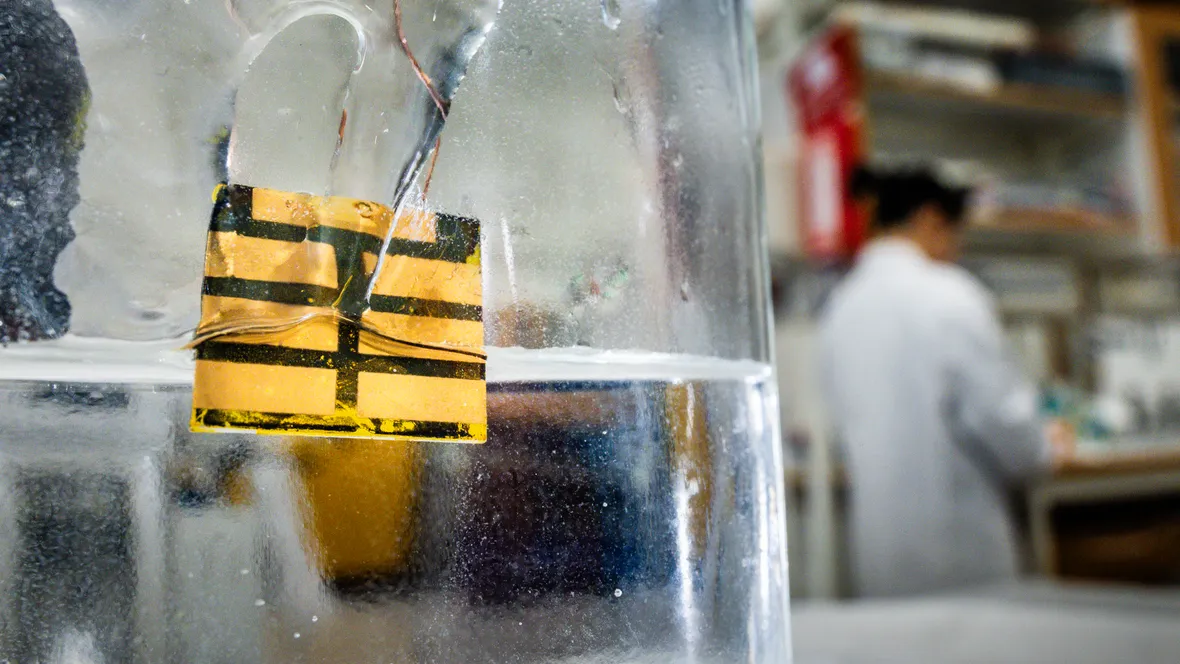
Using water as the main solvent enables a more sustainable recycling process - Foto: Thor Balkhed
Fuente:
https://liu.se/en/news-item/nasta-gener ... inningsbar
Anders Törneholm, 12-Feb-2025
In a study published in Nature, researchers at Linköping University have developed a method to recycle all parts of a solar cell repeatedly without environmentally hazardous solvents. The recycled solar cell has the same efficiency as the original one. The solar cell is made of perovskite and the main solvent is water.
One of the most promising technologies for next-generation solar cells involves perovskite. Now researchers at Linköping University have developed a method to recycle all parts of a perovskite solar cell repeatedly using water as the main solvent. Photographer:Thor Balkhed
Electricity use is expected to increase drastically in the coming years with the development of AI and the transition to electrified transport, among other things. In order for the change to not drive climate change, different sustainable energy sources need to work together.
Solar energy has long been considered to have great potential and solar panels based on silicon have been on the market for over 30 years. But first-generation silicon solar panels are at the end of their life cycle, which has created an unexpected problem.
“There is currently no efficient technology to deal with the waste of silicon panels. That’s why old solar panels end up in the landfill. Huge mountains of electronic waste that you can’t do anything with,” says Xun Xiao, postdoc at the Department of Physics, Chemistry and Biology (IFM) at Linköping University (LiU).
Feng Gao, professor of optoelectronics at the same department, adds:
“We need to take recycling into consideration when developing emerging solar cell technologies. If we don’t know how to recycle them, maybe we shouldn’t put them on the market at all.”
Avoid another landfill
One of the most promising technologies for next-generation solar cells involves perovskite. They are not only relatively inexpensive and easy to manufacture but also lightweight, flexible and transparent. Thanks to these properties, perovskite solar cells can be placed on many different surfaces, even on windows. Also, they can convert up to 25 per cent of the solar energy into electricity, which can be comparable to today’s silicon solar cells.
“There are many companies that want to get perovskite solar cells on the market right now, but we’d like to avoid another landfill. In this project, we’ve developed a method where all parts can be reused in a new perovskite solar cell without compromising performance in the new one,” says Niansheng Xu, postdoc at LiU.
However, given that perovskite solar cells currently have a shorter life span than silicon solar cells it is important that perovskite solar cell recycling is efficient and environmentally friendly. Perovskite solar cells also contain a small amount of lead that is necessary for high efficiency, but this also places great demands on a functioning recycling process.
In addition, there are also legal requirements in large parts of the world for producers to collect and recycle end-of-life solar cells in a sustainable way.
Water as the solvent
There are already methods for dismantling perovskite solar cells. This mostly involves using a substance called dimethylformamide, a common ingredient in paint solvents. It is toxic, environmentally hazardous and potentially carcinogenic. What the Linköping researchers have now done is to instead develop a technology where water can be used as a solvent in dismantling the degraded perovskites. And more importantly, high-quality perovskites can be recycled from the water solution.
Foto: Thor Balkhed
“We can recycle everything – covering glasses, electrodes, perovskite layers and also the charge transport layer.” says Xun Xiao.
The next step for the researchers is to develop the method for larger scale use in an industrial process. In the long term, they believe that perovskite solar cells can play an important role in providing the energy when surrounding infrastructure and supply chains are in place.
The study was funded by the Knut and Alice Wallenberg Foundation, the Wallenberg Initiative Materials Science for Sustainability, The Swedish Energy Agency and through the Swedish Government’s strategic area in advanced functional materials, AFM, at Linköping University. Researchers Xun Xiao, Niansheng Xu and Feng Gao have applied for patents on the technology described above.
Artículo con acceso abierto:
Aqueous based recycling of perovskite photovoltaics.
Fotos de la fuente:
When water solvable cell is operational, it will be protected by a cover - Foto: Thor Balkhed
Using water as the main solvent enables a more sustainable recycling process - Foto: Thor Balkhed
Fuente:
https://liu.se/en/news-item/nasta-gener ... inningsbar
Re: Notas de energías renovables
Esto todavía es un desarrollo experimental, pero muy interesante en todo caso
Mini Flow Battery Speeds Energy Storage Research
Karyn Hede, PNNL, 13-Feb-2025
Tiny flow battery delivers outsized benefits, reducing time, cost, and resources needed for testing new battery materials

PNNL flow battery researcher Ruozhu Feng handles a standard lab-scale flow battery device.(Photo by Andrea Starr | Pacific Northwest National Laboratory)
RICHLAND, Wash.—Sometimes, in order to go big, you first have to go small. That’s what researchers at the Department of Energy’s Pacific Northwest National Laboratory have done with their latest innovation in energy storage.
With a goal to speed the time to discovery of new grid energy storage technology, the team designed a compact, high-efficiency flow battery test system that requires an order of magnitude less starting material while delivering results equal to the standard lab-scale test systems. The new mini flow cell design and experimental validation is described in an article published in the Journal of The Electrochemical Society. The redesigned mini flow cell closely mimics the internal structure of a traditional flow cell, scaled down by a factor of 5. But, despite its smaller size, the mini flow cell exhibits comparable performance to its larger counterpart.
Mini flow battery delivers big results
“This report is the first step, showing that scaling down our experimental system works,” said materials scientist and flow battery researcher Ruozhu Feng, a lead author of the study. “Our ultimate goal is to bring the power of AI and robotics into this process to automate and accelerate the testing of new flow battery designs.”
By reducing the amount of material needed and speeding up the validation process, this technology could help advance renewable energy solutions. Researchers also believe this miniaturized approach will facilitate experimentation with a broader range of experimental chemistries.
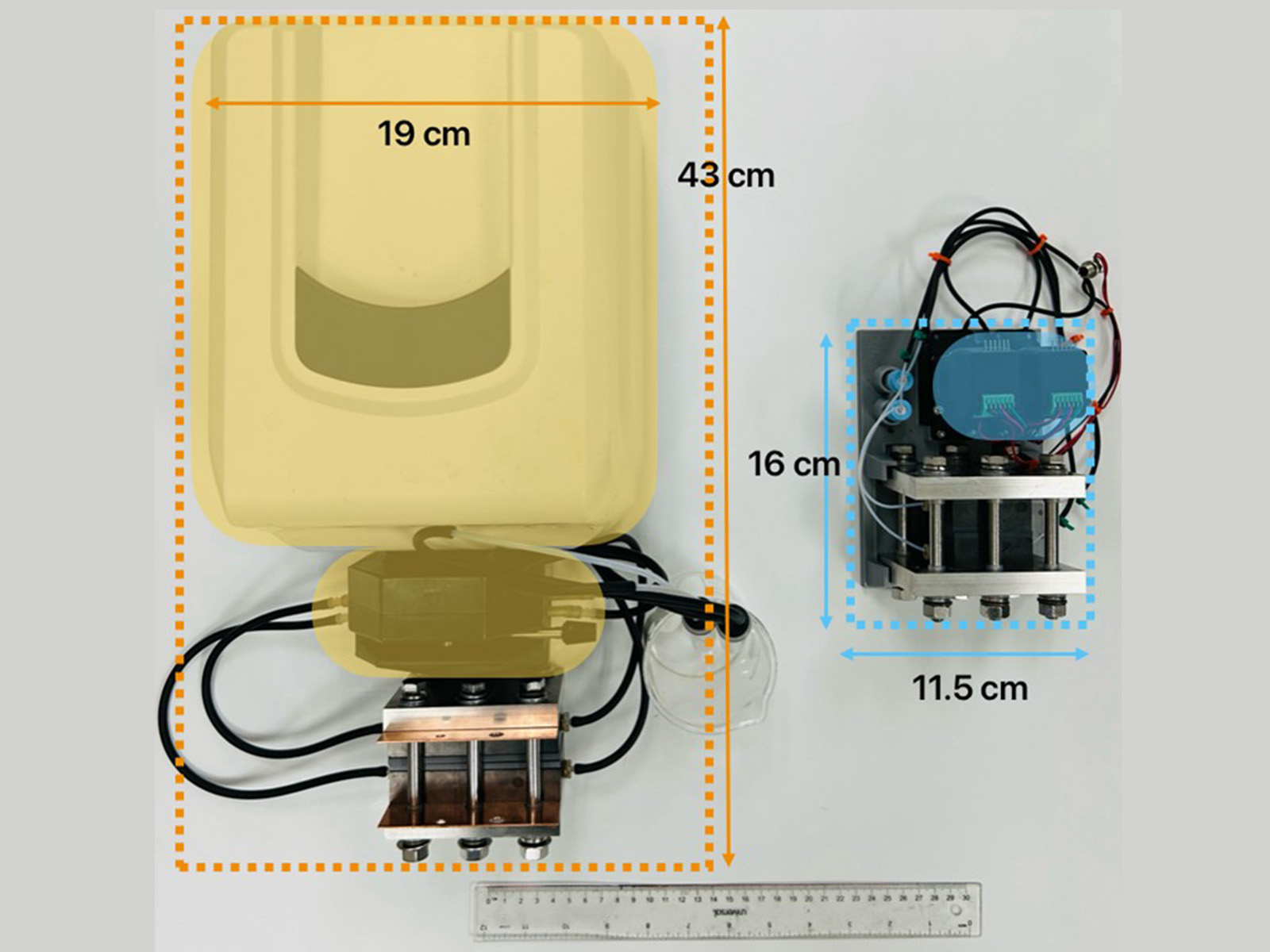
A new mini flow cell battery (right) is designed to speed the testing of promising new flow battery technologies. (Photo by Ruozhu Feng | Pacific Northwest National Laboratory)
“Currently, we have to prepare a lot of material when we identify a promising new battery formula, and this takes a lot of time,” Feng said. “With this mini flow cell process, we can figure out whether a proposed new material works with only a tiny amount—milligrams—available.”
The mini flow cell design is geared toward research laboratories that are focused on rapid screening and development of new battery materials. In their research study, the team showed that the new mini flow cell is suitable for rapid validation of material stability. Rigorous testing over a wide range of material chemistries and concentrations helped boost researchers’ confidence in the new scaled-down system. However, the team does note that it requires highly purified starting materials that are free from impurities that could otherwise clog the narrow channels and tubes.
The research team has applied for U.S. patent protection for their new battery design. To learn more about collaboration or licensing opportunities related to the new technology, contact our commercialization team (NB! ver enlace abajo).
A team effort
The key to their success, according to lead researcher and designer of the mini flow cell, Soowhan Kim, was that the team has over a decade of experience in flow battery cell design, along with engineering, skilled machining, and chemistry experience. For example, PNNL instrumentation and systems control expert Andrey Liyu used his mechanical engineering and microfluidics experience to complete the scale down without sacrificing accuracy.
“From small cells to big stacks, we can handle all scales of flow battery design and experimentation,” said Kim, a lead research at PNNL’s Grid Storage Launchpad. “When we add the computational expertise and analytical chemistry experience, this is how we combined efforts to develop the mini flow cell. Our hope is to make this available to all researchers who are interested in using it.”
What is a flow battery?
As their name suggests, flow batteries consist of two chambers, each filled with a different liquid. The batteries charge through an electrochemical reaction and store energy in chemical bonds. When connected to an external circuit, they release that energy, which can power electrical devices. Flow batteries are a linchpin technology—they store energy from intermittent energy sources such as wind and hydroelectric power, and then release that energy on demand for grid-scale applications. Unlike traditional batteries, flow batteries use liquid electrolytes stored in external tanks, providing flexible scaling of energy capacity.

In this example of a commercial-scale flow battery, an aqueous iron (Fe) redox flow battery captures energy in the form of electrons (e-) and stores it by changing the charge of iron in the flowing liquid electrolyte. When the stored energy is needed, the iron can release the charge to supply energy (electrons) to the electric grid. (Animation by Sara Levine | Pacific Northwest National Laboratory)
Why are new flow battery designs needed?
To make flow battery systems practical for large-scale use, researchers are seeking new chemical and material combinations that address limitations of existing systems. Some of these limitations include high material costs, low power density and the desire to source materials domestically in the United States.
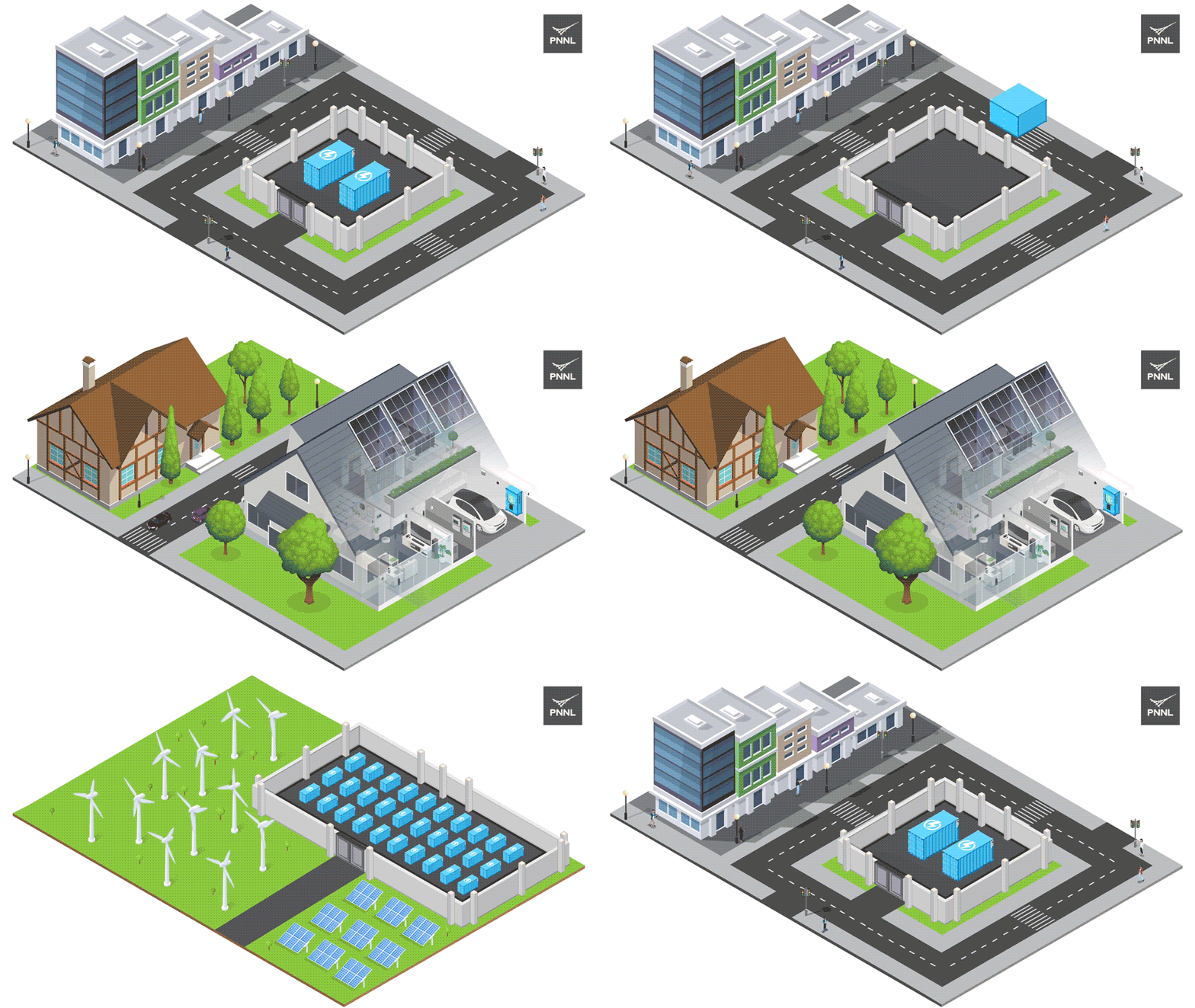
Commercial, grid-scale battery energy storage systems, illustrated above, are 1,000 to 2,000 times the size of the experimental mini flow cell. (Animation by Cortland Johnson | Pacific Northwest National Laboratory)
How are new flow batteries discovered?
Traditionally, discovery of new materials for flow batteries has been a laborious trial-and-error process, often requiring gram-scale synthesis of organic compounds, extensive testing, and significant time investment. This new miniaturized cell design, about the size of a playing card, uses the equivalent of a few grains of sand, drastically reducing the time and resources required for each test while still delivering reliable results.
In addition to Feng, Liyu and Kim, the research team included PNNL scientists Chao Zeng, Carter C. Bracken, Yangang Liang, and principal investigator Wei Wang. This research was supported by the Energy Storage Research Alliance (ESRA), an Energy Innovation Hub funded by the U.S. Department of Energy, Office of Science, Basic Energy Sciences program and by the Energy Storage Materials Initiative, a PNNL laboratory-directed strategic research investment.
The ESRA unites leading experts from national laboratories and universities to pave the way for energy storage and next-generation battery discovery that will shape the future of power. Learn more at Energy Storage Research Alliance.
Mini Flow Battery Speeds Energy Storage Research
Karyn Hede, PNNL, 13-Feb-2025
Tiny flow battery delivers outsized benefits, reducing time, cost, and resources needed for testing new battery materials
PNNL flow battery researcher Ruozhu Feng handles a standard lab-scale flow battery device.(Photo by Andrea Starr | Pacific Northwest National Laboratory)
RICHLAND, Wash.—Sometimes, in order to go big, you first have to go small. That’s what researchers at the Department of Energy’s Pacific Northwest National Laboratory have done with their latest innovation in energy storage.
With a goal to speed the time to discovery of new grid energy storage technology, the team designed a compact, high-efficiency flow battery test system that requires an order of magnitude less starting material while delivering results equal to the standard lab-scale test systems. The new mini flow cell design and experimental validation is described in an article published in the Journal of The Electrochemical Society. The redesigned mini flow cell closely mimics the internal structure of a traditional flow cell, scaled down by a factor of 5. But, despite its smaller size, the mini flow cell exhibits comparable performance to its larger counterpart.
Mini flow battery delivers big results
“This report is the first step, showing that scaling down our experimental system works,” said materials scientist and flow battery researcher Ruozhu Feng, a lead author of the study. “Our ultimate goal is to bring the power of AI and robotics into this process to automate and accelerate the testing of new flow battery designs.”
By reducing the amount of material needed and speeding up the validation process, this technology could help advance renewable energy solutions. Researchers also believe this miniaturized approach will facilitate experimentation with a broader range of experimental chemistries.
A new mini flow cell battery (right) is designed to speed the testing of promising new flow battery technologies. (Photo by Ruozhu Feng | Pacific Northwest National Laboratory)
“Currently, we have to prepare a lot of material when we identify a promising new battery formula, and this takes a lot of time,” Feng said. “With this mini flow cell process, we can figure out whether a proposed new material works with only a tiny amount—milligrams—available.”
The mini flow cell design is geared toward research laboratories that are focused on rapid screening and development of new battery materials. In their research study, the team showed that the new mini flow cell is suitable for rapid validation of material stability. Rigorous testing over a wide range of material chemistries and concentrations helped boost researchers’ confidence in the new scaled-down system. However, the team does note that it requires highly purified starting materials that are free from impurities that could otherwise clog the narrow channels and tubes.
The research team has applied for U.S. patent protection for their new battery design. To learn more about collaboration or licensing opportunities related to the new technology, contact our commercialization team (NB! ver enlace abajo).
A team effort
The key to their success, according to lead researcher and designer of the mini flow cell, Soowhan Kim, was that the team has over a decade of experience in flow battery cell design, along with engineering, skilled machining, and chemistry experience. For example, PNNL instrumentation and systems control expert Andrey Liyu used his mechanical engineering and microfluidics experience to complete the scale down without sacrificing accuracy.
“From small cells to big stacks, we can handle all scales of flow battery design and experimentation,” said Kim, a lead research at PNNL’s Grid Storage Launchpad. “When we add the computational expertise and analytical chemistry experience, this is how we combined efforts to develop the mini flow cell. Our hope is to make this available to all researchers who are interested in using it.”
What is a flow battery?
As their name suggests, flow batteries consist of two chambers, each filled with a different liquid. The batteries charge through an electrochemical reaction and store energy in chemical bonds. When connected to an external circuit, they release that energy, which can power electrical devices. Flow batteries are a linchpin technology—they store energy from intermittent energy sources such as wind and hydroelectric power, and then release that energy on demand for grid-scale applications. Unlike traditional batteries, flow batteries use liquid electrolytes stored in external tanks, providing flexible scaling of energy capacity.
In this example of a commercial-scale flow battery, an aqueous iron (Fe) redox flow battery captures energy in the form of electrons (e-) and stores it by changing the charge of iron in the flowing liquid electrolyte. When the stored energy is needed, the iron can release the charge to supply energy (electrons) to the electric grid. (Animation by Sara Levine | Pacific Northwest National Laboratory)
Why are new flow battery designs needed?
To make flow battery systems practical for large-scale use, researchers are seeking new chemical and material combinations that address limitations of existing systems. Some of these limitations include high material costs, low power density and the desire to source materials domestically in the United States.
Commercial, grid-scale battery energy storage systems, illustrated above, are 1,000 to 2,000 times the size of the experimental mini flow cell. (Animation by Cortland Johnson | Pacific Northwest National Laboratory)
How are new flow batteries discovered?
Traditionally, discovery of new materials for flow batteries has been a laborious trial-and-error process, often requiring gram-scale synthesis of organic compounds, extensive testing, and significant time investment. This new miniaturized cell design, about the size of a playing card, uses the equivalent of a few grains of sand, drastically reducing the time and resources required for each test while still delivering reliable results.
In addition to Feng, Liyu and Kim, the research team included PNNL scientists Chao Zeng, Carter C. Bracken, Yangang Liang, and principal investigator Wei Wang. This research was supported by the Energy Storage Research Alliance (ESRA), an Energy Innovation Hub funded by the U.S. Department of Energy, Office of Science, Basic Energy Sciences program and by the Energy Storage Materials Initiative, a PNNL laboratory-directed strategic research investment.
The ESRA unites leading experts from national laboratories and universities to pave the way for energy storage and next-generation battery discovery that will shape the future of power. Learn more at Energy Storage Research Alliance.
https://www.pnnl.gov/news-media/mini-fl ... e-researchPacific Northwest National Laboratory draws on its distinguishing strengths in chemistry, Earth sciences, biology and data science to advance scientific knowledge and address challenges in energy resiliency and national security. Founded in 1965, PNNL is operated by Battelle and supported by the Office of Science of the U.S. Department of Energy. The Office of Science is the single largest supporter of basic research in the physical sciences in the United States and is working to address some of the most pressing challenges of our time. For more information, visit the DOE Office of Science website. For more information on PNNL, visit PNNL's News Center. Follow us on Twitter, Facebook, LinkedIn and Instagram.
Re: Notas de energías renovables
Un poco como nota de prensa, pero también interesante.
La batería híbrida holandesa de hidrógeno y iones de litio permite almacenar energía de forma más económica todo el año
André Oerlemans, Change.inc, 20-feb-2025
Esta primavera, la empresa holandesa All-Energy lanzará una batería que combina una batería iones de litio con una de hidrógeno. Esto significa que se puede almacenar todo el año, a mitad de costo, la energía eólica y solar.
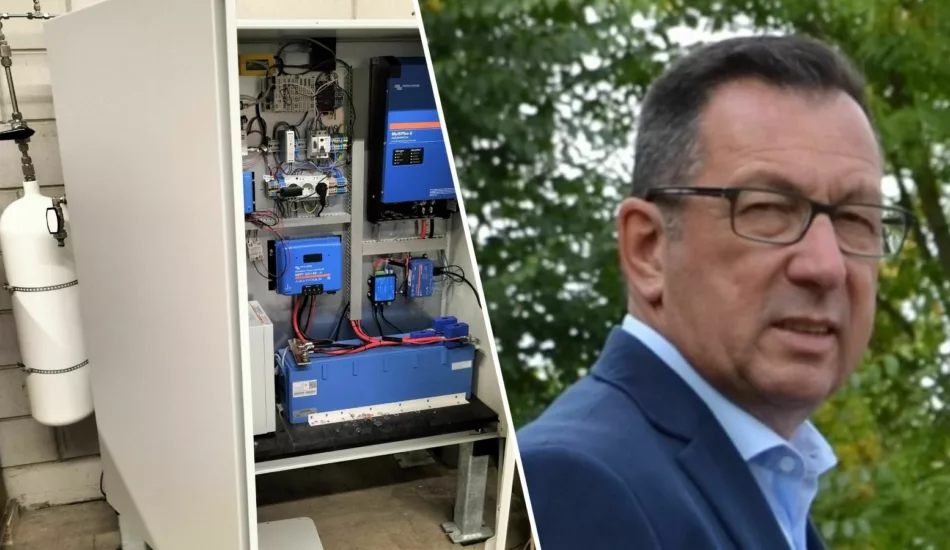
El director Rinie van Tilburg y la configuración de prueba de la batería híbrida. | Crédito: All-Energy
La batería de hidrógeno consta de un electrolizador, que convierte el exceso de energía solar o eólica en hidrógeno verde, un tanque para almacenar ese hidrógeno y una celda de combustible para generar electricidad a partir de ese hidrógeno en invierno u otros períodos de baja energía. La batería de litio almacena la energía a corto plazo; también es necesaria para absorber los picos de demanda de electricidad y poder suministrar mucha energía rápidamente. La batería de hidrógeno garantiza que la de iones de litio esté continuamente cargada.
Nuevo concepto
Nuevo concepto
All-Energy ha combinado varios componentes de diferentes proveedores en un solo dispositivo. “Por supuesto, no vamos a construir nosotros mismos electrolizadores, inversores o baterías de litio. “Se pueden comprar sin ningún problema”, afirma el director Rinie van Tilburg. “No se nos ocurrió ni inventamos nada completamente nuevo. “Lo nuevo es el concepto”.
Almacenamiento más largo y más económico
La batería híbrida resuelve las desventajas del almacenamiento a corto plazo de la batería de litio con el almacenamiento de energía en hidrógeno. Esto es posible todo el año. “Por ejemplo, hemos tenido algunos meses oscuros y sin viento con poca generación de energía eólica y solar. “Con esta batería se podría solucionar este problema”, afirma Van Tilburg. Según él, es ventajoso que el almacenamiento es más barato que con una batería estándar. “Si tomamos el sistema más pequeño, los costes son tan altos como una batería de litio. Pero si sumamos una batería de hidrógeno de 1,5 MWh, el precio final será cerca de la mitad del precio del almacenamiento en baterías de litio. La vida útil de una batería de hidrógeno también es mucho mayor: unos veinte años, contra los siete u ocho años de la batería de litio”, afirma.
Solución a la congestión de la red
Cree que puede suministrar la batería híbrida a empresas, zonas residenciales o edificios que no pueden conectarse a la red eléctrica debido a la congestión actual de la red. O aquellos que tienen una conexión demasiado pequeña a la red y no pueden expandirse. Pero también son clientes potenciales las empresas y los edificios que quieran ser autosuficientes energéticamente y utilizar la mayor cantidad posible de energía verde generada por ellos mismos. Incluso las empresas y edificios sin paneles solares pueden utilizar la batería. Luego, el tanque de hidrógeno se rellena continuamente para generar electricidad.
La razón fue la multa por devolución (de energía)
All-Energy desarrolla soluciones para clientes y empresas que desean cambiar a la energía renovable. Estas soluciones van desde digestores de estiércol hasta instalaciones de biogás, bombas de calor, paneles solares, colectores o calderas. “Con los paneles y colectores solares siempre surge la pregunta: ¿qué debemos hacer en invierno? “Por eso se nos ocurrió esto”, dice Van Tilburg.
La idea de la batería híbrida surgió cuando varios agricultores con paneles solares reclamaron por la multa a pagar por la energía solar que devolvían. “Nos preguntaron: ¿no se puede hacer de otra manera? “Ese fue el detonante que nos llevó a crear esto”, afirma.
Más grande también es posible
Actualmente, la empresa está probando la batería en un centro de pruebas en la oficina de Zundert. Si funciona, podría llegar al mercado en unos meses. La batería híbrida tiene una capacidad de almacenamiento de entre 1,5 y 5 MWh, pero es posible crecer. Se va a entregar un sistema de 4,5 MWh en un contenedor de 20 pies para el equipo y un contenedor de 40 pies para almacenar el hidrógeno. La capacidad se puede ampliar agrandando el depósito de hidrógeno o colocando una segunda batería al lado. “No es un dispositivo estándar”, dice Van Tilburg. “Hay varias combinaciones posibles. Esto depende del consumo diario o potencia pico del edificio, empresa o vivienda a la que va destinada la batería”.
No es un “Battolyser”
El concepto es un poco similar a lo que hace el “Battolyser” (NB! ver abajo). También es una combinación de una batería que almacena energía verde y un electrolizador que convierte el excedente en hidrógeno para un almacenamiento prolongado. Para ello, Battolyser Systems está construyendo una gran fábrica en Rotterdam. "Eso es mucho más grande. “Nuestras baterías son de una escala algo más pequeña”, afirma Van Tilburg.
https://www.change.inc/energie/nederlan ... e=hs_email
Battolyser
Una tecnología Batholyser es un dispositivo que combina el almacenamiento de electricidad (batería) y la producción de hidrógeno (por electrólisis) en un solo sistema.
Al cargar la batería, funcionará gradualmente aumenta la producción de hidrógeno por electrólisis. Se mencionan rendimientos del 80-90%. Y si bien la tecnología Battolyser tiene un almacenamiento limitado (19 a 24 WH por kg, es decir alrededor del 10 % de una batería de litio) también funciona como batería.
El prototipo de la tecnología se construyó en base a la batería de hierro-níquel, conocida como batería de Edison. También hay tecnologías Batolyser en base a una batería de plomo.
Historia
La tecnología Battolyser fue inventada en 2015 por Fokko Mulder y Bernhard Weninger y fue patentado por Tu Delft. La tecnología Battolyser se alojó en el spin-off Battolyser Holding B.V., fundada en 2018 en Schiedam. Hay una configuración de prueba industrial en el Centro de Energía Magnum de RWE en el Eemshaven
https://nl.wikipedia.org/wiki/Battolyser
La batería híbrida holandesa de hidrógeno y iones de litio permite almacenar energía de forma más económica todo el año
André Oerlemans, Change.inc, 20-feb-2025
Esta primavera, la empresa holandesa All-Energy lanzará una batería que combina una batería iones de litio con una de hidrógeno. Esto significa que se puede almacenar todo el año, a mitad de costo, la energía eólica y solar.
El director Rinie van Tilburg y la configuración de prueba de la batería híbrida. | Crédito: All-Energy
La batería de hidrógeno consta de un electrolizador, que convierte el exceso de energía solar o eólica en hidrógeno verde, un tanque para almacenar ese hidrógeno y una celda de combustible para generar electricidad a partir de ese hidrógeno en invierno u otros períodos de baja energía. La batería de litio almacena la energía a corto plazo; también es necesaria para absorber los picos de demanda de electricidad y poder suministrar mucha energía rápidamente. La batería de hidrógeno garantiza que la de iones de litio esté continuamente cargada.
Nuevo concepto
Nuevo concepto
All-Energy ha combinado varios componentes de diferentes proveedores en un solo dispositivo. “Por supuesto, no vamos a construir nosotros mismos electrolizadores, inversores o baterías de litio. “Se pueden comprar sin ningún problema”, afirma el director Rinie van Tilburg. “No se nos ocurrió ni inventamos nada completamente nuevo. “Lo nuevo es el concepto”.
Almacenamiento más largo y más económico
La batería híbrida resuelve las desventajas del almacenamiento a corto plazo de la batería de litio con el almacenamiento de energía en hidrógeno. Esto es posible todo el año. “Por ejemplo, hemos tenido algunos meses oscuros y sin viento con poca generación de energía eólica y solar. “Con esta batería se podría solucionar este problema”, afirma Van Tilburg. Según él, es ventajoso que el almacenamiento es más barato que con una batería estándar. “Si tomamos el sistema más pequeño, los costes son tan altos como una batería de litio. Pero si sumamos una batería de hidrógeno de 1,5 MWh, el precio final será cerca de la mitad del precio del almacenamiento en baterías de litio. La vida útil de una batería de hidrógeno también es mucho mayor: unos veinte años, contra los siete u ocho años de la batería de litio”, afirma.
Solución a la congestión de la red
Cree que puede suministrar la batería híbrida a empresas, zonas residenciales o edificios que no pueden conectarse a la red eléctrica debido a la congestión actual de la red. O aquellos que tienen una conexión demasiado pequeña a la red y no pueden expandirse. Pero también son clientes potenciales las empresas y los edificios que quieran ser autosuficientes energéticamente y utilizar la mayor cantidad posible de energía verde generada por ellos mismos. Incluso las empresas y edificios sin paneles solares pueden utilizar la batería. Luego, el tanque de hidrógeno se rellena continuamente para generar electricidad.
La razón fue la multa por devolución (de energía)
All-Energy desarrolla soluciones para clientes y empresas que desean cambiar a la energía renovable. Estas soluciones van desde digestores de estiércol hasta instalaciones de biogás, bombas de calor, paneles solares, colectores o calderas. “Con los paneles y colectores solares siempre surge la pregunta: ¿qué debemos hacer en invierno? “Por eso se nos ocurrió esto”, dice Van Tilburg.
La idea de la batería híbrida surgió cuando varios agricultores con paneles solares reclamaron por la multa a pagar por la energía solar que devolvían. “Nos preguntaron: ¿no se puede hacer de otra manera? “Ese fue el detonante que nos llevó a crear esto”, afirma.
Más grande también es posible
Actualmente, la empresa está probando la batería en un centro de pruebas en la oficina de Zundert. Si funciona, podría llegar al mercado en unos meses. La batería híbrida tiene una capacidad de almacenamiento de entre 1,5 y 5 MWh, pero es posible crecer. Se va a entregar un sistema de 4,5 MWh en un contenedor de 20 pies para el equipo y un contenedor de 40 pies para almacenar el hidrógeno. La capacidad se puede ampliar agrandando el depósito de hidrógeno o colocando una segunda batería al lado. “No es un dispositivo estándar”, dice Van Tilburg. “Hay varias combinaciones posibles. Esto depende del consumo diario o potencia pico del edificio, empresa o vivienda a la que va destinada la batería”.
No es un “Battolyser”
El concepto es un poco similar a lo que hace el “Battolyser” (NB! ver abajo). También es una combinación de una batería que almacena energía verde y un electrolizador que convierte el excedente en hidrógeno para un almacenamiento prolongado. Para ello, Battolyser Systems está construyendo una gran fábrica en Rotterdam. "Eso es mucho más grande. “Nuestras baterías son de una escala algo más pequeña”, afirma Van Tilburg.
https://www.change.inc/energie/nederlan ... e=hs_email
Battolyser
Una tecnología Batholyser es un dispositivo que combina el almacenamiento de electricidad (batería) y la producción de hidrógeno (por electrólisis) en un solo sistema.
Al cargar la batería, funcionará gradualmente aumenta la producción de hidrógeno por electrólisis. Se mencionan rendimientos del 80-90%. Y si bien la tecnología Battolyser tiene un almacenamiento limitado (19 a 24 WH por kg, es decir alrededor del 10 % de una batería de litio) también funciona como batería.
El prototipo de la tecnología se construyó en base a la batería de hierro-níquel, conocida como batería de Edison. También hay tecnologías Batolyser en base a una batería de plomo.
Historia
La tecnología Battolyser fue inventada en 2015 por Fokko Mulder y Bernhard Weninger y fue patentado por Tu Delft. La tecnología Battolyser se alojó en el spin-off Battolyser Holding B.V., fundada en 2018 en Schiedam. Hay una configuración de prueba industrial en el Centro de Energía Magnum de RWE en el Eemshaven
https://nl.wikipedia.org/wiki/Battolyser
Re: Notas de energías renovables
A groovy new way to produce solar cells
University of Sheffield, 21-Feb-2025
While solar energy is renewable, the manufacturing process for panels is energy intensive. Professor David Lidzey and Power Roll Ltd have developed a solar cell design that could be easier to produce and eliminates the use of expensive elements.
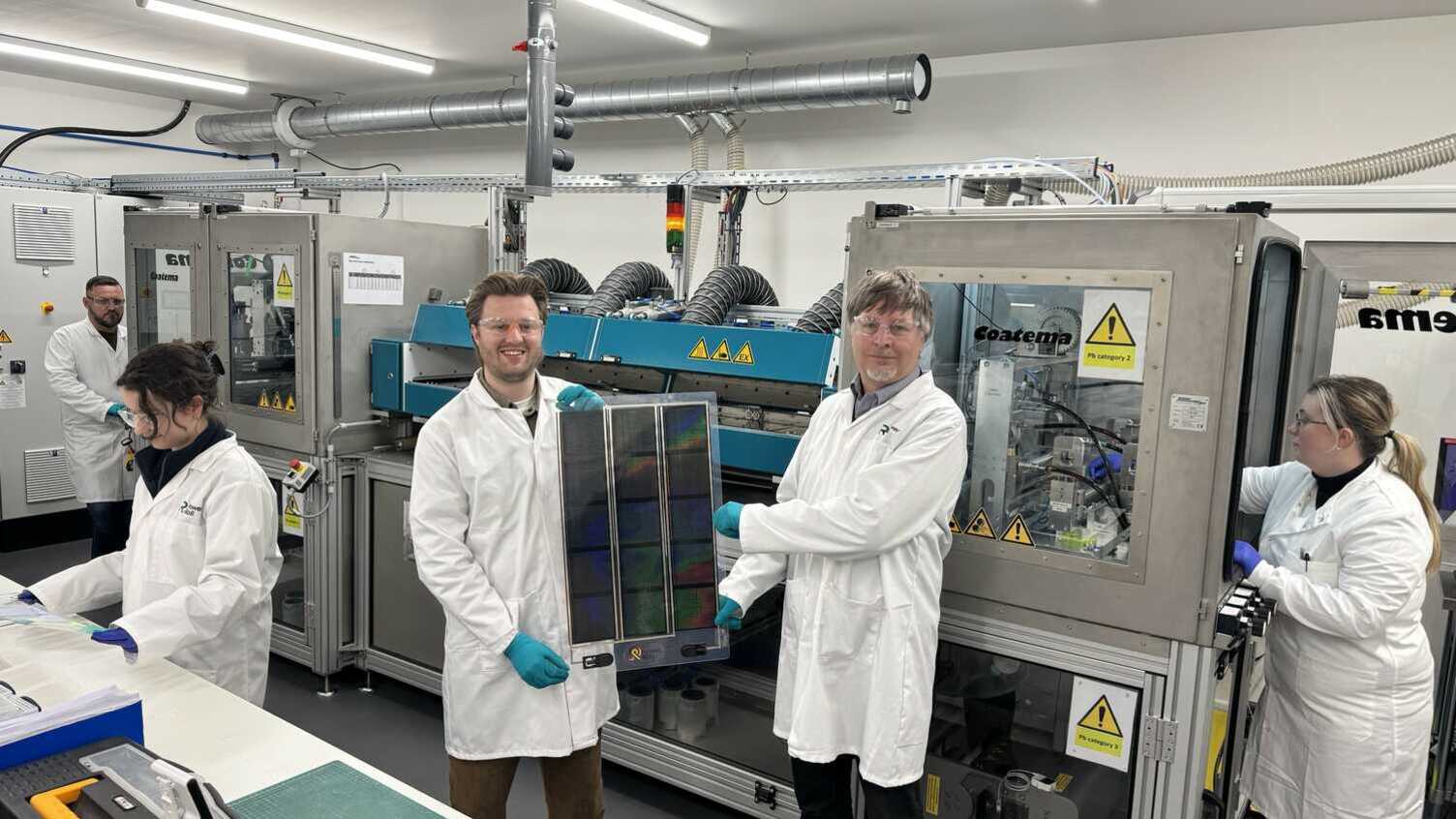
Dr Nathan Hill, Power Roll and Professor David Lidzey, University of Sheffield (left to right)
Solar electricity panels are made of solar cells that capture the sun’s energy and convert it into electricity.
The invention of the solar cell was credited to French scientist Edmond Becquerel in 1839, who discovered that light could be used to increase electricity generation by placing two electrodes into a conducting solution. This was defined as the photovoltaic effect, and is at the core of the solar cell technology found in solar panels today.
Solar panels turn sunlight into direct current electricity before an inverter converts it into alternating current electricity that is fed into a grid or stored in a battery.
Currently, 4.8% of the UK’s electricity is produced from solar panels and 500 solar farms provide energy directly to the Grid. While this renewable source of energy doesn’t require fuel or produce polluting gases, the manufacturing of most solar panels is energy intensive and harmful to the environment.
Silicon is an abundantly available material but, the production of silicon solar panels creates a lot of waste during the heat-intensive manufacturing process. Most solar panels are made of silicon because they deliver the highest efficiency compared to the alternative polycrystalline solar panels or thin-film solar panels.
The average silicon solar panel efficiency stands at 22-25 per cent. There are panels based on compound semiconductors that have 40 to 50 per cent efficiency, but they tend to be a lot more expensive and have even more complex and harmful manufacturing processes.
But what if there was a way to improve the efficiency of solar panels and reduce the embodied energy (energy required in production), to make solar an even more sustainable technology?
At the University of Sheffield, we’ve partnered with Power Roll Ltd for over 10 years, combining our expertise in materials science and advanced imaging techniques to improve the design and manufacturing of solar cells. Power Roll is a technology company based in the North East developing energy generation and storage products - and we’ve worked together on multiple occasions to develop the technology needed to cultivate a brighter future for the UK.
In 2014, Professor David Lidzey and his team from the Department of Physics and Astronomy first collaborated with Power Roll to develop a new solar cell design. The research discovered that by coating opposing walls of micro-grooves with different electrical contacts, and then filling the groove with a solution-processable semiconductor, it was possible to create a new type of back contacted solar cell that is easier to manufacture.
“Silicon cells themselves are relatively heavy and not particularly flexible. For many years, we’ve been looking at ways to make solar cells using printing technologies. Through this, we found a way to reduce manufacturing complexity and make steps towards low cost and high energy efficient solar cells” explains Professor Lidzey.
Following the work published in the paper, researchers from the University of Sheffield and Power Roll successfully produced working mini-module demonstrators. The flexibility of the material used makes it easier and cheaper to transport, allowing communities that couldn’t access traditional solar panels to access electricity.
A powerful collaboration
Flexible solar cells that do not contain any scarce, expensive metals are paving the way for the development of low cost, highly efficient solar energy - and new research from the University of Sheffield and Power Roll highlights the development of a type of solar cell using a perovskite semiconductor. Unlike traditional solar cells, these cells are made by embossing tiny grooves into a plastic film and then filling them with the perovskite material. Critically, these devices are made without the use of expensive elements, which otherwise add to the cost of the technology.
This innovative approach presents a new way to produce lightweight, flexible solar films that can be used on surfaces such as rooftops and other unconventional surfaces that could not normally stand the weight of solar panels. Together with their anticipated low cost, this could significantly enhance the roll out of solar, particularly in developing countries, and make a real difference in the drive to replace fossil fuels with sustainable solar energy.
“A key advantage of these flexible films is that the panel can be stuck onto any surface. In the UK, you currently have to think twice about adding thick solar panels onto relatively fragile roofs of warehouses that are not really designed to be load-bearing. With this lightweight solar technology, you could essentially stick it anywhere. This could be a gamechanger for solar energy in low and middle income countries” explains Professor Lidzey.
“Solar energy is a strategic priority for our research and one of our key competences is developing innovative techniques for fabricating and depositing solution-processable solar cells” adds Professor Lidzey.
The new microgroove structure creates a new type of solar cell that has a back-contact format. Regular devices use a sandwich structure composed of a number of layers deposited in a specific order. The back-contact cells have all the electrical contacts on the back of the device making it easier and cheaper to manufacture, with the potential for high efficiency.
To check the structure and composition of the solar cells a Hard X-ray nanoprobe microscope at Diamond Light Source in Oxfordshire, was used to take very detailed images of the solar cells. These also helped to spot hidden problems like empty spaces, flaws and the boundaries between tiny crystals within the semiconductor material. This was the first time this type of analysis had been used on this kind of solar cell.
“This partnership demonstrates the potential of combining cutting-edge research with industrial innovation to deliver transformative solutions in renewable energy. We are advancing technology that could play a significant role in achieving global net-zero targets, and by combining our collective research and academic capabilities we are able to further prove out the science sitting behind Power Roll’s technology” explains Dr Nathan Hill, Research Scientist at Power Roll.
“It’s exciting to see our relationship with the University of Sheffield continue to strengthen. Previously, we have worked with the University’s Department of Physics and Astronomy to further develop our solar designs, which not only reduced manufacturing costs but also enhanced solar efficiency” adds Dr Hill.
“With perovskite solar generation still an emerging field, ongoing research and academic focus is greatly accelerating the advance of product development and scientific understanding. The next phase of the work on this project will be to further develop the use of X-ray microscopy in characterising these materials. New experiments are scheduled this summer, at the Diamond Light Source, to help understand key aspects of device operation, particularly device stability” says Professor Lidzey.
https://www.sheffield.ac.uk/research/fe ... efficiency
University of Sheffield, 21-Feb-2025
While solar energy is renewable, the manufacturing process for panels is energy intensive. Professor David Lidzey and Power Roll Ltd have developed a solar cell design that could be easier to produce and eliminates the use of expensive elements.
Dr Nathan Hill, Power Roll and Professor David Lidzey, University of Sheffield (left to right)
Solar electricity panels are made of solar cells that capture the sun’s energy and convert it into electricity.
The invention of the solar cell was credited to French scientist Edmond Becquerel in 1839, who discovered that light could be used to increase electricity generation by placing two electrodes into a conducting solution. This was defined as the photovoltaic effect, and is at the core of the solar cell technology found in solar panels today.
Solar panels turn sunlight into direct current electricity before an inverter converts it into alternating current electricity that is fed into a grid or stored in a battery.
Currently, 4.8% of the UK’s electricity is produced from solar panels and 500 solar farms provide energy directly to the Grid. While this renewable source of energy doesn’t require fuel or produce polluting gases, the manufacturing of most solar panels is energy intensive and harmful to the environment.
Silicon is an abundantly available material but, the production of silicon solar panels creates a lot of waste during the heat-intensive manufacturing process. Most solar panels are made of silicon because they deliver the highest efficiency compared to the alternative polycrystalline solar panels or thin-film solar panels.
The average silicon solar panel efficiency stands at 22-25 per cent. There are panels based on compound semiconductors that have 40 to 50 per cent efficiency, but they tend to be a lot more expensive and have even more complex and harmful manufacturing processes.
But what if there was a way to improve the efficiency of solar panels and reduce the embodied energy (energy required in production), to make solar an even more sustainable technology?
At the University of Sheffield, we’ve partnered with Power Roll Ltd for over 10 years, combining our expertise in materials science and advanced imaging techniques to improve the design and manufacturing of solar cells. Power Roll is a technology company based in the North East developing energy generation and storage products - and we’ve worked together on multiple occasions to develop the technology needed to cultivate a brighter future for the UK.
In 2014, Professor David Lidzey and his team from the Department of Physics and Astronomy first collaborated with Power Roll to develop a new solar cell design. The research discovered that by coating opposing walls of micro-grooves with different electrical contacts, and then filling the groove with a solution-processable semiconductor, it was possible to create a new type of back contacted solar cell that is easier to manufacture.
“Silicon cells themselves are relatively heavy and not particularly flexible. For many years, we’ve been looking at ways to make solar cells using printing technologies. Through this, we found a way to reduce manufacturing complexity and make steps towards low cost and high energy efficient solar cells” explains Professor Lidzey.
Following the work published in the paper, researchers from the University of Sheffield and Power Roll successfully produced working mini-module demonstrators. The flexibility of the material used makes it easier and cheaper to transport, allowing communities that couldn’t access traditional solar panels to access electricity.
A powerful collaboration
Flexible solar cells that do not contain any scarce, expensive metals are paving the way for the development of low cost, highly efficient solar energy - and new research from the University of Sheffield and Power Roll highlights the development of a type of solar cell using a perovskite semiconductor. Unlike traditional solar cells, these cells are made by embossing tiny grooves into a plastic film and then filling them with the perovskite material. Critically, these devices are made without the use of expensive elements, which otherwise add to the cost of the technology.
This innovative approach presents a new way to produce lightweight, flexible solar films that can be used on surfaces such as rooftops and other unconventional surfaces that could not normally stand the weight of solar panels. Together with their anticipated low cost, this could significantly enhance the roll out of solar, particularly in developing countries, and make a real difference in the drive to replace fossil fuels with sustainable solar energy.
“A key advantage of these flexible films is that the panel can be stuck onto any surface. In the UK, you currently have to think twice about adding thick solar panels onto relatively fragile roofs of warehouses that are not really designed to be load-bearing. With this lightweight solar technology, you could essentially stick it anywhere. This could be a gamechanger for solar energy in low and middle income countries” explains Professor Lidzey.
“Solar energy is a strategic priority for our research and one of our key competences is developing innovative techniques for fabricating and depositing solution-processable solar cells” adds Professor Lidzey.
The new microgroove structure creates a new type of solar cell that has a back-contact format. Regular devices use a sandwich structure composed of a number of layers deposited in a specific order. The back-contact cells have all the electrical contacts on the back of the device making it easier and cheaper to manufacture, with the potential for high efficiency.
To check the structure and composition of the solar cells a Hard X-ray nanoprobe microscope at Diamond Light Source in Oxfordshire, was used to take very detailed images of the solar cells. These also helped to spot hidden problems like empty spaces, flaws and the boundaries between tiny crystals within the semiconductor material. This was the first time this type of analysis had been used on this kind of solar cell.
“This partnership demonstrates the potential of combining cutting-edge research with industrial innovation to deliver transformative solutions in renewable energy. We are advancing technology that could play a significant role in achieving global net-zero targets, and by combining our collective research and academic capabilities we are able to further prove out the science sitting behind Power Roll’s technology” explains Dr Nathan Hill, Research Scientist at Power Roll.
“It’s exciting to see our relationship with the University of Sheffield continue to strengthen. Previously, we have worked with the University’s Department of Physics and Astronomy to further develop our solar designs, which not only reduced manufacturing costs but also enhanced solar efficiency” adds Dr Hill.
“With perovskite solar generation still an emerging field, ongoing research and academic focus is greatly accelerating the advance of product development and scientific understanding. The next phase of the work on this project will be to further develop the use of X-ray microscopy in characterising these materials. New experiments are scheduled this summer, at the Diamond Light Source, to help understand key aspects of device operation, particularly device stability” says Professor Lidzey.
https://www.sheffield.ac.uk/research/fe ... efficiency
Re: Notas de energías renovables
Es un desarrollo científico, todavía no comercial, pero interesante de todos modos.
New Catalyst Transforms Waste Carbon Dioxide into Liquid Methanol
Reviewed by Laura Thomson, AZOCleanTech, Feb 21 2025
Yale chemist Hailiang Wang and his colleagues report their most recent success in turning industrial emissions of CO2, a major greenhouse gas causing climate change, into methanol, a common liquid fuel for internal combustion and other engines, in a new study published in the journal Nature Nanotechnology.

This image shows the working mechanism of the newly designed “dual-site” catalyst turning CO2 into CO and then into methanol. Image Credit: Wang Lab
Yale scientists took a “two-in-one” catalyst that converts waste carbon into liquid methanol. The next crucial step is developing a scalable method to extract carbon dioxide (CO2) from the atmosphere and “recirculate” it as a renewable fuel.
Wide-ranging industrial applications could result from the process.
The chemical reaction that turns CO2 into methanol happens in two steps. First, carbon monoxide (CO) is created when CO2 combines with a catalyst. After that, the CO transforms into methanol by a catalytic process.
The most successful earlier method, which Wang’s group also created, used a single catalyst composed of molecules of cobalt tetraaminophthalocyanine supported on carbon nanotubes. On this single-site catalyst, however, the two reaction steps are mismatched: the conversion of CO2 to CO is less selective and efficient, which poses a problem for researchers attempting to develop a reliable procedure that can be expanded for industrial use.
Seonjeong Cheon, Yuanzuo Gao, Bo Shang, Huan Li, Longtao Ren, and Shize Yang are other Yale co-authors. Yang is the director of Yale's aberration-corrected electron microscopy core facility, a comprehensive lab for materials science research that focuses on electron microscopy and spectroscopy.
Quansong Zhu and Robert Baker from Ohio State University collaborated on the study and contributed experimental proof of CO spillover from the nickel site to the cobalt site. Huan Li, Zhan Jiang, and Yongye Liang from Southern University of Science and Technology, as well as Alvin Chang and Zhenxing Feng from Oregon State University, are additional study collaborators.
The National Science Foundation and the Yale Center for Natural Carbon Capture provided some funding for the study.
Journal Reference (por subscripción o pago):
Li, J., et al. (2025) Molecular-scale CO spillover on a dual-site electrocatalyst enhances methanol production from CO2 reduction. Nature Nanotechnology. doi.org/10.1038/s41565-025-01866-8
https://www.azocleantech.com/news.aspx?newsID=35546
New Catalyst Transforms Waste Carbon Dioxide into Liquid Methanol
Reviewed by Laura Thomson, AZOCleanTech, Feb 21 2025
Yale chemist Hailiang Wang and his colleagues report their most recent success in turning industrial emissions of CO2, a major greenhouse gas causing climate change, into methanol, a common liquid fuel for internal combustion and other engines, in a new study published in the journal Nature Nanotechnology.
This image shows the working mechanism of the newly designed “dual-site” catalyst turning CO2 into CO and then into methanol. Image Credit: Wang Lab
Yale scientists took a “two-in-one” catalyst that converts waste carbon into liquid methanol. The next crucial step is developing a scalable method to extract carbon dioxide (CO2) from the atmosphere and “recirculate” it as a renewable fuel.
Wide-ranging industrial applications could result from the process.
Wang is a member of both the Yale Energy Sciences Institute and the Yale Center for Natural Carbon Capture.This is a new strategy that brings CO2 reduction into methanol to a new level.
Hailiang Wang, Study Lead Author and Professor, Chemistry, Faculty of Arts and Sciences, Yale University
The chemical reaction that turns CO2 into methanol happens in two steps. First, carbon monoxide (CO) is created when CO2 combines with a catalyst. After that, the CO transforms into methanol by a catalytic process.
The most successful earlier method, which Wang’s group also created, used a single catalyst composed of molecules of cobalt tetraaminophthalocyanine supported on carbon nanotubes. On this single-site catalyst, however, the two reaction steps are mismatched: the conversion of CO2 to CO is less selective and efficient, which poses a problem for researchers attempting to develop a reliable procedure that can be expanded for industrial use.
To convert CO2 into CO, the novel method begins with a nickel tetramethoxyphthalocyanine site. To finish the reduction into methanol, the freshly created CO then moves onto a cobalt site, which catalysis scientists call “spillover.”Having just one type of catalytic site was not optimal for both steps in the reaction. To avoid this trade-off, we’ve now designed a ‘two-in-one’ catalyst.
Jing Li, Study First Author and Postdoctoral Associate, Faculty of Arts and Sciences, Yale University
Based on research from the Wang lab, Rooney is a creator of Oxylus Energy, a company that collaborates with industry partners to turn carbon waste into methanol liquid fuel.Our work offers a potentially scalable solution to reduce carbon footprints and accelerate the transition to cleaner energy.
Conor Rooney, Study Co-Author Former Ph.D. Student, Faculty of Arts and Sciences, Yale University
Seonjeong Cheon, Yuanzuo Gao, Bo Shang, Huan Li, Longtao Ren, and Shize Yang are other Yale co-authors. Yang is the director of Yale's aberration-corrected electron microscopy core facility, a comprehensive lab for materials science research that focuses on electron microscopy and spectroscopy.
Quansong Zhu and Robert Baker from Ohio State University collaborated on the study and contributed experimental proof of CO spillover from the nickel site to the cobalt site. Huan Li, Zhan Jiang, and Yongye Liang from Southern University of Science and Technology, as well as Alvin Chang and Zhenxing Feng from Oregon State University, are additional study collaborators.
The National Science Foundation and the Yale Center for Natural Carbon Capture provided some funding for the study.
Journal Reference (por subscripción o pago):
Li, J., et al. (2025) Molecular-scale CO spillover on a dual-site electrocatalyst enhances methanol production from CO2 reduction. Nature Nanotechnology. doi.org/10.1038/s41565-025-01866-8
https://www.azocleantech.com/news.aspx?newsID=35546


