Notas de energías renovables

Aquí puede comentar todo aquello que no sea de política, de economía, de temas sociales del día a día
Fermat
Mensajes: 2139
Registrado: Mié Mar 02, 2022 5:42 am

Re: Notas de energías renovables

Mensaje sin leer por Fermat »

Este artículo habla de una célula con eficiencia del 60% (!), pero habrá que ver la economía de los materiales.

Investigadores de la Universidad Complutense de Madrid crearon la primera célula solar usando fosfuro de galio y titanio que podría alcanzar una eficiencia del 60% > por primera vez en el mundo
22 octubre, 2024
Imagen
Al equipo le llevó 15 años construir la primera célula solar usando estos Gap y Ti, pero podría cambiar la industria de la energía solar en el futuro.

Célula solar innovadora con potencial de conversión de energía del 60%
Un equipo de investigadores de la Universidad Complutense de Madrid ha logrado un hito importante en el campo de la energía solar. Después de 15 años de trabajo, han fabricado la primera célula solar con una banda intermedia (IB) utilizando fosfuro de galio (GaP) y titanio (Ti), que podría alcanzar una eficiencia de conversión energética del 60%. Este desarrollo podría revolucionar la industria de la energía solar en el futuro.

Aprovechando la luz solar de manera más eficiente
Desde hace décadas, se utilizan células solares para transformar la luz solar en electricidad. La mayoría de estas células están basadas en silicio, un material que tiene limitaciones en cuanto a la cantidad de luz que puede convertir en corriente eléctrica. Esto se debe a que no todas las longitudes de onda de la luz solar son captadas por las células de silicio, lo que resulta en que una parte significativa de la energía solar se disipe en forma de calor.

El límite teórico máximo de conversión de energía de una célula solar, conocido como el límite de Shockley-Queisser (SQ), está directamente relacionado con el material que se usa en su fabricación. Para las células solares de silicio, el límite de SQ es del 33,7%, lo que significa que, en las mejores condiciones, estas células no pueden aprovechar el 66,3% de la luz solar que reciben. Esta ineficiencia ha impulsado la búsqueda de nuevos materiales que permitan superar este límite y mejorar la producción de energía.

Rompiendo el límite de Shockley-Queisser
El equipo dirigido por Javier Olea Ariza ha estado investigando el uso de fosfuro de galio (GaP) y titanio (Ti) para crear una célula solar más eficiente. Estos materiales ofrecen características que pueden superar las limitaciones del silicio. El GaP tiene una banda prohibida de 2,26 eV, lo que es significativamente mayor que la del silicio, permitiendo que la célula solar pueda captar una mayor porción del espectro solar.

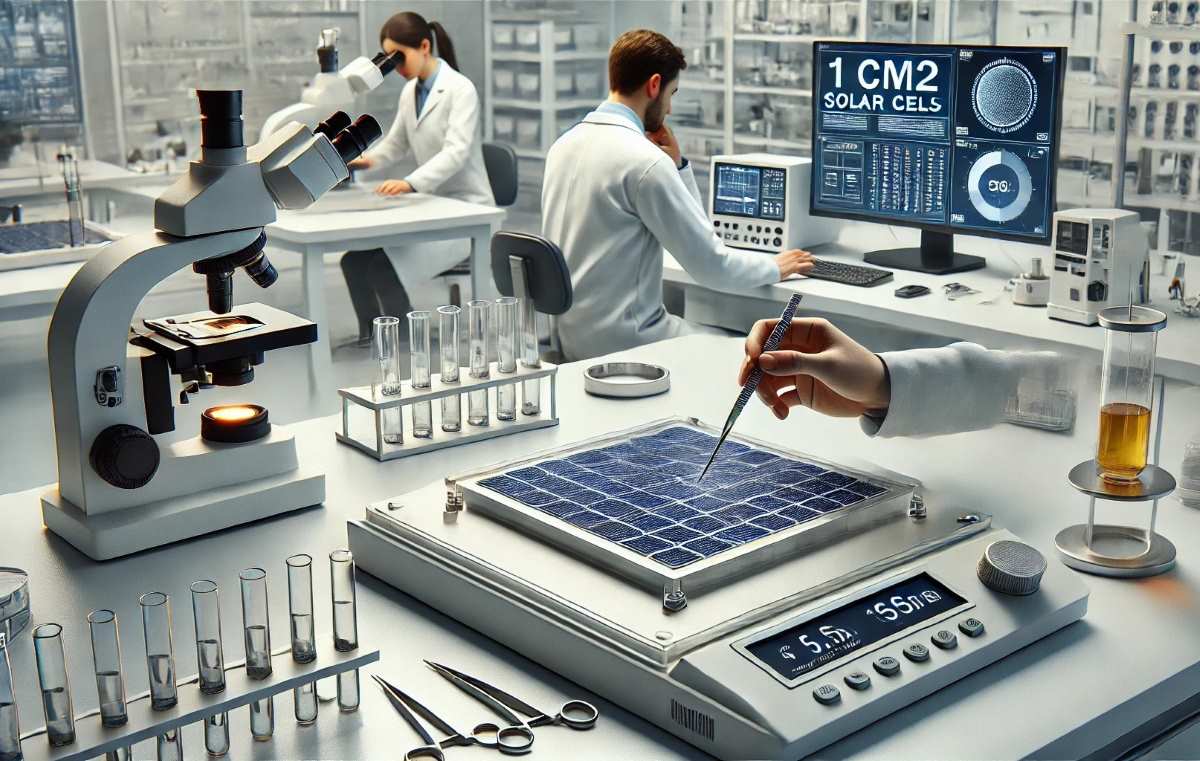
La célula solar desarrollada por los investigadores tiene un tamaño de 1 cm² y utiliza un absorbente de GaP:Ti con un grosor de solo 50 nm. En lugar de los contactos metálicos tradicionales, el equipo optó por una combinación de oro y germanio, lo que contribuye a mejorar la capacidad de absorción de luz a longitudes de onda superiores a los 550 nm.

Potencial de una conversión del 60%
Según las pruebas realizadas en cuanto a transmitancia y reflectancia, la célula solar mostró una absorción de luz significativamente mejorada, lo que podría explicar el alto potencial teórico de conversión de energía, que se estima en torno al 60%. A pesar de este avance teórico, la eficiencia real de la célula en su estado actual aún es baja y queda mucho por hacer antes de que pueda implementarse en aplicaciones comerciales.

Los investigadores están trabajando en mejorar el diseño de la célula solar, especialmente en la forma en que se incorpora el titanio en la estructura. Su objetivo es desarrollar un prototipo que demuestre una mayor eficiencia en condiciones prácticas, lo que podría allanar el camino para futuras aplicaciones en la producción de energía solar.

Implicaciones para la sostenibilidad y las energías renovables
Este desarrollo tiene el potencial de impactar significativamente en la transición hacia fuentes de energía más limpias y sostenibles. La capacidad de aumentar la eficiencia de las células solares podría reducir la cantidad de paneles necesarios para generar electricidad, lo que disminuiría el uso de terrenos y recursos para la instalación de plantas solares.

Además, al hacer que la generación de electricidad sea más eficiente, se reduciría la dependencia de combustibles fósiles, lo que contribuiría a mitigar los efectos del cambio climático. Aunque aún hay desafíos por superar, los avances logrados por el equipo de la Universidad Complutense de Madrid son un paso importante hacia la creación de tecnologías solares más eficientes y sostenibles.

Próximos pasos
El equipo de investigadores no se detiene aquí. Su próximo objetivo es desarrollar un prototipo completamente funcional que pueda superar las limitaciones actuales de eficiencia. Están explorando diferentes enfoques para mejorar la incorporación del titanio en la célula solar y optimizar otros aspectos de su diseño. Si logran aumentar la eficiencia práctica de la célula, esto podría transformar la forma en que se produce energía solar en todo el mundo.

La creación de esta célula solar basada en GaP y Ti es un avance crucial en el campo de las energías renovables. Aunque todavía queda mucho por investigar, los resultados preliminares son prometedores y abren nuevas posibilidades para mejorar la sostenibilidad energética global.

Más información (artículo gratuito): Optoelectronic properties of GaP:Ti photovoltaic devices

https://ecoinventos.com/primera-celula- ... ia-record/

Fermat
Mensajes: 2139
Registrado: Mié Mar 02, 2022 5:42 am

Re: Notas de energías renovables

Mensaje sin leer por Fermat »

Este artículo (o nota de prensa) habla de una batería más barata y totalmente reciclable (!!). En casos como estos hay que tomar las cosas con cautela y seguir los avances, porque sería verdaderamente revolucionario si cumplen lo prometido.

Rechargeable paper battery is cheaper, safer & as powerful as lithium
C.C. Weiss, New Atlas, February 25, 2025

Imagen
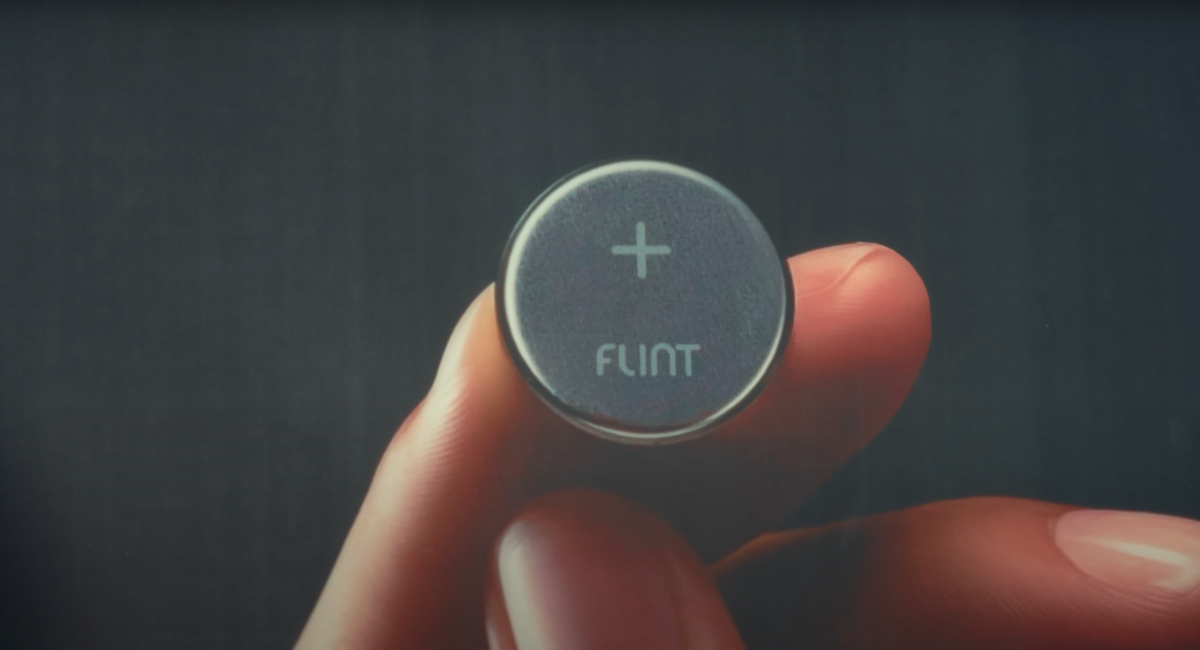
Singaporean startup Flint is working to make a battery with purely sustainable materials, including plant-based cellulose, water-based electrolyte and recyclable metals - Flint

A battery that's safer and cheaper than lithium-ion while offering comparable energy density? That sounds like a pipe dream. But such a battery is in fact in the works, using a chemistry of renewables to store over 220 Wh/kg. Singaporean startup Flint believes it has the formula for the most sustainable battery the world has ever seen, capable of replacing lithium for applications like EV power and grid storage. Maybe that is a dream. Or maybe it's the revolutionary eco-optimized battery of the near-future.

A fully sustainable paper battery that can be recycled and dropped in compost at the end of its life cycle sounds too good to be true. It kicks off a major cynicism alert, and the questions flow like water through a burst dam.

Does it offer such low capacity as to be useless for anything outside a laboratory? No, Flint estimates energy density at 226 Wh/kg, which falls comfortably within the range of existing lithium tech.

Does it have a life cycle measured in hours rather than years? Nope, Flint says the rechargeable batteries will have a life cycle comparable to traditional battery technologies, unlike other single-use paper battery designs.

Will it prove impossible to scale from lab to mass production? Flint has conceived the battery with mass manufacturing in mind and is developing it from the ground up to work within existing lithium manufacturing systems and processes.

Does it seem like Flint has meticulously crafted answers to every pointed question a skeptic might make? Yes, we suppose it does. But that doesn't mean we're not hopeful its paper battery can materialize into a commercialized reality, even if it's in some lesser form than what's being proposed today.

Imagen
Flint plans to begin pilot production this year - Flint

Founded by a "team of scientists, technologists, designers and innovators," Flint aims to take a direct shot at climate change with practical, scalable solutions. In fact, the company wasn't initiated as a battery startup at all but developed organically from the innate desire to answer the question, "Why are the tools we depend on to power our lives so harmful to the planet?" Predictably, the focus on batteries came not long after digging for answers.

Company founder and CEO Carlo Charles and his team believe that the best solution won't ever come from merely tweaking existing battery tech but from rethinking the entire system. And Flint's battery chemistry reflects that – instead of just replacing an element or two, Flint is writing a completely new formula out of renewable and readily recyclable ingredients.

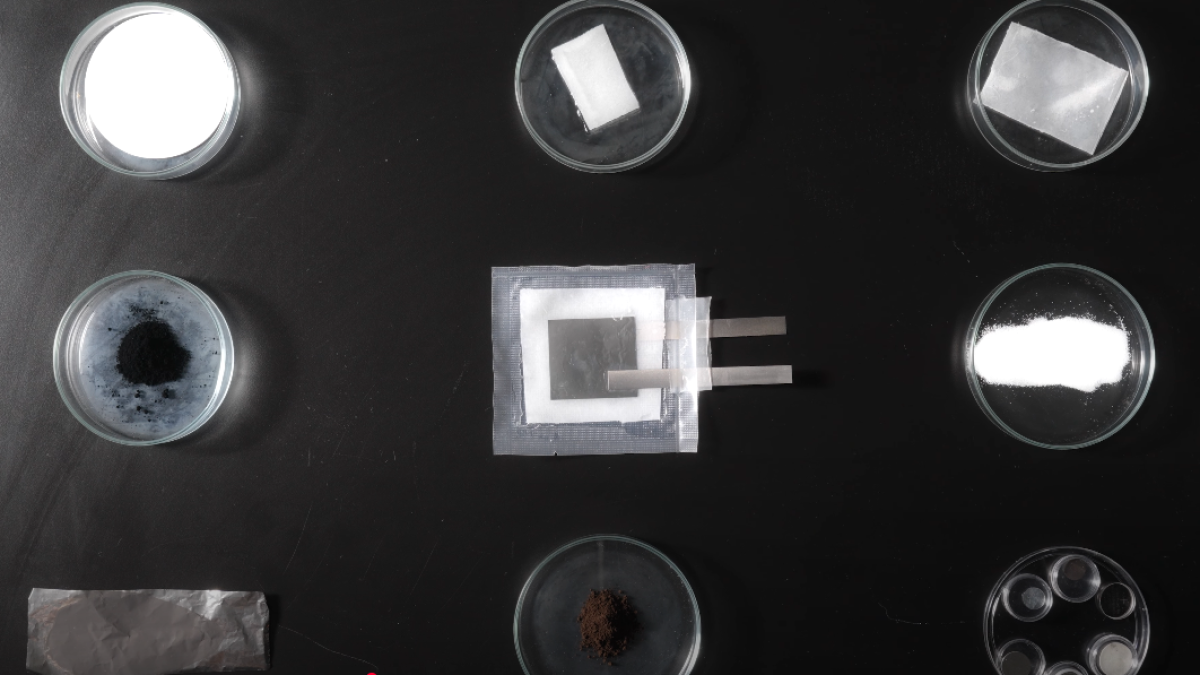
The company's proprietary battery chemistry relies on cellulose, the structural plant material used to make paper, as the medium for ion transfer between the anode and cathode. Flint then replaces problematic non-renewables like cobalt and lithium with less environmentally impactful, easily recycled metals like zinc and manganese.

Imagen
Flint leverages more sustainable materials toward creating the "world's most sustainable battery," one that can be fully recycled and composted at life's end - Flint

The cellulose also underpins a more versatile, pliable battery structure, allowing Flint to make batteries in different forms. Rather than having to design a vehicle or device around a battery brick, builders could theoretically structure the battery to fit into the optimal space in the vehicle or gadget.

We've seen over the years that declaring the next great battery technology on paper and backing the claim up with a few lab milestones is the easy part. The big lifting comes in wresting that next great technology from the white coats and putting it on production lines, and doing so in a time period measured in units smaller than decades. That's why Flint has been working to create its battery in a form that can be built via the same manufacturing processes currently in use for lithium batteries.

As to cost, the company believes it can eventually build its batteries for roughly US$50/kWh, less than half the average 2024 cost of lithium-ion. That's thanks largely to the use of those abundantly available sustainable materials and metals that are easier and less costly to mine than traditional battery metals.

Finally, if you still have a little bit of credulity left to offer, Flint claims its cellulose-based battery is significantly safer and more stable than lithium, virtually eliminating the chance of catastrophic fire. The water-based electrolytes are stable and non-toxic and formulated to prevent overheating, sparking and explosion.

Imagen
Flint says that its cellulose-based battery will continue working briefly when exposed to flame, then degrade naturally without sparking a larger fire or explosion - Flint

Flint even says its batteries can work for a short period of time when lit with an open flame or damaged, ultimately degrading without causing a catastrophic event. And because of that same stability and non-toxic design, the innards can be removed from their vacuum-sealed casing, the metals extracted and recycled, and the remainder left to degrade naturally in the soil, without environmental harm.

Okay, that's quite an overflowing mouthful of potential pie-in-the-sky promise to chew on all at once. Flint recognizes it has a serious hill to climb in fulfilling the huge objectives its laid out for itself, but it remains steadfast in its mission. It closed a $2-million seed funding round in late 2024 and plans to purpose that money toward commercial expansion, intellectual property development, and a 2025 pilot production program.

We certainly hope this isn't the last we hear from Flint, and we don't believe it will be. Because even if it only comes through on a part of that scroll of breakthroughs and advantages, it will still have a very special product to market.

Source: Flint
https://newatlas.com/energy/paper-batte ... materials/
Fermat
Mensajes: 2139
Registrado: Mié Mar 02, 2022 5:42 am

Re: Notas de energías renovables

Mensaje sin leer por Fermat »

Why enhanced geothermal systems could be a game-changer for clean energy
Stanford report, 25-02-2025

According to researchers, electricity from natural underground heat could become cost-competitive with grid power by 2027 using EGS, though care is needed to address earthquake risks.

Imagen
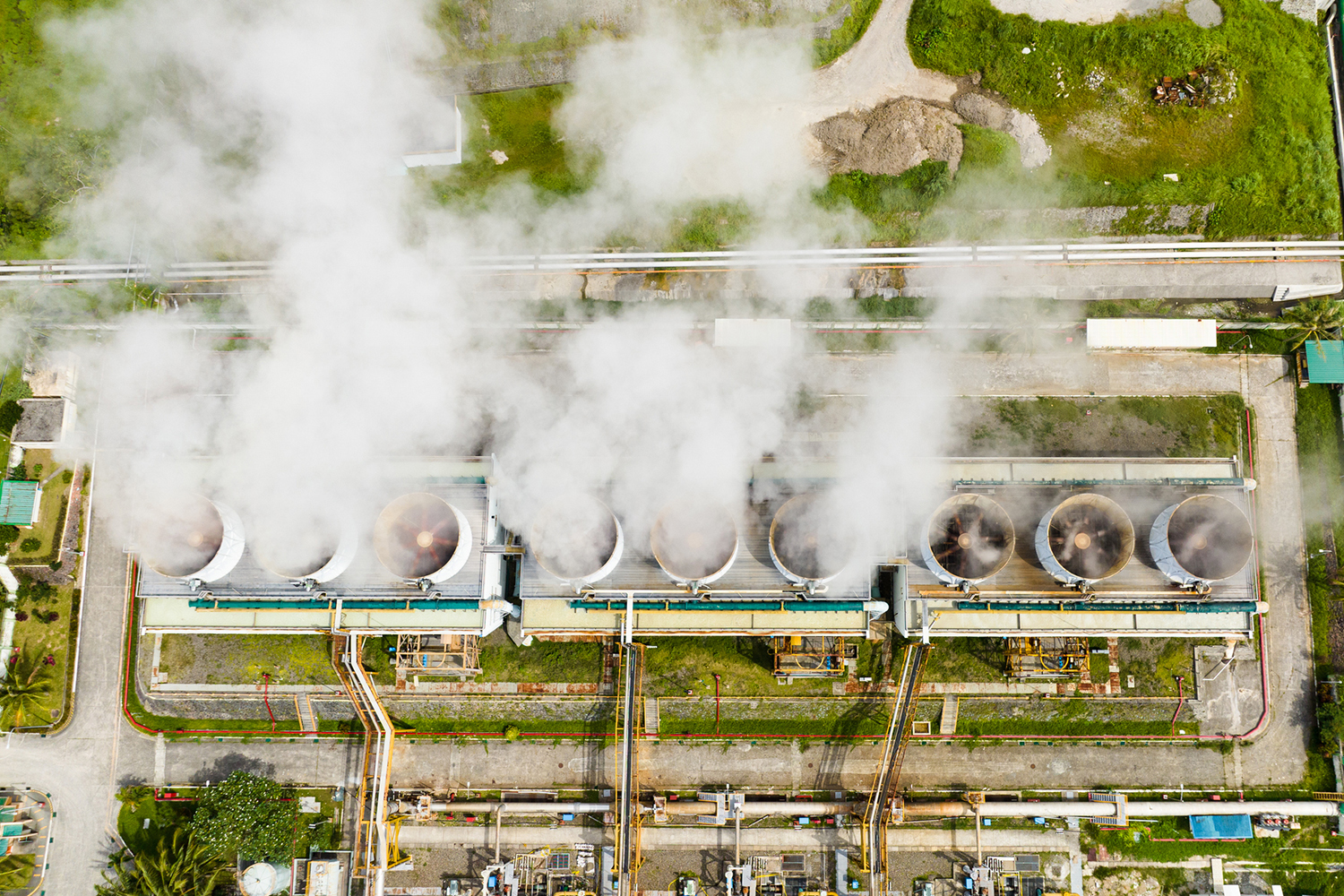
A geothermal power station in a mountainous province of the Philippines. | Getty Images

Historically, access to geothermal energy has hinged on real estate’s famously three most important factors: location, location, and location.

Because conventional geothermal power plants require hot, permeable rocks and plenty of underground fluid, use of the technology has been limited mostly to places with recent volcanism, such as Japan, New Zealand, the Philippines, Kenya, El Salvador, Iceland, and the western United States.

Over the past 50 years, however, techniques originally developed for oilfields and adapted for “enhanced geothermal systems” (EGS) have offered the promise of tapping deep reserves of natural heat across a broader swath of the planet.

“There is a lot of excitement about enhanced geothermal energy,” said Roland Horne, a professor of energy science and engineering in the Stanford Doerr School of Sustainability, who convened more than 450 engineers, scientists, and managers from 28 countries earlier this month at the 50th Stanford Geothermal Workshop to exchange ideas and report results from projects around the world.

To date, nearly all EGS applications have been for research purposes in one-off, small-scale plants, said Horne, who was invited to gather a team of authors to write a review paper for the February 2025 issue of Nature Reviews Clean Technology about EGS and its potential to supply energy at a larger scale.

Millennia after ancient Romans tapped subterranean heat to warm their buildings, and more than a century after Italy started up the world’s first geothermal power plant, Horne and co-authors note that geothermal today contributes as much as 45% of the electricity supply in some countries, like Kenya. But it still contributes less than half of 1% globally. Solar and wind contribute more than 25 times as much. With EGS, the potential now exists for geothermal to comprise a far greater share of humanity’s energy needs.

Faster drilling reduces costs
Many of the drilling techniques that enabled the shale gas boom of the early 2000s have been adapted to make geothermal work in more regions at lower cost, said Horne. These techniques include horizontal drilling and hydraulic fracturing, or fracking, which involves pumping fluids at high pressure into wells drilled down into and across rock formations thousands of feet underground. The pressure forces open existing fractures in the rock or creates new ones, easing the flow of petroleum or other fluids to the surface. In enhanced geothermal systems, the fluid is just hot water from the natural underground reservoirs.

Other adapted techniques include drilling multiple wells from a single pad to increase efficiency and reduce costs. Synthetic diamond drill bits, which can effectively chew through hard rock, have also proven critical, making it possible to complete a new geothermal well within a few weeks instead of months.

“Drilling faster makes an enormous difference to the whole economics of EGS,” said Horne, the Thomas Davies Barrow Professor at Stanford, who also serves on the scientific advisory board of an enhanced geothermal development company co-founded by Stanford alumni Tim Latimer, MS-MBA ’17, and Jack Norbeck, PhD ’16.

Based in part on modeling led by PhD student Mohammad Aljubran, Horne and his co-authors on the review paper estimate the faster drilling rates could make enhanced geothermal systems competitive with average electricity prices across much of the United States by 2027, at approximately $80 per megawatt-hour.

In California, which currently gets about 5% of its electricity from geothermal, the authors estimate geothermal capacity could increase tenfold with EGS to reach 40 gigawatts by 2045 and replace fossil fuels for baseload power. In this way, EGS would complement the intermittent renewables of wind and solar, adding stability to a decarbonized power grid.

“With EGS, we can meet the load,” said Horne, whose co-authors on the Jan. 31 review paper include Norbeck and former student Mark McClure, MS ’09, PhD ’12, the co-founder and chief executive of a company that markets fracture modeling software to oil, gas, and EGS companies. Additional co-authors include William Ellsworth, an emeritus research professor of geophysics in the Doerr School of Sustainability; Eva Schill, who leads Lawrence Berkeley National Laboratory’s geothermal systems program; and Albert Genter, deputy director general of geothermal at Electricité de Strasbourg, which is involved with commercial development of EGS projects in France.
A drip-drip-drip instead of a fire hose approach can significantly reduce the risk and size of induced seismicity.”
Roland Horne
Professor of Energy Science and Engineering in the Stanford Doerr School of Sustainability
Mitigating earthquake risks
As with fracking for oil and gas, fracturing deep rocks to access geothermal reservoirs can trigger earthquakes.

One obvious way to mitigate risk again hearkens back to location: Simply avoid drilling in places prone to earthquakes. For example, building a site atop the San Andreas Fault that perilously wends through California would be ill advised, Horne said.

A second approach is monitoring seismicity with a system known as a traffic-light protocol. If a seismic event of a certain magnitude occurs, operators slow down their drilling. Bigger seismic events are treated as red lights that halt all drilling and prompt a review prior to potential restart.

A recently developed strategy for limiting seismicity, Horne said, involves creating many smaller fractures during drilling rather than just one or a few massive fractures. Most earthquakes associated with EGS have occurred when big, human-stimulated fractures are pumped full of fluid and activate faults, which are naturally existing fractures in rock. “A drip-drip-drip instead of a fire hose approach can significantly reduce the risk and size of induced seismicity,” said Horne.

He and his colleagues hope the new study encourages further research and development of EGS as a sustainable and reliable energy source. “EGS could be a game changer for green energy production not just in California but across the U.S. and worldwide,” said Horne. “Safely harnessing Earth’s internal heat could substantially contribute to powering our future.”

Horne is also a senior fellow in the Precourt Institute for Energy and serves on the scientific advisory boards of Utah FORGE and Fervo Energy. Norbeck is the chief technology officer at Fervo Energy. McClure is the chief executive at ResFrac, which markets software to EGS development companies including Utah FORGE and Fervo.

This story was originally published by the Stanford Doerr School of Sustainability.

https://news.stanford.edu/stories/2025/ ... ean-energy
Fermat
Mensajes: 2139
Registrado: Mié Mar 02, 2022 5:42 am

Re: Notas de energías renovables

Mensaje sin leer por Fermat »

NB! Finos de roca (“steinmel”).
En Noruega se usa como relleno, el material producto de voladura de macizos rocosos (“sprengstein”). En muchos casos se tamiza el material para eliminar los finos; estos finos residuales son llamados “steinmel” cuya traducción literal es "harina de roca".

Almacenamiento de calor solar en finos de piedra
Stig Granås, EnergiAktuelt, 24-Feb-2025
Imagen
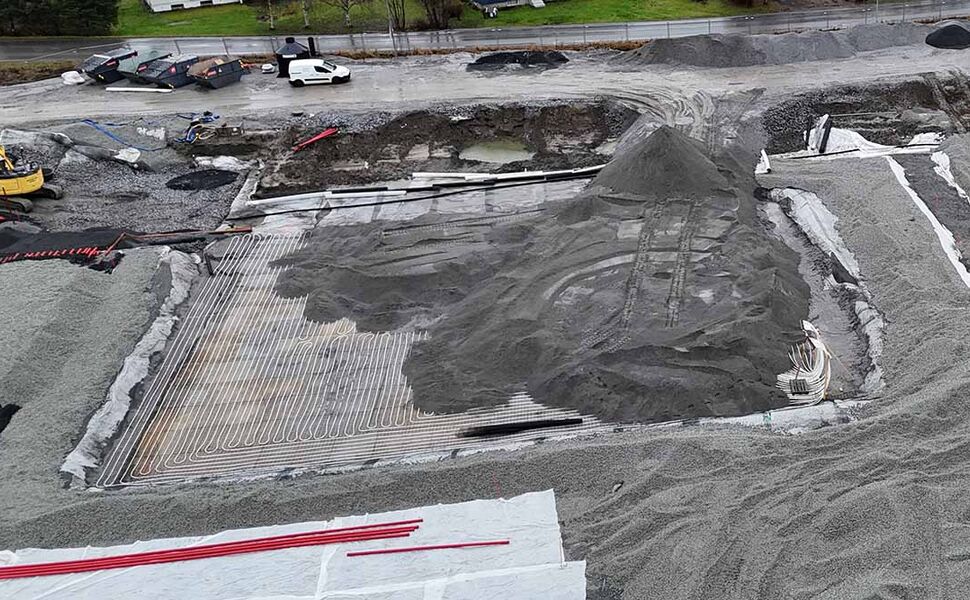
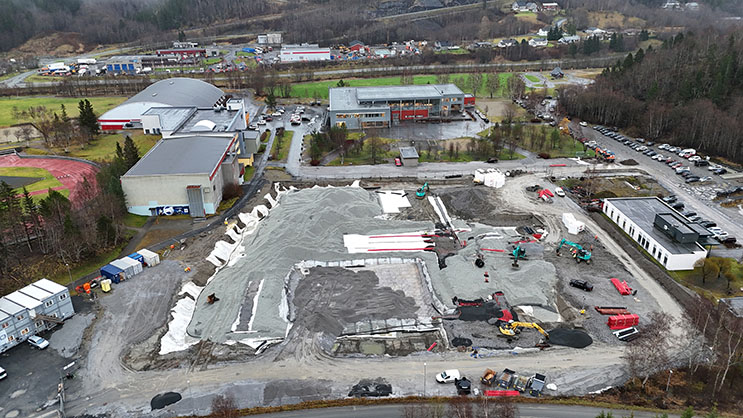
Almacén de energía en construcción en Mosjøen. Foto: Consto

Se ha creado un “almacén” de calor solar (NB! de colectores solares, no de paneles) en la escuela secundaria superior Nye Mosjøen que emplea finos de roca. El almacenamiento se basa en la tecnología ASES y permite almacenar el calor solar en verano para su uso en invierno, cuando la necesidad es mayor.

Norconsult ha desarrollado la tecnología ASES (Active Solar Energy Storage). El objetivo de ASES es maximizar el uso de energía renovable en edificios, minimizando así la necesidad de energía de la red.
–En Suecia hay hasta 20 lugares que utilizan esta tecnología. La mayoría son instalaciones más pequeñas para hogares y jardines de infancia, pero también hay algunas más grandes, explica a EnergiAktuelt, Pål Bøe, director del departamento de sistemas técnicos de Norconsult en Helgeland.
–En algunos plantas y oficinas suecas, la energía solar suele ser la porción mayor de la factura energética total. Utilizan más energía solar directamente en los sistemas, mientras el exceso se almacena, dice Bøe.
–En algunas instalaciones grandes de Suecia, la energía solar y las bombas de calor operan en paralelo. Hemos elegido un enfoque ligeramente diferente, almacenando la energía solar en el terreno y extrayéndola cuando es más económico.

El “almacén” de finos de roca ya está construído
–El almacenamiento de calor en finos de roca es parte del concepto ASES. Se ha descubierto que es posible construir un sistema compacto de almacenamiento de calor usando finos de roca, que consiste en masas de roca triturada que se comprimen. Es casi como devolver material a la roca, dice Bøe.
–Actualmente estamos trabajando en los cimientos del instituto Nye Mosjøen y ya se ha instalado una planta de triturado de roca, informa a EnergiAktuellt el director del proyecto, Tom Grønnslett, del municipio del condado de Nordland.
–Lo especial de Kippermoen en Mosjøen, localidad de la escuela, es que no encontramos roca. La zona está formada por suelo entre 80 y 100 metros de espesor procedente de la Edad de Hielo, explica Grønnslett.
–Cuando quisimos almacenar calor procedente de los colectores solares, descubrimos que la tecnología ASES era la mejor opción, añade.

Imagen
El nuevo instituto Mosjøen se está construyendo en Kippermoen, Mosjøen. Foto: Consto

Los finos de rocas tienen buenas propiedades como almacén de calor
Los finos de piedra son el material fino sobrante de la trituración de la roca para producir grava. Para que la grava no sufra por el congelamiento se requiere tamizar las partículas finas. Además también se produce finos de roca durante las perforaciones asociadas a los trabajos de voladura. –Los finos de roca son básicamente un producto residual que rara vez se utiliza, pero tiene muy buenas propiedades de almacenamiento de calor, dice Grønnslett.
El acumulador de calor de finos de roca se encuentra bajo el edificio, debajo de una capa aislante estándar, como en un edificio tradicional.
–Esto crea un efecto térmico. La energía se almacena en el terreno y puede conservarse durante meses, quizás hasta un año, dependiendo del flujo de agua en el suelo, dice Grønnslett.

Económica de construir
Construir un almacén de calor de finos de roca es rentable. En Mosjøen se está construyendo un almacén de unos 800 m² con una profundidad de aproximadamente dos metros.
–Nuestro contratista Consto ha recibido la harina de piedra prácticamente gratis de varios proveedores que la consideran un desecho, dice Grønnslett.
–El mayor costo corresponde a la excavación, transporte, compactación y colocación de las tuberías de plástico. En comparación con otros tipos de almacenamiento, esta es una solución relativamente económica, dice.
–Podemos almacenar calor para el invierno, pero el uso más eficiente es cargar y descargar el almacenamiento regularmente, como una batería, dice Grønnslett. Durante el invierno es especialmente interesante extraer energía, ya que los precios de la electricidad suelen ser elevados.
–Aunque los precios de la electricidad al norte de Noruega no siempre son tan altos como en el resto del país, también hay picos. Hace unos días, en determinados momentos, el precio podía llegar a alcanzar las 4-5 coronas por kWh (NB! 1USD circa 11,3 NOK). En tales casos, sería apropiado apagar la calefacción urbana y maximizar el uso de la energía del almacenamiento de finos de roca, dice Grønnslett.

Capacidad de almacenamiento de 49 MWh
Hemos calculado que el almacén tiene una capacidad de cerca de 49 MWh, afirma Pål Bøe de Norconsult.
–El almacén está diseñado para tener una temperatura máxima de 28 grados. No queremos temperaturas más altas en el suelo debido al riesgo de alta presión de vapor. Esto se relaciona con el método de construcción. Tenemos una losa maciza de concreto sobre el almacén, por lo que no nos preocupa que la humedad se filtre al edificio, dice Bøe.
–Si el agua subterránea fluye a través del almacén, puede provocar un enfriamiento más rápido. Pero el almacén de energía en Mosjøen está ubicado por encima del agua subterránea, y en Kippermoen hay poco flujo de agua subterránea porque el área es plana, dice Bøe.
–El almacén se cargará principalmente con energía de los colectores solares, pero también recibirá algo de calor procedente de energía geotérmica. No podemos bajar de cuatro grados en el almacenamiento de energía cuando extraemos energía, ya que es importante evitar las heladas en la planta. Si dejamos de usar el almacén en diciembre, tras vaciarlo, y si la temperatura es de cuatro grados, la energía geotérmica, con una temperatura media de siete a ocho grados, ayudará a recargarlo, dice Grønnslett.

130 m² con colectores solares
Se instalarán 130 m² de colectores solares en el tejado del instituto Nye Mosjøen.
-Los colectores solares son muy eficientes en la captación y recolección de energía. Son entre cuatro y cinco veces más eficientes que las células solares convencionales, afirma Grønnslett.
–El agua circula a través de los colectores solares hasta un tanque acumulador, y un sistema de bombeo envía el calor al almacen del ASES, explica.
Se han realizado cálculos para encontrar el área correcta para los colectores solares, de modo que no se produzca más calor del que el almacén puede tolerar.
–En verano puede ser un desafío, porque el requerimiento de calefacción es bajo, mientras que los colectores solares producen mucha energía. Por lo tanto, era importante calcular el área correcta para evitar la sobreproducción, dice Grønnslett.
Los 130 m² de colectores solares están diseñados para producir aproximadamente 82 MWh al año.
– Para aprovechar el potencial de almacenamiento de cerca de 49 MWh, el almacén debería vaciarse casi dos veces al año, afirma Bøe.

Este es un extracto de un caso que se puede encontrar íntegramente en el Informe Energético nº 1. 7/2025.

https://www.energiaktuelt.no/skal-lagre ... 75509.html
Fermat
Mensajes: 2139
Registrado: Mié Mar 02, 2022 5:42 am

Re: Notas de energías renovables

Mensaje sin leer por Fermat »

Europa innova con baterías de litio con silicio y sin cobalto
Enerzine, 4-mar-2025

Si bien los vehículos eléctricos se están posicionando como una alternativa esencial a los motores de combustión, el problema de las baterías sigue siendo una preocupación central. El rendimiento de estos dispositivos energéticos determina no sólo la experiencia del usuario, sino también la viabilidad ecológica y económica del sector automovilístico. En este contexto, un proyecto europeo ha movilizado a varios actores para repensar los fundamentos de las baterías de litio, para implantarlas a gran escala a nivel industrial.

El proyecto SeNSE, en el marco del programa Horizonte 2020, finalizará a principios de 2024 después de cuatro años de intensa investigación. Este gran proyecto, con un presupuesto total de más de 10 millones de euros, ha sido liderado por Empa, un instituto suizo especializado en materiales para la conversión de energía. La iniciativa estuvo liderada por Corsin Battaglia, director del laboratorio en cuestión, quien logró reunir a once socios provenientes del mundo académico e industrial.

Entre las instituciones colaboradoras se encontraban universidades de renombre como la Universidad de Münster y la de Coventry, así como empresas como Northvolt, Huntsman y FPT Motorenforschung AG. Estos últimos aportaron su experiencia para transformar las innovaciones científicas en soluciones aplicables. "Trabajamos en toda la cadena de valor", dice Corsin Battaglia. Este enfoque integrador permitió abarcar todo el proceso, desde el diseño de los materiales hasta su ensamblaje en módulos funcionales.

Avances concretos en la tecnología
La densidad energética de las nuevas baterías mejoró al reducir significativamente el cobalto en el cátodo. Este material crítico, cuya extracción a menudo es controvertida, fue parcialmente reemplazado por silicio, un elemento abundante en la corteza terrestre. Al mismo tiempo, el ánodo sufrió un gran cambio al usar silicio, aumentando así la capacidad de almacenar energía.

También se optimizó el electrolito, componente esencial que permite la transferencia de iones entre los electrodos. Ruben-Simon Kühnel, investigador de Empa, explica: "Los electrolitos convencionales son inflamables”. Añade que el equipo ha conseguido reducir esto sin comprometer la conductividad, esencial para garantizar ciclos rápidos de carga y descarga. Esta innovación se complementó con un sofisticado sistema de gestión térmica desarrollado conjuntamente por la Universidad de Coventry y FPT Motorenforschung AG.

Gracias a los sensores integrados directamente en las celdas, ahora es posible monitorizar la temperatura interna de las baterías en tiempo real. Un algoritmo especialmente diseñado ajusta la velocidad de carga para evitar cualquier riesgo de sobrecalentamiento, garantizando así una mayor durabilidad y seguridad.

Imagen
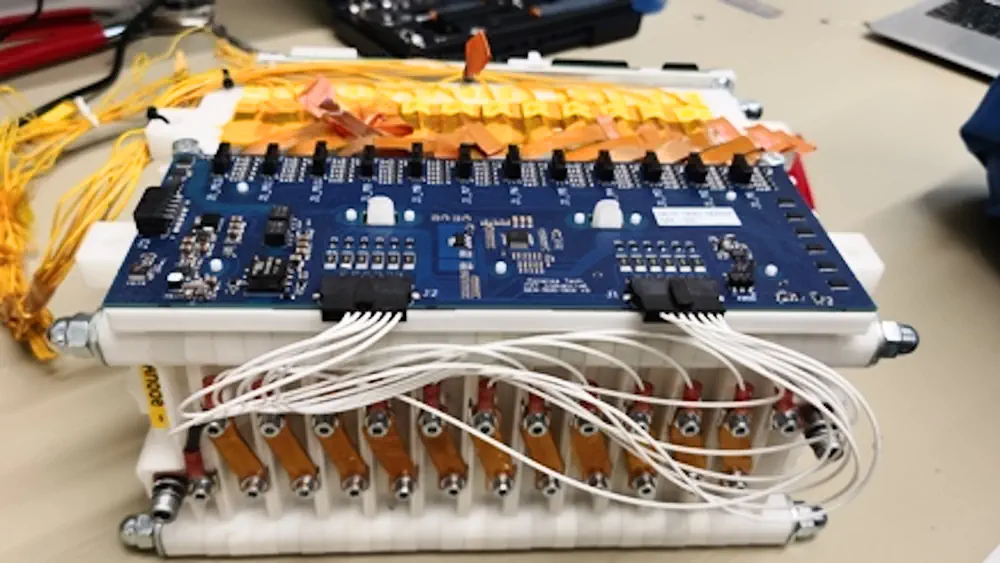
Para demostrar la escalabilidad de las nuevas tecnologías, los socios del proyecto construyeron un módulo de batería listo para usar, completo con controles y software, como los que se utilizan en los automóviles eléctricos. Imagen: FPT Motorenforschung AG Retos técnicos e industriales superados

A pesar de sus éxitos, los equipos se enfrentaron a grandes obstáculos. La pandemia interrumpió las colaboraciones internacionales, mientras que las cadenas de suministro inestables y la inflación de los productos básicos desaceleraron algunos avances. Además, aunque los prototipos producidos han alcanzado un rendimiento alentador, todavía están lejos de los estándares requeridos para la producción en masa en una gigafábrica.

“Todas las innovaciones se han trasladado a escala piloto”, afirma Corsin Battaglia. Sin embargo, para satisfacer las necesidades industriales, en particular las de socios como Northvolt, será necesario aumentar aún más la capacidad de producción. Este paso requerirá una inversión masiva y un compromiso sostenido de financiación.

Hacia nuevos horizontes para la investigación de baterías
Más allá de SeNSE, los investigadores continúan explorando otras vías prometedoras. El proyecto IntelLiGent, lanzado bajo los auspicios de Horizonte Europa, tiene como objetivo diseñar celdas de alto voltaje libres de cobalto. Los cuatro proyectos resultantes de la misma convocatoria de propuestas formaron un grupo colaborativo, facilitando intercambios regulares entre expertos.

Los resultados obtenidos durante SeNSE ya han permitido a varios socios industriales presentar patentes y comercializar ciertas innovaciones. Huntsman, por ejemplo, ahora comercializa un aditivo conductor utilizado en electrodos desarrollados en el marco del proyecto. Esta dinámica ilustra cómo la investigación básica puede llegar rápidamente el mercado.
SeNSE El proyecto Horizonte 2020 “SeNSE” tenía como objetivo desarrollar la próxima generación de baterías de iones de litio y fortalecer la industria europea de baterías. El proyecto de cuatro años, apoyado por la UE con 10 millones de euros, fue dirigido por Empa. En el proyecto colaboraron la Universidad de Münster, el Instituto Helmholtz de Münster, la Universidad de Coventry (Gran Bretaña), el Instituto Tecnológico Austriaco AIT y el Centro de Investigación de Energía Solar e Hidrógeno de Baden-Württemberg (ZSW), así como numerosos socios industriales: el fabricante sueco de baterías Northvolt, el centro de innovación suizo FPT Motorenforschung AG de FPT Industrial, las start-ups francesas Solvionic y Enwires y el grupo químico Huntsman, que tiene un centro de investigación en Basilea.
https://www.enerzine.com/leurope-innove ... 19-2025-03
Fermat
Mensajes: 2139
Registrado: Mié Mar 02, 2022 5:42 am

Re: Notas de energías renovables

Mensaje sin leer por Fermat »

Breakthrough in Clean Energy: Palladium Nanosheets Pave Way for Affordable Hydrogen
Tokyo University, 2025.03.04 Tuesday

Scientists develop a low-cost palladium-based nanosheet catalyst that matches platinum's performance in hydrogen production
Imagen

Breakthrough in Clean Energy: Palladium Nanosheets Pave Way for Affordable Hydrogen
Hydrogen energy is emerging as a key driver of a clean, sustainable future, offering a zero-emission alternative to fossil fuels. Although it is promising, the large-scale production of hydrogen relies heavily on expensive platinum-based catalysts, and hence affordability remains a major challenge for the industry.

To surpass this, researchers from the Tokyo University of Science (TUS) have developed a novel hydrogen evolution catalyst, bis(diimino)palladium coordination nanosheets (PdDI), that offers platinum-like efficiency at a fraction of the cost. Their groundbreaking study, which was published on November 28, 2024, and made available online on January 27, 2025, in Volume 31, Issue 6 of Chemistry - A European Journal, has also been selected as a "Cover Feature" for the journal, highlighting its significance in advancing sustainable hydrogen production.

The study was led by Dr. Hiroaki Maeda and Professor Hiroshi Nishihara from TUS in collaboration with high-profiled researchers from the University of Tokyo, Japan Synchrotron Radiation Research Institute, Kyoto Institute of Technology, RIKEN SPring-8 Center, and the National Institute for Materials Science, Japan. The discovery marks a breakthrough in the hydrogen evolution reaction (HER) technology, which is a key process in green hydrogen energy generation. HER occurs in the process of electrolytic splitting of water for the generation of hydrogen. The HER catalyst electrodes, traditionally made of platinum, facilitate the conversion of nascent hydrogen ([H])―generated at the electrode surface during water splitting―into hydrogen gas (H₂). While platinum (Pt) as a HER catalyst is highly effective, its scarcity and high cost significantly increase manufacturing expenses, limiting its large-scale application.

Using a simple synthesis process and limited amounts of precious metals, the research team offered a highly efficient alternative for Pt catalysts. The team fabricated palladium-based nanosheets that could maximize catalytic activity while minimizing metal usage, drastically lowering the costs associated with H₂ production.

"Developing efficient HER electrocatalysts is key to sustainable H₂ production. Bis(diimino)metal coordination nanosheets, with their high conductivity, large surface area, and efficient electron transfer, are promising candidates," says lead researcher, Dr. Maeda. "Additionally, their sparse metal arrangement reduces material usage. Here, we have successfully developed these nanosheets using palladium metal."

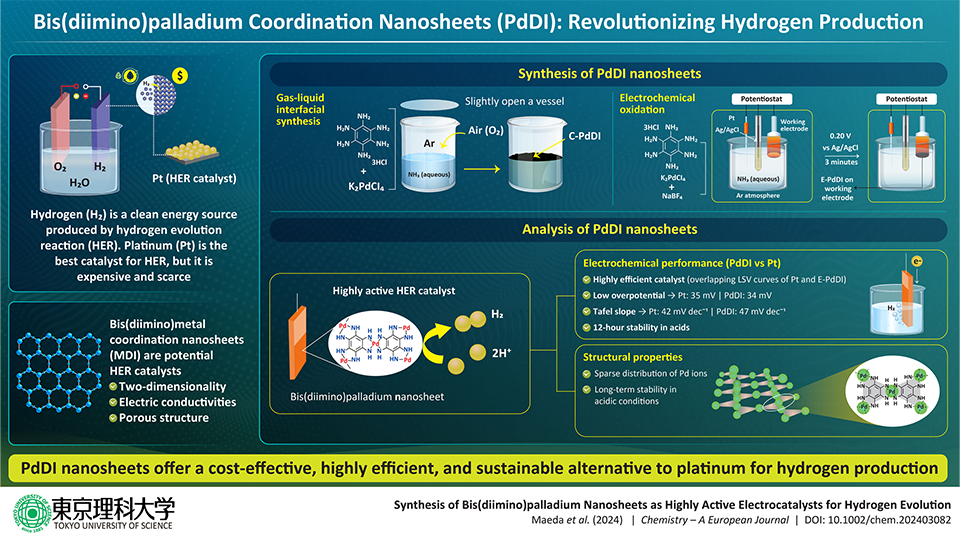
The team developed PdDI nanosheets (C-PdDI and E-PdDI) using two different methods: gas-liquid interfacial synthesis and electrochemical oxidation respectively. After undergoing the activation, the E-PdDI sheets exhibited a low overpotential of 34 mV as well as platinum's overpotential of 35 mV, which meant that very little extra energy was required to drive the hydrogen production. The exchange current density of 2.1 mA/cm² also matched the platinum's catalytic performance. The results therefore place E-PdDI among the most efficient HER catalysts developed to date, making it a promising low-cost alternative to platinum.

One of the critical aspects of any catalyst is its long-term stability. These PdDI nanosheets demonstrated excellent durability, remaining intact after 12 hours in acidic conditions, confirming their suitability for real-world hydrogen production systems. "Our research brings us one step closer to making H₂ production more affordable and sustainable, a crucial step for achieving a clean energy future," explains Dr. Maeda.

Furthermore, by minimizing the reliance on scarce and costly platinum, PdDI nanosheets align with the United Nations' Sustainable Development Goals (SDGs): SDG 7―promoting affordable and clean energy, SDG 9―industry, innovation, and infrastructure. The implications of this study extend beyond laboratory experiments. The scalability, enhanced activity, and cost-effectiveness of PdDI nanosheets make them highly attractive for industrial hydrogen production, hydrogen fuel cells, and large-scale energy storage systems.

Additionally, replacing platinum-based catalysts with PdDI could reduce mining-related emissions, accelerating the transition to a sustainable hydrogen economy. Also, the density of palladium atoms is ten times lesser than Pt atoms, reducing the dependency on precious Pt metal, and approaching for a cost-effective production of electrodes. The replacement of Pt with PdDI nanosheets is expected to produce great outcomes in automobiles, hydrogen production, and electrode-supplying industries.

As research progresses, the team at TUS aims to further optimize PdDI nanosheets for commercialization, contributing to the development of an environmentally friendly hydrogen society.

Imagen
Breakthrough in Clean Energy: Palladium Nanosheets Pave Way for Affordable Hydrogen
Image title: Highly active catalyst for hydrogen evolving reaction (HER)
Image caption: Researchers develop a highly active catalyst to replace platinum-based catalysts for affordable production of hydrogen.
Image credit: Hiroaki Maeda from Tokyo University of Science, Japan
License type: Original content
Usage restrictions: Credit must be given to the creator.


Reference:
Title of original paper: Synthesis of Bis(diimino)palladium Nanosheets as Highly Active Electrocatalysts for Hydrogen Evolution
Journal: Chemistry - A European Journal
DOI: https://chemistry-europe.onlinelibrary. ... .202403082 (NB! Artículo gratuito).
Fermat
Mensajes: 2139
Registrado: Mié Mar 02, 2022 5:42 am

Re: Notas de energías renovables

Mensaje sin leer por Fermat »

La primera vez que se escucha de este sistema. Habrá que ver los resultados para juzgar.

Calefacción urbana: primeros paneles geotérmicos en un estacionamiento francés
Axel Ker, L'Energeek, 03-Mar-2025

Imagen
Calefacción urbana: primeros paneles geotérmicos en un aparcamiento en Francia | L’Energeek

París quiere redefinir la calefacción urbana y acelerar la transición energética. La ciudad inauguró el 27 de febrero de 2025 un experimento inédito: la utilización de paneles geotérmicos instalados en las paredes de un estacionamiento subterráneo.

Un estacionamiento transformado en fuente de energía renovable
París está intentando un enfoque innovador para reducir su huella energética. En un edificio de viviendas sociales del distrito 11, un estacionamiento subterráneo se usa como suministro de agua caliente y calefacción. El experimento consiste en la instalación de 145 paneles geotérmicos de aluminio fijados a las paredes del sótano, capaces de captar la energía térmica natural del suelo.

La gran ventaja de estos paneles geotérmicos, creados por la start-up suiza Enerdrape, es que no requieren ninguna perforación, lo que los hace especialmente interesantes y prometedores para su aplicación en zonas urbanas. La energía captada se redistribuye mediante una bomba de calor, lo que permite cubrir el 25% de las necesidades de agua caliente de las 72 viviendas del edificio, especifica el comunicado de prensa del ayuntamiento de París. Paris Habitat, que financia con 100 000 euros el experimento, ve en este proyecto una palanca estratégica para aprovechar de forma diferente la infraestructura subterránea, reduciendo a la vez la dependencia de los combustibles fósiles y las facturas domésticas.

¿Hacia una generalización de los paneles geotérmicos?
Con más de 190.000 plazas de estacionamiento, con 70.000 de ellas gestionadas por Paris Habitat, esta primera experiencia parece muy prometedora para la calefacción urbana.

Este proyecto se inscribe en los objetivos del Plan Climático de París, que pretende aumentar la cuota de energía renovable y recuperada al 10% del consumo local de aquí a 2030. Engie Solutions, a través de su filial CIEC, apoya el experimento y podría considerar un acuerdo de exclusividad con Enerdrape para un despliegue más amplio.

https://lenergeek.com/2025/03/03/chauff ... hermiques/

Video de la compañia fabricante del sistema:
Fermat
Mensajes: 2139
Registrado: Mié Mar 02, 2022 5:42 am

Re: Notas de energías renovables

Mensaje sin leer por Fermat »

Lithium needed for the battery revolution could be harvested from lakes
Ian Mundell, Imperial College, London, 12 March 2025

Imagen
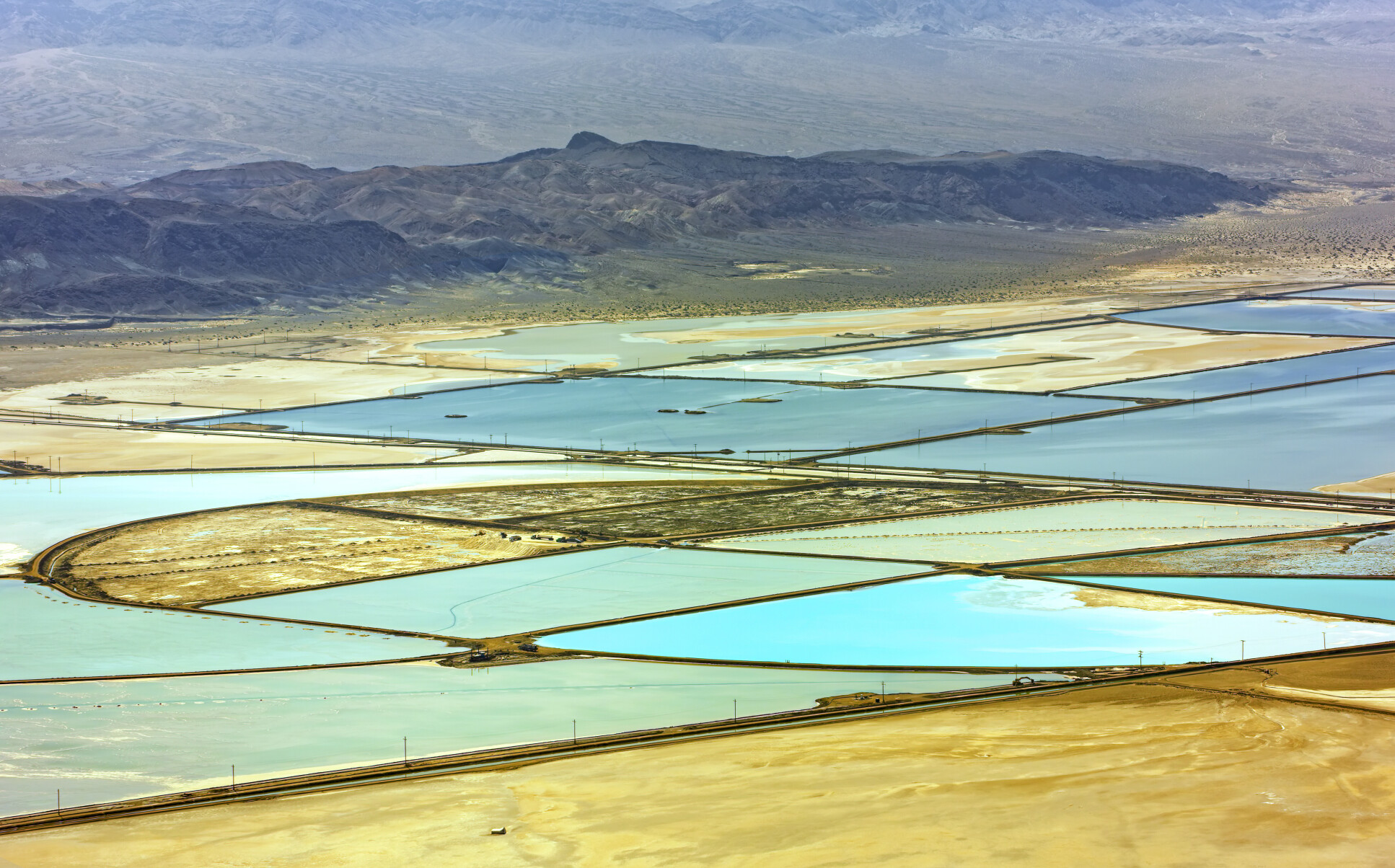
Salt lake brines hold untapped reserves of lithium

Lithium can be harvested efficiently from brines thanks to an innovative membrane developed at Imperial.

Demand for lithium is rising due to its use in batteries for mobile devices, cars and clean energy storage. Securing access to natural deposits of the mineral is now matter of strategic importance, but lithium can be found elsewhere in nature.

As an alternative to mining, Imperial researchers have created a technology that could be used to efficiently extract it from saltwater sources such as salt-lake brines or geothermal brine solutions.

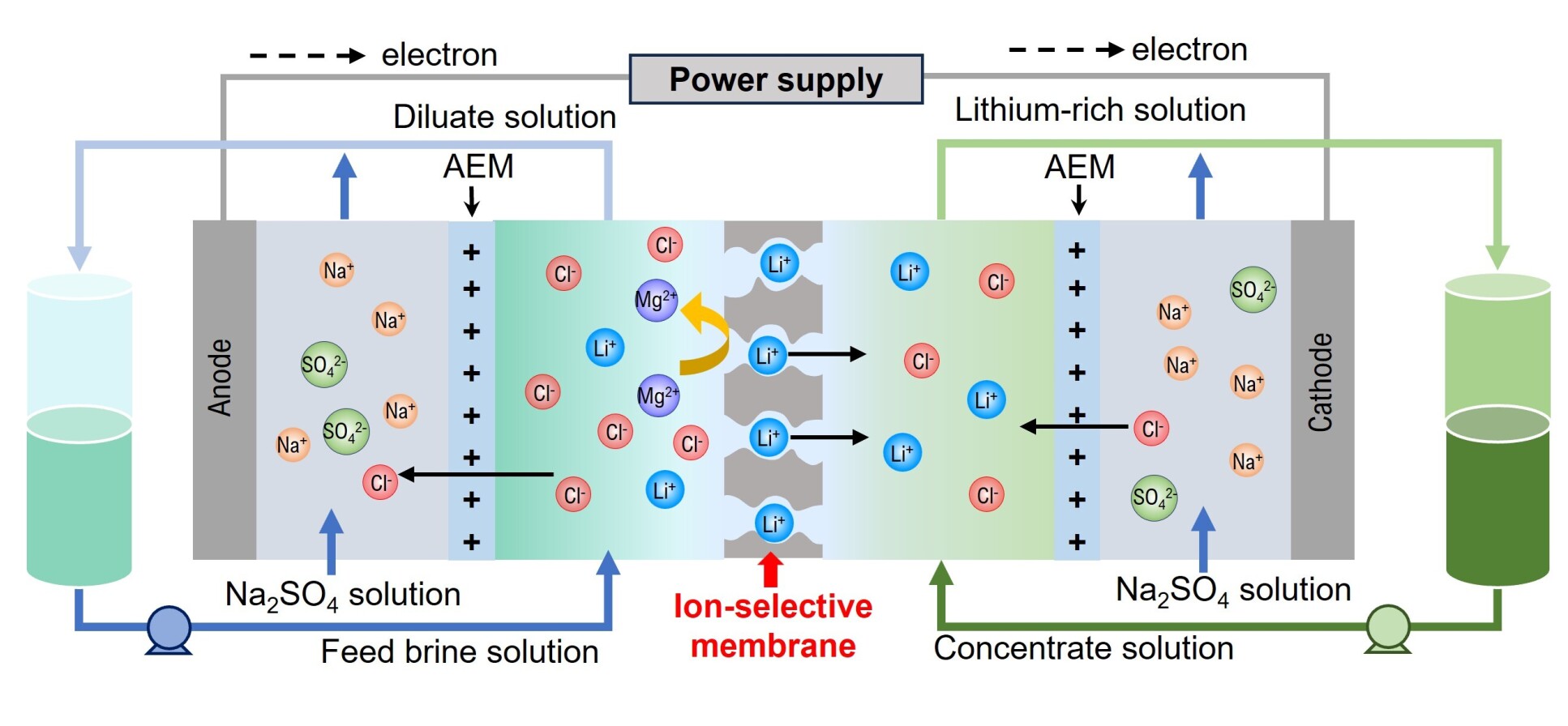
Conventional lithium extraction from brines takes months and uses significant amounts of water and chemicals, generating greenhouse gas emissions in the process. The alternative developed by Dr Qilei Song and his team in the Department of Chemical Engineering uses a membrane that separates lithium from salt water by filtering it through tiny pores.

Imagen
Lithium mines, such as Silver Peak in Nevada, use evaporation to concentrate the metal in vast ponds. (Getty Images)

The usual shortcoming with this approach is that the pores also let through magnesium and other contaminants, but the team have developed a class of special polymers that are highly selective for lithium. Details of the method, and how it can be scaled up for practical application, have just been published in the journal Nature Water*.

Polymers of intrinsic microporosity
For more than a decade, Dr Song has been working on a new generation of synthetic polymer membranes, based on materials known as polymers of intrinsic microporosity (PIMs). These polymers are shot through with tiny, hour-glass shaped micropores that provide ordered channels through which small molecules and ions can travel.

In this new study, Dr Song’s team fine-tuned the micropores to become highly selective for lithium. Used in an electrodialysis device, the lithium ions are effectively pulled through the membrane micropores by an electrical current, while larger magnesium ions are left behind.Graphic of electrodialysis systemTested on simulated salt-lake brines, these PIM membranes were highly selective for lithium, and produced high purity battery-grade lithium carbonate.

Imagen

If these membranes are to be of practical use, however, they must be produced in large quantities. Fortunately, the polymers are soluble in common solvents and can be turned into membranes using established industrial techniques.

“The polymer synthesis routes are based on commercially available monomers and simple chemical modifications, which makes scaling up the membranes relatively easy,” said Dingchang Yang, a PhD student in Dr Song’s group who led the experimental work. They can also be incorporated easily into commercial membrane modules and combined with other separation processes, which will also speed their use.

Commercial prospects
Imperial has filed patent applications for these membranes and a range of different uses, including lithium extraction. Dr Song is now working with Imperial Enterprise and ChemEng Enterprise, the technology transfer initiative of the Department of Chemical Engineering, to explore potential commercialisation of the technology.

“We are in the process of establishing a climate tech company and are keen to build partnerships with companies to extract lithium at a large scale using real brine solutions,” he said.
We are keen to build partnerships with companies to extract lithium at a large scale using real brine solutions.
Dr Qilei Song
Department of Chemical Engineering
Isolating lithium is just the beginning of the potential for these high-selectivity membranes. “This technology has tremendous potential in a variety of commercially important areas, from energy storage to water purification to recovery of critical materials in a circular economy,” said Professor Sandro Macchietto, Director of Enterprise in the Department of Chemical Engineering.

One line of investigation will apply the ion-exchange polymers and selective electrodialysis to the extraction of copper and other metal ions from mining process waters. “This links well with the sustainable extraction of critical materials, which is being pursued by the Rio Tinto Centre for Future Materials at Imperial,” Dr Song said.

In addition to Dr Song’s team, the research on lithium extraction was carried out with support from Professor Magda Titirici and Professor Nilay Shah in the Department of Chemical Engineering, Professor Kim Jelfs’ group in the Department of Chemistry, and colleagues from the University of Birmingham, University College London, the University of Edinburgh, the Institut Laue Langevin in Grenoble, and the University of Science and Technology of China in Hefei.

Solution-processable polymer membranes with hydrophilic subnanometre pores for sustainable lithium extraction
Dingchang Yang, Yijie Yang, Toby Wong, Sunshine Iguodala, Anqi Wang, Louie Lovell, Fabrizia Foglia, Peter Fouquet, Charlotte Breakwell, Zhiyu Fan, Yanlin Wang, Melanie M Britton, Daryl R Williams, Nilay Shah, Tongwen Xu, Neil B. McKeown, Maria-Magdalena Titirici, Kim E Jelfs, Qilei Song.
Nature Water 2025. https://doi.org/10.1038/s44221-025-00398-8 (NB! Artículo gratuito).

https://www.imperial.ac.uk/news/261774/ ... harvested/
Fermat
Mensajes: 2139
Registrado: Mié Mar 02, 2022 5:42 am

Re: Notas de energías renovables

Mensaje sin leer por Fermat »

Plantas solares flotantes: electricidad limpia desde aguas más limpias
Erneurbare Energien, 13 de marzo de 2025
Imagen
La planta Seekdorn, situada en un lago cerca de Zwolle (Holanda), fue uno de los generadores examinados. - © Velka Botička © Velka Botička

Los sistemas solares flotantes no tienen perjudican la calidad del agua de los lagos. Un estudio ha demostrado que la vegetación tampoco se ve afectada. La legislación debería adaptarse en consecuencia.

El potencial de las plantas solares flotantes en Alemania, Austria y Suiza es grande. Sin embargo, hasta ahora sólo unos pocos cuerpos de agua artificiales se utilizan para producir energía solar. A nivel mundial, se han construido cerca alrededor de 5,6 gigavatios de potencia fotovoltaica flotante, la mayor parte en Asia. Solo flotan en aguas europeas unos 500 megavatios de energía solar.

Tres lagos analizados
Una de las razones es la incertidumbre sobre cómo afectarán los sistemas solares a la ecología acuática. Konstantin Ilgen, del Fraunhofer ISE, ya puede dar su aprobación. Examinó tres lagos en Suiza, Países Bajos y Alemania donde se habían instalado plantas de energía solar. Hasta ahora, el sistema de la energía fotovoltaica flotante apenas ha sido investigado, lo que tiene implicancias en la legislación. Por ejemplo, en Alemania, los paneles solares sólo pueden cubrir el 15 por ciento de la superficie del agua y deben mantener una distancia de 40 metros de la orilla.

Impacto bajo
Esto reduce significativamente el potencial de la energía fotovoltaica flotante en Alemania. Sin embargo, las reglas no se basan en estudios concretos. El grupo del Fraunhofer ISE dirigido por Konstantin Ilgen ha logrado cerrar esta brecha. El resultado de su estudio, que presentó en el Simposio Fotovoltaico de este año en Bad Staffelstein: El impacto de la energía fotovoltaica en la ecología de los cuerpos de agua es mínimo.

En concreto, se centró en la calidad del agua y el crecimiento de las plantas acuáticas en los tres lagos. Aquí los macrófitos fueron de especial interés. Son las plantas acuáticas que crecen cerca de la orilla, realizan la fotosíntesis y por tanto dependen de la luz. A más distancia de la orilla, menos crecen estas plantas.

Vegetación Cartografiada
Además, hubo un examen de los efectos del sistema solar sobre la temperatura del agua y un análisis químico. El impacto de los sistemas solares sobre las masas de agua depende, entre otras cosas, de la estructura de las masas de agua. La planta solar en Suiza fue construida sobre un depósito de agua que de todos modos se vacía y se vuelve a llenar con frecuencia. “De todos modos, su calidad ecológica no es muy buena”, explica Konstantin Ilgen. “Encontramos una mayor diversidad de plantas y animales en el lago de Alemania”.

El cartografiado de macrófitos en los lagos ha demostrado que no crecen muy adentro del lago. En total, los investigadores contaron 15 especies diferentes. Muchas de ellas eran especies invasoras que en realidad no crecen en los lagos. Se encontraron especies muy valiosas en raras ocasiones.

La calidad del agua se mantiene (básicamente) estable
La calidad del agua tampoco se ve afectada en gran medida por los sistemas solares. El cambio de la temperatura del agua en los lagos de los Países Bajos y Alemania está dentro de los límites de las imprecisiones de medición y, por lo tanto, no es significativo. Sin embargo, los científicos han observado un mayor enfriamiento en el lago de Suiza. Sin embargo, estos no se deben al sistema solar, sino al ingreso de nieve derretida de las montañas.

El agua se vuelve más clara
Los investigadores incluso observaron una disminución de la turbidez en las aguas de Alemania. “Esto se debe a que muchos mejillones se depositan en la subestructura del sistema solar y filtran el agua”, explica Konstantin Ilgen.

Esto fue relevante porque el cuerpo de agua estudiado es un lago de grava con una entrada rica en sedimentos. Esto provoca la entrada de mucha materia suspendida en el lago, lo que implica que menos plantas pueden asentarse. “Simulamos el estado natural del lago, qué pasaría si no se hiciera ningún dragado. En este caso, el asentamiento de macrófitos se expandiría”, dice Ilgen.

La profundidad del agua es (el factor) crucial
Los desarrolladores del proyecto pueden aprovechar los resultados generales del estudio para posicionar la planta solar de tal manera que tenga poco impacto en la calidad del agua o incluso la mejore. Sin embargo, los resultados también muestran que los requisitos legales no aportan ningún fundamento científico.

“Sólo encontramos macrófitos en la zona de la orilla”, dice Ilgen. Sin embargo, esta zona aún está lejos de los 40 metros exigidos por la ley. “En este caso, la profundidad del agua sería un criterio más útil, ya que es el factor decisivo para la colonización por macrófitos. “La distancia de 40 metros desde la orilla no tiene sentido”, dice Konstantin Ilgen.

https://www.erneuerbareenergien.de/tech ... gewaessern
Fermat
Mensajes: 2139
Registrado: Mié Mar 02, 2022 5:42 am

Re: Notas de energías renovables

Mensaje sin leer por Fermat »

Esta es casi una noticia en desarrollo. Será cuestión de ver como resulta.

Terabase raises US$130 million to scale up automated project construction work
JP Casey, March 14, 2025

Imagen
Terabase has now raised US$200 million to support its work. Credit: Terabase.

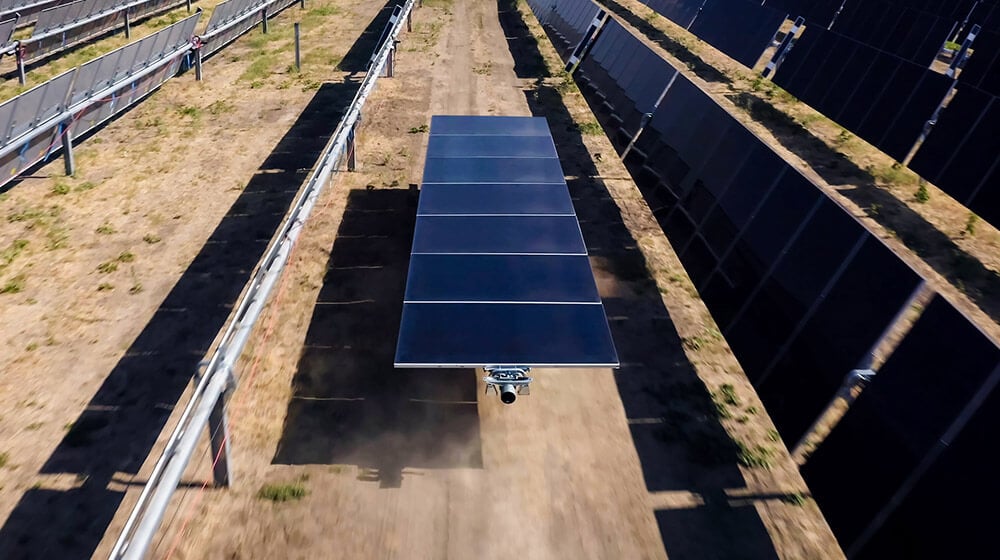
US solar technology firm Terabase Energy has raised US$130 million in finance to support the scale-up of its Terafab solar project assembly line, which uses robotics to improve module installation time and project efficiency.

The latest round of financing comes through the SoftBank Vision Fund, a technology-focused investment fund, and brings the total volume of capital raised for Terabase to US$200 million.

The company noted that the money would be used to help expand the reach of its Terafab programme, and help “reduce costs and construction times for solar power plants,” which have become increasingly important as demand for renewable power has grown.

“The surge in energy demand, particularly from AI data centres, underscores the urgency of scalable, sustainable solutions,” said Kentaro Matsui, managing partner at SoftBank Global Advisers. According to the Electric Power Research Institute, data centres are expected to account for more than double the US’ power demand by 2030 than they do presently.

“Terabase’s innovative approach to digitalising and automating solar power plant deployment positions it as a leader in this transition,” added Matsui.

This “innovative approach” includes the Terafab programme, which Terabase has described as a “factory to make factories”. Terafab uses robotics and automation to perform some of the engineering, procurement and construction (EPC) work typically done by humans at solar plants, which Terabase says can improve the operational efficiency of such projects by 25%.

Terabase used its Terafab approach at the White Wing Ranch solar farm in Texas in 2023, and in the following weeks, CEO and founder Matt Campbell told PV Tech Premium that the system can help tackle what he described as an “epidemic” of poor quality in the EPC industry. Terabase has already used its Terafab system to install 40MW of solar capacity at commercial projects in the US, and expects to install “hundreds of megawatts” of new solar capacity by the end of next year.

https://www.pv-tech.org/terabase-raises ... tion-work/
Fermat
Mensajes: 2139
Registrado: Mié Mar 02, 2022 5:42 am

Re: Notas de energías renovables

Mensaje sin leer por Fermat »

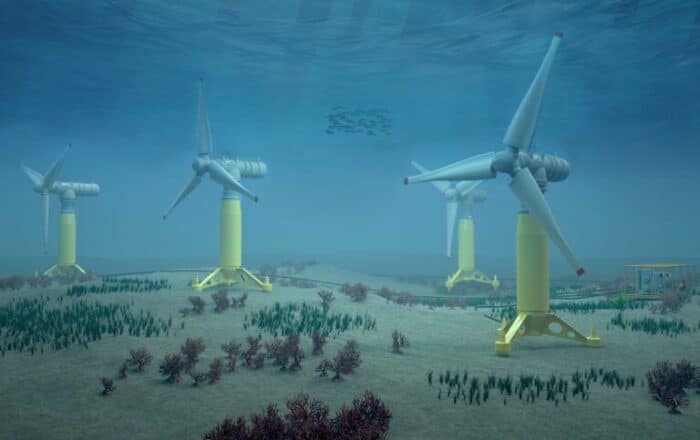
Esto parece una nota de prensa sobre un proyecto experimental que se ve interesante. Habrá que esperar resultados la operación del sistema.

Un monstruo de acero bajo el agua: esta turbina alimenta por sí sola 15.000 hogares
Gabin B., l’energeek, 17 de marzo de 2025
El proyecto NH1 de Cherburgo podría transformar la energía maremotriz en Francia, con un potencial de 6 GW de aquí a 2030.

Imagen
Un monstruo de acero bajo el agua: estas turbinas alimenta por sí mismas 15.000 hogares | L’EnerGeek

El proyecto NH1, ubicado en Cherburgo (Francia), representa un punto de inflexión en el mundo de las energías renovables. Se trata de una instalación de turbinas maremotriz diseñada para captar la energía de las corrientes oceánicas y contribuir así a los objetivos de transición energética fijados para 2030. Gracias a la financiación de 31,3 millones de euros concedida por el Fondo de Innovación de la Unión Europea 2023, NH1 se posiciona como líder en el desarrollo de soluciones bajas en carbono.

Un impulso europeo
El proyecto NH1 se beneficia de un importante apoyo financiero de 31,3 millones de euros del Fondo de Innovación de la Unión Europea 2023, con un presupuesto total de 4.800 millones de euros. Esta financiación tiene como objetivo fomentar tecnologías innovadoras y respetuosas del medio ambiente. La selección de NH1 entre los 85 proyectos “Zero-Net” seleccionados demuestra sus perspectivas en términos de reducción de emisiones de gases de efecto invernadero y desarrollo tecnológico.

En línea con la estrategia francesa en materia de energía renovable, el proyecto está ubicado en Alderney Race, que ofrece un potencial de energía mareomotriz de hasta 5 GW. NH1 pretende producir 34 GWh al año en 2028, lo que proporcionaría electricidad a unas 15.000 personas (sic). A largo plazo, el sitio podría tener una capacidad de hasta 6 GW y generar entre 15 y 18 TWh, suficiente para abastecer a casi 8 millones de personas (esta capacidad ilustra claramente el tamaño del proyecto).

Tecnología innovadora y beneficios económicos
El núcleo tecnológico se basa en el aerogenerador de eje horizontal Proteus AR3000, desarrollado por Proteus Marine Renewables. Considerada la turbina más potente y eficiente actualmente en operación comercial, su ingenioso diseño le permite producir mucha energía con muy poco impacto en la vida marina circundante.

En el aspecto económico, se espera que NH1 cree alrededor de 400 empleos directos e indirectos a nivel local. Además, todo el sector de la energía mareomotriz podría generar hasta 6.000 nuevos empleos en Francia de aquí a 2030. Una gran parte de los componentes utilizados procede de proveedores franceses, lo que apoya la actividad económica local y nacional.

Activos ambientales y fortaleza de los socios
Las turbinas hidroeléctricas desplegadas en el marco de NH1 presentan varias ventajas para la energía renovable. Están totalmente sumergidas, lo que evita cualquier molestia visual o acústica en las costas. Su diseño permite además un fácil reciclaje al final de su vida útil, reduciendo así su huella ecológica.

El éxito del proyecto también depende de la estrecha colaboración con diversos socios. Estos incluyen: --EFINOR, especializada en ingeniería y fabricación.
-Proteus Marine Renewables, con su experiencia tecnológica.
-Participaciones Normandía, que proporciona apoyo financiero regional.

Katia Gautier, directora de Normandie Hydroliennes, indica que “esta financiación nos permitirá implementar nuestra solución innovadora y competitiva”.

Para seguir el progreso del proyecto u obtener más información sobre sus posibles beneficios, visite el sitio web https://normandiehydroliennes.fr/

https://lenergeek.com/2025/03/17/un-mon ... lle-seule/
Fermat
Mensajes: 2139
Registrado: Mié Mar 02, 2022 5:42 am

Re: Notas de energías renovables

Mensaje sin leer por Fermat »

Hidrógeno verde a 4 dólares el kilo: la apuesta de Corea por un futuro energético sin carbono
Enerzine, 19-Mar-2025

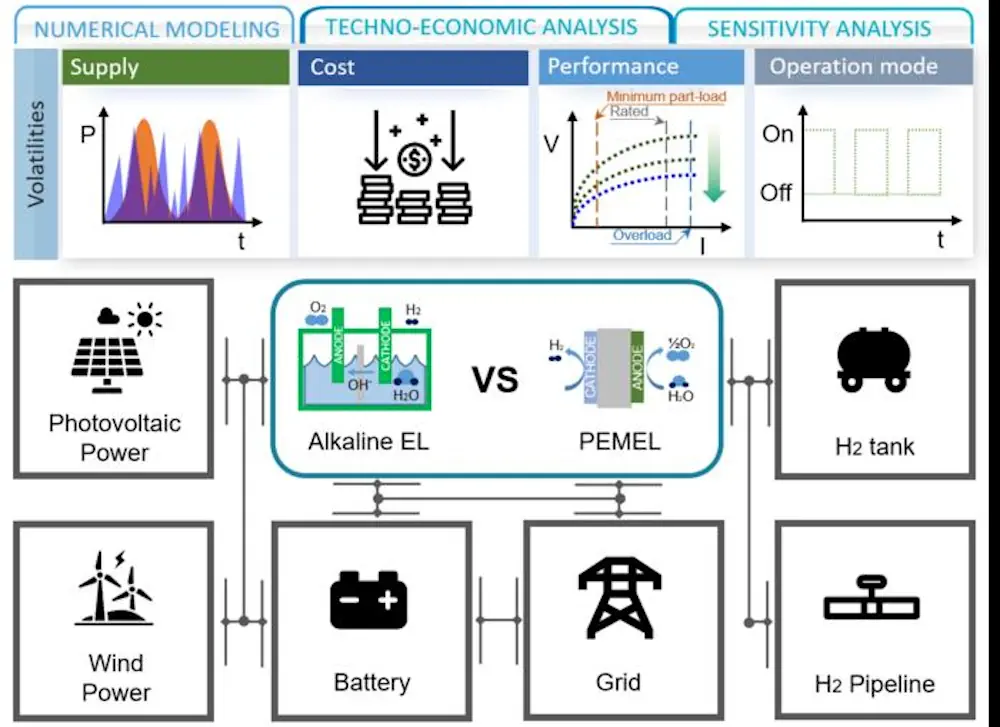
La transición energética se acelera y la producción de hidrógeno verde se enfrenta a un dilema tecnológico: ¿cómo conciliar rentabilidad y sostenibilidad? Un estudio coreano explora las sinergias entre los electrolizadores alcalinos y de membrana de intercambio de protones (PEM), revelando nuevas estrategias para optimizar costos y eficiencia.

A medida que el hidrógeno verde emerge como un pilar de las economías sin combustibles fósiles, un equipo de investigadores del Instituto Coreano de Investigación Energética (KIER) ha examinado las tecnologías de electrólisis del agua, evaluando su desempeño económico y técnico. Dirigidos por el Dr. Joungho Park, los científicos compararon dos procesos dominantes (electrólisis alcalina y electrólisis de membrana PEM) para identificar vías de optimización financiera y ambiental. Sus hallazgos, publicados recientemente, proporcionan un marco de toma de decisiones para futuras inversiones en un sector aún en construcción.

Dos tecnologías, desafíos asimétricos
El hidrógeno verde, producido mediante electrólisis del agua con energías renovables, se basa principalmente en dos métodos. La electrólisis alcalina, una tecnología clásica, permite una producción a gran escala a menor coste gracias a su electrolito líquido (como el hidróxido de potasio). Por otra parte, su dependencia del suministro eléctrico estable la hace poco compatible con la intermitencia de la energía solar o eólica. “Los ciclos repetidos de arranque y parada degradan los electrodos, reduciendo la vida útil de las instalaciones”, destaca el estudio.

Por el contrario, la electrólisis PEM, aunque es más costosa de instalar, ofrece una mayor flexibilidad: tolera variaciones de potencia y puede funcionar con aportes eléctricas mínimos, lo que es ideal para energías renovables intermitentes. Sin embargo, su fase de desarrollo menos avanzada y sus elevados costes iniciales están dificultando su uso masivo.

Estrategias económicas: entre el pragmatismo y la transición
Para sortear las limitaciones, el equipo de KIER modeló escenarios de hibridación. En cuanto a la electrólisis alcalina, utilizar la red eléctrica existente como fuente complementaria resulta ser la solución más rentable a corto plazo. Según sus cálculos, combinar renovables con energía parcial (20%) de la red fósil reduce el coste de producción a 6,60 dólares/kg, frente a los 8,60 dólares/kg con un sistema de almacenamiento (baterías). Un ahorro importante, pero que no resuelve los problemas ambientales.

"A largo plazo, será esencial sustituir gradualmente la electricidad generada con combustibles fósiles por fuentes libres de carbono (nuclear, biomasa o energías renovables combinadas con almacenamiento eficiente)", afirma el informe. Una transición que dependerá de la reducción de los costes de los sistemas de almacenamiento (ESS), todavía muy caros para garantizar la rentabilidad de las energías verdes.

Imagen
Marco conceptual para un análisis técnico-económico comparando la electrólisis alcalina y la electrólisis PEM del agua. Crédito: KIER

Electrólisis PEM: flexibilidad versus rendimiento
En el lado del electrolizador PEM, los investigadores han identificado una ventaja poco conocida: la sobrecarga eléctrica. Al aprovechar su capacidad para soportar picos de energía (hasta 1,5 veces lo normal), se puede maximizar la producción de hidrógeno durante los períodos de sobreproducción. El método reduce el costo a $5,80/kg, una reducción del 12% en comparación con el uso estándar.

Este método, sin embargo, requiere un acceso privilegiado a fuentes renovables abundantes y estables. “Las zonas con alto potencial eólico o solar, como los desiertos o las costas, serían las más propensas a beneficiarse”, señala el estudio.

Aplicadas al contexto coreano, estas conclusiones definen una hoja de ruta pragmática. Al cruzar datos meteorológicos de la isla de Jeju, el equipo simuló un sistema que combina 100 MW de electrólisis alcalina, 100 MW de energía eólica marina y 100 MW de energía solar. Resultado: una producción estable de hidrógeno en torno a los 4 dólares/kg, un umbral competitivo en comparación con los combustibles fósiles.

"Este modelo ilustra la importancia de la hibridación tecnológica", explica el Dr. Park. “En Corea, donde la red eléctrica sigue basándose en gran medida en combustibles fósiles, centrarse en la electrólisis alcalina combinada con fuentes verdes emergentes, como el hidrógeno producido por reactores nucleares, podría acelerar la transición.»

Hacia una estandarización de las decisiones estratégicas
El estudio destaca finalmente la importancia del indicador LCOH (coste nivelado del hidrógeno), que integra todos los gastos de inversión y operación. Si bien la Unión Europea apunta a un LCOH de 1,8 dólares/kg para 2030, los escenarios coreanos muestran que este objetivo requiere una reducción drástica de los costos de los electrolizadores y los sistemas de almacenamiento.

“Las políticas públicas deberán priorizar los subsidios para tecnologías emergentes como PEM, al tiempo que apoyan la I+D en materiales resistentes a ciclos de potencia variables”, concluye el Dr. Park. Un enfoque equilibrado, donde la innovación y el pragmatismo económico guiarán la búsqueda de hidrógeno verdaderamente verde.

Léxico técnico
Hidrógeno verde: Hidrógeno producido a través de la electrólisis del agua alimentado por energías renovables.
Electrólisis alcalina: proceso que utiliza un electrolito líquido (por ejemplo, hidróxido de potasio) para separar el agua en hidrógeno y oxígeno.
Electrólisis PEM: Tecnología de membrana sólida que permite una producción flexible de hidrógeno, adecuada para fuentes intermitentes.
LCOH: Costo nivelado de producción de hidrógeno, calculado dividiendo los costos totales (de capital y operativos) por la cantidad de hidrógeno producido.

Datos clave
Costo de producción con ESS: $8,60/kg (electrólisis alcalina + almacenamiento de 500 MWh).
Costo con red fósil: $6,60/kg (20% de energía de la red).
Costo óptimo de PEM: $5,80/kg (recargo eléctrico 1,5x).
Objetivo coreano: 4 dólares/kg mediante una combinación de energía eólica, solar y electrólisis alcalina.

Article : Comparative techno-economic evaluation of alkaline and proton exchange membrane electrolysis for hydrogen production amidst renewable energy source volatility (NB! Por subscripción)

https://www.enerzine.com/lhydrogene-ver ... 09-2025-03
Fermat
Mensajes: 2139
Registrado: Mié Mar 02, 2022 5:42 am

Re: Notas de energías renovables

Mensaje sin leer por Fermat »

Películas biodegradables para proteger las células solares: una innovación finlandesa
Enerzine, 22-Mar-2025

Un equipo de investigadores de la Universidad de Turku, Finlandia, está explorando una vía innovadora para mejorar la durabilidad de los paneles solares: el uso de materiales de origen biológico como filtros UV. Su estudio, realizado en colaboración con la Universidad Aalto y la Universidad de Wageningen en los Países Bajos, revela que las películas a base de nanocelulosa (Wikipedia) tratadas con extractos de cáscara de cebolla roja ofrecen una protección excepcional contra la radiación ultravioleta, al tiempo que mantienen una transmisión óptima de la luz visible. Estos resultados, publicados como parte del proyecto BioEST financiado por la Academia de Finlandia, podrían redefinir los estándares de protección de las células fotovoltaicas, que actualmente están protegidas en su mayoría por películas petroquímicas.

Las células solares, diseñadas para convertir la luz en electricidad, siguen siendo vulnerables a la degradación inducida por los rayos UV. Las películas protectoras tradicionales, basadas en fluoruro de polivinilo (PVF) o tereftalato de polietileno (PET), proporcionan una barrera eficaz pero dependen de recursos fósiles no renovables. En un contexto de transición ecológica, los materiales biodegradables como la nanocelulosa surgen como una alternativa atractiva. Producida a partir de fibras de celulosa fragmentadas a escala nanométrica, esta sustancia vegetal posee notables propiedades mecánicas y ópticas, modulables mediante tratamientos químicos o biológicos.

El estudio finlandés destaca por su enfoque comparativo único: los investigadores analizaron la evolución en el tiempo de cuatro tipos de películas basadas en nanofibras de celulosa, tratadas respectivamente con extractos de cáscara de cebolla roja, lignina e iones ferrosos. Estos tres agentes son reconocidos por su capacidad de absorber los rayos UV, pero su rendimiento a largo plazo sigue siendo desconocido. Después de 1.000 horas de pruebas bajo luz artificial, simulando la exposición de un año en un clima europeo templado, los resultados fueron concluyentes.

Nanocelulosa coloreada, campeona de la protección UV
La película impregnada con extracto de cebolla roja demostró ser la más efectiva, bloqueando el 99,9% de la radiación UV hasta 400 nanómetros, superando incluso a los filtros PET comerciales. "Esta solución combina una protección óptima y una transparencia adecuada para aplicaciones fotovoltaicas", destaca Rustem Nizamov, estudiante de doctorado de la Universidad de Turku. A diferencia de la lignina, cuyo color marrón limita su uso en películas transparentes, el extracto de cebolla roja conserva una transmisión superior al 80% de la luz visible, particularmente en longitudes de onda entre 650 y 1100 nm, esenciales para la producción de energía.

Otra ventaja es la estabilidad en el tiempo de las propiedades ópticas. Las películas tratadas con iones de hierro, aunque inicialmente eficientes, vieron caer su transparencia con el envejecimiento. Por su parte, la película de cebolla ha conservado sus características, una cualidad esencial para aplicaciones exteriores sujetas a condiciones climáticas variables. Los investigadores también monitorearon visualmente el estado de las células solares protegidas, usando fotografías digitales para identificar cualquier degradación.

Imagen
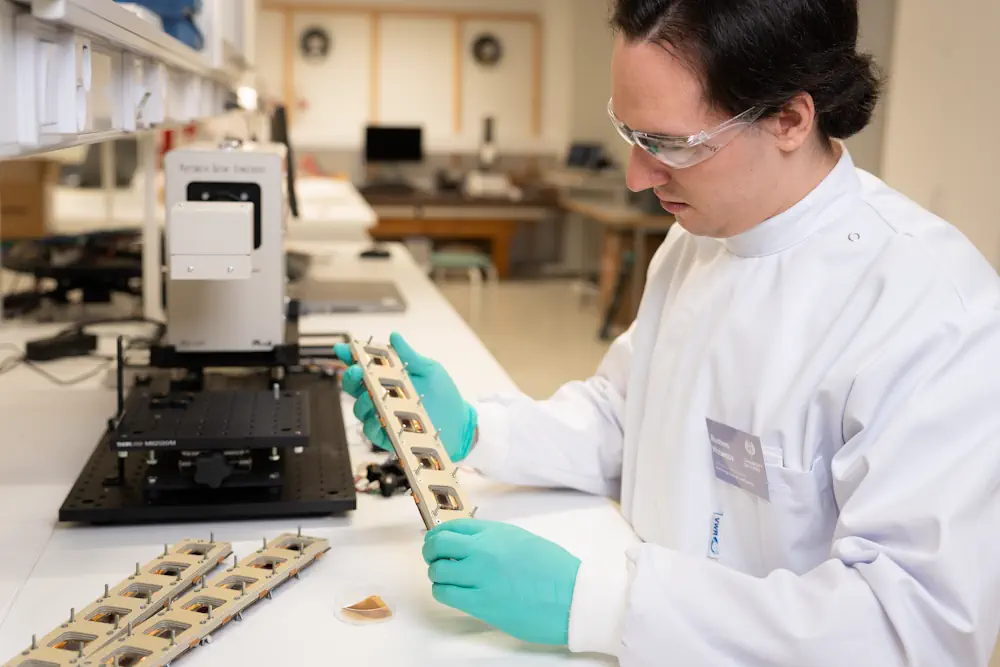
Rustem Nizamov, investigador de doctora ... nttalainen

Hacia aplicaciones más sostenibles
Las pruebas se efectuaron en células solares sensibilizadas con colorante (DSSC), particularmente sensibles al daño UV. Sin embargo, los hallazgos podrían aplicarse potencialmente a otras tecnologías, como las células de perovskita o la energía fotovoltaica orgánica, cuyo despliegue a gran escala requiere materiales respetuosos con el ecosistema. "Estos filtros también podrían ser de interés para la industria del envasado de alimentos, donde sensores solares biodegradables integrados en los productos podrían alimentar dispositivos de trazabilidad", anticipa Nizamov.

El equipo de investigación ahora planea desarrollar células solares biodegradables (“compostables”), en asociación con la industria forestal finlandesa, que ya está involucrada en la recuperación de biomasa. "Los actores de la industria buscan diversificar sus productos de alta gama, especialmente en el campo de los componentes electrónicos", afirma Kati Miettunen, profesora de ingeniería de materiales en Turku.

Un paso más cerca de la energía solar circular
Este avance se enmarca en una dinámica más amplia: la integración de las energías renovables en un modelo circular, donde cada componente está diseñado para ser reciclado o reintegrado a la naturaleza. El grupo de investigación de Materiales y Sistemas de Energía Solar (SEMS) en Turku también está trabajando para optimizar todos los sistemas fotovoltaicos, desde su fabricación hasta el final de su vida útil.

Aunque las películas basadas en nanocelulosa aún no están listas para la producción industrial, este estudio demuestra su potencial para conciliar el rendimiento técnico y el respeto por el medio ambiente. A medida que la demanda mundial de energía solar continúa creciendo, innovaciones como esta podrían acelerar el reemplazo de plásticos derivados del petróleo por alternativas de origen vegetal, garantizando al mismo tiempo la longevidad de las instalaciones. Una transición silenciosa pero significativa para el futuro de la energía limpia.

Articulo : « Sustainable Nanocellulose UV Filters for Photovoltaic Applications: Comparison of Red Onion (Allium cepa) Extract, Iron Ions, and Colloidal Lignin » https://pubs.acs.org/doi/10.1021/acsaom.4c00484 (Acceso libre).

https://www.enerzine.com/des-films-biod ... 49-2025-03
Fermat
Mensajes: 2139
Registrado: Mié Mar 02, 2022 5:42 am

Re: Notas de energías renovables

Mensaje sin leer por Fermat »

Green and Efficient Strategy for Recycling Lithium-Ion Batteries
AZO_materials, Reviewed by Lexie Corner, Mar 12 2025

In a recent study published in Angewandte Chemie, researchers developed a novel approach to extract lithium and other valuable metals from neutral solutions. The method uses the hydrometallurgical process, which is low-cost, highly effective, and environmentally friendly. The addition of the amino acid glycine and a solid-solid reduction mechanism, called the battery effect, both increase the leaching efficiency.

Imagen
Image Credit: Angewandte Chemie

Lithium-ion batteries are essential for powering smartphones, tablets, and electric cars, and are increasingly critical for storing erratic renewable energy. As their use grows, so does the number of spent batteries.

Recycling these batteries offers the potential to recover raw materials like lithium, cobalt, nickel, and manganese for the production of new rechargeable batteries. It also has the potential to reduce environmental impact.

Currently, hydrometallurgical reprocessing techniques for spent lithium-ion batteries rely on acid or ammonia-leaching processes. However, excessive and repeated use of acids and bases raises environmental concerns and safety risks. A pH-neutral procedure would be a safer, more environmentally friendly alternative.

The aggressive reagents required for traditional leaching methods are difficult to replace. To address this, the team led by Lei Ming and Xing Ou at Central South University, Zhen Yao at Guizhou Normal University, and Jiexi Wong at the National Engineering Research Center of Advanced Energy Storage Materials had to explore alternative solutions.

The first step in the process was the creation of "micro batteries" on the spot. These micro batteries assist in breaking down the lithium-coated nickel cobalt manganese oxide (NCM) cathode material from the spent batteries. The NCM particles are combined with sodium oxalate, an iron (II) salt, and the amino acid glycine in a neutral liquid.

This results in a thin, solid layer of iron(II) oxalate being deposited on the particles. The NCM cores act as the cathode, while the iron(II) oxalate “shell” serves as the anode (battery effect), allowing for easy electron transfer through direct contact.

Moreover, this coating prevents unwanted byproducts from adhering to the particles. An electrochemical reaction, fueled by the battery effect, reduces oxygen ions from the NCM particles to OH– ions with water, while iron (II) ions are oxidized to iron (III) ions.

As a result, the NCM layers break down, releasing the ions of manganese, nickel, cobalt, and lithium into the solution.

The second step involves the glycine "trapping" these ions in complexes. Glycine also helps to buffer the pH of the solution, maintaining it within a neutral range. After 15 minutes, 99.99 % of the lithium, 96.8 % of the nickel, 92.35 % of the cobalt, and 90.59 % of the manganese can be leached out of the spent cathodes.

This efficient, neutral solution-based leaching process could enable large-scale, environmentally friendly recycling of spent batteries. The glycine effluent can be used as fertilizer, and minimal toxic gases are produced. Compared to traditional methods, this process is cheaper and consumes significantly less energy.

Journal Reference:
Xu, Z., et al. (2025) A Green and Efficient Recycling Strategy for Spent Lithium‐Ion Batteries in Neutral Solution Environment. Angewandte Chemie International Edition.
https://onlinelibrary.wiley.com/doi/10. ... .202414899 (NB! Por subscripción)

https://www.azom.com/news.aspx?newsID=64343[url][/url]
Fermat
Mensajes: 2139
Registrado: Mié Mar 02, 2022 5:42 am

Re: Notas de energías renovables

Mensaje sin leer por Fermat »

Como se hace notar, ésta es una nota de prensa, pero estos desarrollos son interesantes a seguir.

La energía renovable se puede almacenar eficientemente en una batería de flujo redox sostenible
Nota de Prensa de Redox Storage Solutions, 24-Mar-2025

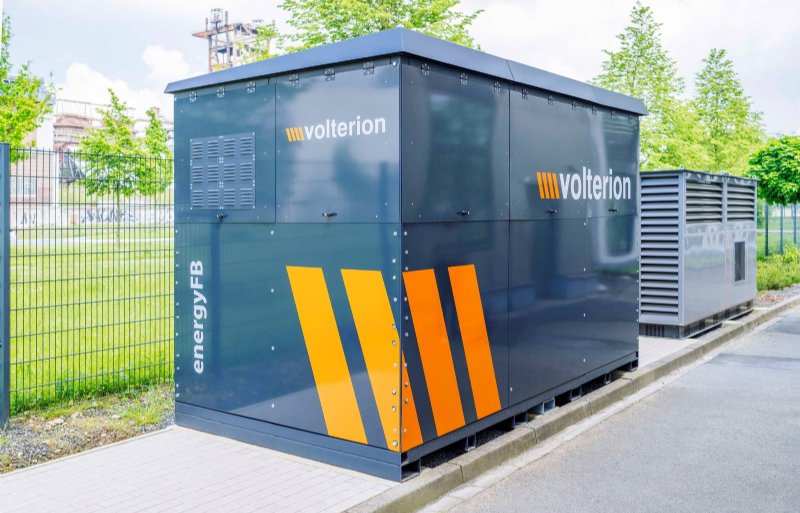
¿Quiere almacenar su propia energía en baterías que duren hasta 25 años, no pierdan capacidad con el paso de los años y sin riesgo de incendio? Es posible con una batería de flujo (Wikipedia). Esta ofrece una alternativa atractiva a las baterías convencionales de litio, en la escala requerida por empresas agrícolas.

Los recientes avances en el mercado de la energía sostenible están aumentando el interés en el almacenamiento de energía in situ. Los proveedores de sistemas de almacenamiento también están notando esto. 'Casi todos los proveedores de energía cobran costos de alimentación a los propietarios de paneles solares. Es por ello que recibimos cada vez más solicitudes de empresarios que preguntan por nuestra oferta. “Sobre todo de agricultores y jardineros”, afirma Xavier van der Putten, director de Redox Storage Solutions.

Junto con Kees van de Kerk, director general del fabricante de baterías Volterion, habla sobre los últimos avances en el mercado de sistemas de almacenamiento de energía. Estas ofrecen opciones interesantes para agricultores y jardineros. Esto afecta en especial a la llamada batería de flujo redox.

Van der Putten afirma que la batería de flujo redox también es la forma más eficiente de almacenar electricidad renovable en la granja. El corazón de la batería está formado por pilas patentadas. Se trata de celdas apiladas, cada una contiene un electrodo positivo y uno negativo, separados por una membrana que permite el paso de iones. A más celdas y más pilas, más potencia (kilovatios) dará la batería.

Los electrones se almacenan como energía química en tanques de doble pared que contienen una solución segura de agua con iones de vanadio. Cuando la batería se descarga, la energía química se convierte en electricidad. La ventaja de estas baterías es que se pueden cargar y descargar al menos 20.000 veces sin pérdida de capacidad. Por lo tanto, el recambio sólo es necesario después de 25 a 30 años.

Devolver energía (a la red) se vuelve menos atractivo
Muchas granjas tienen uno o más molinos de viento. Y muchos más empresarios agrícolas han instalado paneles solares en los techos de graneros y establos en los últimos años. En general, se asumió un precio razonable para el excedente de energía renovable devuelto a la red. Esta situación está cambiando rápidamente. Con casi todas las compañías energéticas pagas extra si generas y suministras tu propia electricidad. El suministro a la red eléctrica produce un rendimiento mucho menor y no será atractivo en los próximos años.

'¿Qué podría ser más lógico que almacenar la energía de los paneles solares si no se puede usar de inmediato? Muchos agricultores tienen máquinas que usan cuando el sol brilla poco o nada. Tal es el caso de las máquinas de ordeño o los purificadores de aire. "Allí se puede almacenar fácilmente la energía no utilizada a media tarde", afirma Van der Putten. Una opción adicional para el almacenamiento es aprovechar la diferencia horaria de precio entre las tarifas con una gestión inteligente de la energía, es decir almacenando electricidad de la red a precio bajo y usándola durante las horas pico.

Hasta ahora, los agricultores y jardineros han utilizado casi exclusivamente baterías tradicionales de litio para almacenar energía. Pero, especialmente ahora que el mercado de almacenamiento de energía está en auge, hay motivos para mirar más allá, según Van de Kerk. Afirma que la batería de flujo es la forma ideal para que las empresas agrícolas operen independientemente de la red eléctrica. Y también para funcionar como fuente de energía de emergencia.

Las baterías de flujo duran unos 25 años, mucho más que las baterías de litio. Esto es sostenible y muy interesante desde el punto de vista económico, pero hay una ventaja adicional: el valor residual de la batería. Una batería de litio contiene materiales escasos que son difíciles de reciclar. Una batería de este tipo debe desecharse y procesarse al final de su vida útil. Aparte de los problemas logísticos, está el costo.

El fluido (de la batería) mantiene su valor
Con una batería de flujo, el líquido sigue como nuevo al final de su vida útil y se puede utilizar en una batería nueva sin problemas. El líquido alcanza cerca de un tercio del costo. No necesita ser procesado ni reciclado, sino que simplemente conserva su valor', señala Van de Kerk como la principal diferencia entre los dos sistemas al final del ciclo de vida.

No existen requisitos especiales para instalar una batería de flujo en una empresa agrícola. Lo único importante es un piso de hormigón nivelado que pueda soportar el peso de la batería, fácilmente alrededor de 13 toneladas. "Y después sólo es necesario conectar dos cables", explica Van der Putten.

Debido al riesgo mínimo de incendio, no es necesario respetar ninguna distancia mínima a los edificios. Por el contrario, también se puede simplemente instalar en el interior. Cumple con los estándares europeos de calidad y seguridad. El mínimo riesgo de incendio también ha llevado a conversaciones con las aseguradoras sobre primas más bajas para las baterías de flujo redox.

Imagen
© Storage Solutions/Volterion

La inversión para este sistema es mayor que la de las baterías de litio. Pero esto se amortiza fácilmente asegura Van der Putten. La larga vida útil, la capacidad constante y los bajos costos para la eliminación final responsable de la batería brindan un amplio margen para esto.

La inversión para este sistema es mayor que la del almacenamiento de energía con baterías de litio. Pero esto se amortiza fácilmente si se utiliza una batería de flujo redox, asegura Van der Putten. La larga vida útil, la capacidad constante y los bajos costos para la eliminación final responsable de la batería brindan un amplio margen para esto.

La eficiencia de aproximadamente el 70 por ciento es ligeramente inferior a la de una batería de litio, pero también es fácil hacer algo al respecto. La menor eficiencia se debe a la pérdida de calor. Si se aprovecha ese calor, a una temperatura de 30 a 40 grados, por ejemplo para una calefacción por suelo radiante o una bomba de calor, se puede conseguir una eficiencia del 90 por ciento. 'La conexión para las mangueras necesarias para ello ya está incluida de serie en la batería', explica Van de Kerk. 'La compra de una batería de flujo redox es una inversión responsable y rentable para los agricultores y jardineros que generan renovable'.

https://www.nieuweoogst.nl/nieuws/2025/ ... w-batterij
Fermat
Mensajes: 2139
Registrado: Mié Mar 02, 2022 5:42 am

Re: Notas de energías renovables

Mensaje sin leer por Fermat »

The Future of Ultra-Fast EV Charging: Inside the LMFCC Breakthrough
By Muhammad Osama, Reviewed by Laura Thomson, AZOTECH, Mar 21 2025
A recent article published in the journal Engineering introduced an innovative liquid metal flexible charging connector (LMFCC) for high-power direct current fast charging (DC-HPC) in electric vehicles (EVs). This approach aims to enhance cooling efficiency and high-current transmission, addressing key challenges in EV technology.

Imagen
Image Credit: Mariana Serdynska/Shutterstock.com

Advancements in EV Charging Technology
Reducing carbon emissions has become a key priority as global energy structures evolve, particularly transportation.

According to the International Energy Agency, the number of EVs worldwide is expected to increase approximately 10 times by 2030. However, challenges like range anxiety and prolonged charging hinder large-scale adoption compared to conventional fuel vehicles.

HPC technology has emerged as a solution, significantly reducing charging times to levels comparable to traditional refueling.

Recent advancements have increased the peak charging power of DC-HPC systems from 43.5 kW to 450 kW, with new standards aiming for up to 1 MW.

Despite these developments, ultrahigh-current charging exceeding 3000 A remains a significant challenge. The heat generated during high-current charging can lead to equipment failures and safety risks, such as overheating and fire hazards.

Traditional cooling methods, which separate current conduction from heat dissipation, are inadequate for managing the extreme thermal loads of ultrahigh-current applications. This highlights the urgent need for new solutions that enhance thermal management while maintaining charging efficiency and safety.

About this Research: Introducing Gallium-Based LMFCC
Researchers developed a gallium-based LMFCC charging and cooling strategy to address ultrahigh charging currents in DC-HPC systems. They examined its transmission stability under extreme deformation compared to conventional solid metal connectors.

The study employed a compact induction electromagnet-driven system optimized for active cooling to enhance liquid metal flow rates and cooling efficiency. A three-dimensional (3D) multi-physics numerical model was constructed to evaluate the LMFCC's performance across various geometric and hydrodynamic parameters. The experimental setup included a synergetic cooling LMFCC, a direct current (DC) high-power supply, and multi-sensing signal collection systems to monitor temperature, pressure, and flow rate.

The LMFCC system comprises induction electromagnet-driven units, liquid metal flexible cables (LMFCs), liquid metal-enhanced heat dissipation components, and transition connection units. The LMFCs, made of highly elastic silicone tubes filled with liquid metal, enable independent coolant-circulating loops for improved heat dissipation.

The electromagnet-driven unit generated an Ampère force to pump liquid metal through the loops, enhancing cooling performance. Then, a magnetohydrodynamics (MHD)-based numerical model was used to optimize pumping capability and thermal management. The researchers validated the LMFCC's adaptability to superhigh charging currents through experiments, providing insights into its operational reliability and cooling efficiency.

Key Findings of Using New Gallium-based LMFCC
The outcomes indicated that the LMFCC exhibited exceptional cooling efficiency and flexibility, effectively dissipating heat while transmitting high currents. It achieved sudden low temperatures (<16 °C at 1000 A), significantly outperforming traditional cooling methods that struggle to maintain safe levels under similar conditions. Its remarkable bending radius of just 2 cm enhanced adaptability for various applications.

The induction electromagnet-driven system improved liquid metal flow, boosting active cooling capacity and mitigating thermal shocks, extending the charging system lifespan.

Experimental results closely matched the numerical simulations, validating the LMFCC model's accuracy. For example, at a flow rate of 0.2 L·min⁻¹, the experimental pressure head was 47.8 kPa, while the simulation results yielded 44.9 kPa, showing a deviation of 6.5%.

The study highlighted liquid metal's dual role as a coolant and current-carrying conductor, improving reliability while reducing fire hazards associated with copper conductors.

The 3D multi-physics model effectively analyzed MHD generation, optimizing pumping capability and thermal transfer. The results showed that increasing the LMFC's diameter enhanced heat dissipation, ensuring cooling even at high charging currents.

The authors also demonstrated the benefits of integrating an active-rotating magnetic system into the Permanent Magnet Electromagnetic Pump (PM-EMP), which enhances pumping reliability and eliminates common issues like coolant leakage.

Comparative analysis revealed that the LMFCC provides a lightweight, flexible, and highly efficient alternative to conventional copper cables. This makes it a strong candidate for liquid-cooled power lines in electric trucks, aircraft, and ships requiring ultrahigh-current charging.

Potential Applications in the EV Industry
This research has significant implications across multiple industries. In the EV sector, the LMFCC could revolutionize charging infrastructure by enabling rapid recharging and improving the efficiency of the HPC system. Its flexible design allows seamless integration into diverse charging environments, from urban hubs to remote locations.

Beyond EVs, the LMFCC's synergetic cooling strategy could be helpful in renewable energy systems, industrial processes, and thermal management in aerospace and marine transportation.

Its ability to manage heat while transmitting high currents makes it a valuable solution for next-generation power and cooling systems. As demand for high-capacity charging grows, adopting LMFCC technology could enhance the reliability and scalability of future energy infrastructures.

Conclusion and Future Directions
The LMFCC represents a significant advancement in EV charging technology, addressing the challenges of ultrahigh charging with an efficient thermal management solution. It can significantly enhance the performance, safety, and scalability of charging systems, accelerating the adoption of high-power EV infrastructure.

Future work should optimize its design, reduce costs, and integrate it into existing infrastructure. The synergetic cooling and charging strategy marks a breakthrough in thermal management, positioning the LMFCC's potential in high-power applications.

Disclaimer: The views expressed here are those of the author expressed in their private capacity and do not necessarily represent the views of AZoM.com Limited T/A AZoNetwork the owner and operator of this website. This disclaimer forms part of the Terms and conditions of use of this website.

Source:
Liu, C., & et al. Liquid Metal-Enabled Synergetic Cooling and Charging of Superhigh Current. Engineering, 2025. DOI: 10.1016/j.eng.2024.11.035,
https://www.sciencedirect.com/science/a ... 9924007446 (Acceso Libre)

https://www.azocleantech.com/news.aspx?newsID=35617
Fermat
Mensajes: 2139
Registrado: Mié Mar 02, 2022 5:42 am

Re: Notas de energías renovables

Mensaje sin leer por Fermat »

The Future of Graphene Batteries in Electric Vehicles
Ankit Singh, Azotechclean, 31-03-2025, Reviewed by Laura Thomson

The rapid growth of electric vehicles (EVs) is pushing the demand for more efficient, durable, and sustainable battery technologies. While lithium-ion (Li-ion) batteries have dominated the EV landscape, they have several limitations, including long charging times, degradation over multiple cycles, and safety concerns.

Graphene, a groundbreaking material known for its exceptional electrical and thermal properties, is emerging as a game-changer in battery technology. By integrating graphene into energy storage solutions, researchers and companies aim to significantly improve battery performance. This article examines graphene batteries' advantages, research progress, commercialization challenges, and impact on EVs.

Imagen
Image Credit: Aliaksei Kaponia/Shutterstock.com

What is Graphene?
Graphene is a single layer of carbon atoms arranged in a hexagonal lattice, making it the thinnest yet one of the strongest materials known to science. Its remarkable properties include exceptional electrical conductivity, superior mechanical strength, and high thermal conductivity.

Graphene is 200 times stronger than steel while being incredibly lightweight, enabling innovative applications in various industries, from electronics to aerospace.[1]

Due to its high electron mobility, graphene enables faster charge and discharge rates in batteries, enhancing efficiency and performance beyond traditional Li-ion technology.

Since its discovery, extensive research has focused on unlocking its potential for improving energy storage—especially in EV batteries, where it could enhance range, charging speed, and lifespan.1

Advantages of Graphene Batteries Over Li-Ion Batteries
Graphene-based batteries offer several advantages over conventional Li-ion batteries, making them highly promising for the EV industry.
  • Faster Charging: Graphene enables rapid electron movement, significantly reducing charging times. While Li-ion batteries take 30–60 minutes for a full charge, graphene batteries could potentially charge within a few minutes.[1],[2]
  • Higher Energy Density: Li-ion batteries have a limited energy storage capacity. With their high surface area and superior conductivity, graphene batteries can store more energy in the same volume, extending the EV range.[1],[2]
  • Longer Lifespan: Traditional batteries degrade with repeated charge cycles. Graphene batteries exhibit less wear and tear, resulting in a longer operational life and reducing the need for frequent replacements.[1],[2]
  • Improved Efficiency: Graphene enhances ion transport, reducing energy losses during charging and discharging. This leads to better overall battery performance and improved vehicle efficiency.[1],[2]
  • Enhanced Safety: Overheating and thermal runaway are common issues with Li-ion batteries. Graphene’s superior thermal conductivity dissipates heat efficiently, minimizing the risk of fires and explosions.[1],[2]

Video Credit: Enkoretech/YouTube.com

Current Research and Development of Graphene Batteries
Several companies are actively developing graphene-based battery technology to bring it to commercial viability. For example, Nanotech Energy is working on commercializing graphene batteries with high energy density.

Samsung Advanced Institute of Technology (SAIT) is enhancing Li-ion batteries with graphene for faster charging, while Huawei focuses on graphene for improved heat management, boosting battery efficiency and longevity in EVs.[1]

Similarly, research institutions and universities are also leading efforts in optimizing graphene battery applications for EVs.

A recent study published in Applied Surface Science investigated copper-doped graphene as a high-performance anode material for Li-ion batteries using first-principles computational methods.

Copper doping enhanced active sites, significantly increasing theoretical capacities to 1651.8 mAh/g for Li-ion. This material also exhibited low diffusion barriers, minimal lattice changes (<1%), and excellent conductivity, making it a promising anode material for next-generation energy storage solutions.[3]

Another notable study published in the Journal of Power Sources introduced a high-energy-density graphene-based anode using a polyethersulfone (PES) sheet and laser-induced graphene (LIG) techniques for Li-ion batteries.

The hexagonal porous structure enhanced lithiation, improving battery lifespan. This binder-free, non-hazardous anode retained 80.7% capacity from 710 mAh/g at 0.1C and achieved 99% coulombic efficiency over 200 cycles, offering a scalable solution for next-generation Li-ion batteries in portable devices and EVs.[4]

The Benefits of Graphene Batteries
Graphene batteries have the potential to significantly enhance EV performance across several key aspects.

Vehicle performance
In the near future, the higher energy density of graphene batteries is expected to enable EVs to achieve significantly longer driving ranges on a single charge, making them more viable for extended journeys. As graphene technology advances, improved power output will likely enhance acceleration and overall efficiency, pushing EVs closer to the capabilities of high-performance sports cars.[1],[5]

Furthermore, graphene’s superior conductivity is anticipated to ensure consistent energy delivery, reduce performance fluctuations, and optimize power management for a smoother and more reliable driving experience.

Charging times
The ultra-fast charging capability of graphene batteries is one of their most significant advantages. With the ability to charge in minutes rather than hours, EV owners could experience a level of convenience comparable to refueling a traditional gasoline vehicle. This rapid charging would also reduce demand on charging infrastructure, improving accessibility and efficiency in EV networks.[1],[5]

Sustainability
Graphene-based batteries could contribute to a more sustainable EV ecosystem. Their longer lifespan reduces battery waste, and they contain fewer environmentally harmful materials than Li-ion batteries. Graphene can also be derived from abundant carbon sources, potentially reducing reliance on rare earth metals and minimizing the environmental impact of battery production.[1],[5]

Challenges and Limitations of Graphene Batteries
Despite its potential, several challenges hinder the widespread adoption of graphene batteries in EVs.

• Manufacturing Costs: Producing high-quality graphene remains costly, making large-scale manufacturing a significant challenge.¹
• Scalability Issues: Scaling up graphene battery production to meet the demands of the EV industry requires major improvements in fabrication techniques.¹
• Integration into Existing Systems: Most current EVs are built around lithium-ion batteries. Shifting to graphene-based systems would require battery management systems and charging infrastructure updates.¹
• Supply Chain Constraints: Graphene production relies on specialized materials and processes. A sudden spike in demand could strain the supply chain.¹
• Commercialization Timeline: Although research is advancing, it may still take several years before graphene batteries are ready for mass-market adoption, primarily due to the need for further testing and cost reduction.¹

The Future Outlook of Graphene for Battery Production
The path to commercializing graphene batteries in EVs centers on overcoming technical and economic hurdles. Analysts suggest that over the next decade, graphene-enhanced batteries may begin to appear in high-end EV models, with wider adoption expected as production becomes more cost-effective.¹

Looking further ahead, graphene technology could play a key role in accelerating EV adoption by addressing key concerns such as range anxiety and charging limitations. As manufacturing processes mature, graphene-based batteries may also support sustainability efforts by reducing dependence on rare earth materials and extending battery life—helping to lower the overall environmental footprint.¹

Conclusion
Graphene batteries offer strong potential to reshape the EV landscape with faster charging, better performance, and greater durability. While there are still hurdles to clear, ongoing research and investment point to a promising trajectory. As technological progress reduces costs, graphene-based batteries could become a crucial driver of more efficient and sustainable electric mobility.

References and Further Reading (NB! Salvo [5], todos los artículos son por subscripción):
[1] de Bortoli, B. et al. (2023). Graphene: an overview of technology in the electric vehicles of the future. SAE Technical Paper 2022-36-0100, 2023. DOI:10.4271/2022-36-0100. https://www.sae.org/publications/techni ... 2-36-0100/
[2] Wang, X. et al. (2021). Research progress on graphene-based materials for high-performance lithium-metal batteries. New Carbon Materials, 36(4), 711-728. DOI:10.1016/S1872-5805(21)60081-1. https://www.sciencedirect.com/science/a ... 0521600811
[3] Hu, J. et al. (2025). Cu-doped graphene Cu/N2OG: A high-performance alkaline metal ion battery anode with record-theoretical capacity. Applied Surface Science, 682, 161752. DOI:10.1016/j.apsusc.2024.161752. https://www.sciencedirect.com/science/a ... 3224024681
[4] Rahman, M. M. et al. (2025). Polyethersulfone-based thick polymer-supported graphene sheet for high energy density lithium-ion battery. Journal of Power Sources, 626, 235774. DOI:10.1016/j.jpowsour.2024.235774. https://www.sciencedirect.com/science/a ... 5324017269
[5] Chang, H. et al. (2021). Graphene-Enhanced Battery Components in Rechargeable Lithium-Ion and Lithium Metal Batteries. C, 7(3), 65. DOI:10.3390/c7030065. https://www.mdpi.com/2311-5629/7/3/65

https://www.azocleantech.com/article.as ... cleID=1958
Fermat
Mensajes: 2139
Registrado: Mié Mar 02, 2022 5:42 am

Re: Notas de energías renovables

Mensaje sin leer por Fermat »

Un poco como una nota de prensa, pero los sistemas que aprovechan la energía solar para generar calor son interesantes también.

El sistema de energía a calor con batería térmica suministra calor para el procesamiento
Sven Ullrich 1 de abril de 2025
Imagen
Energynest también instalará una batería térmica de este tipo en Leonhard Kurz. - © Energynest

El refinador de superficies (Wikipedia: Surface finishing) Leonhard Kurz utilizará en el futuro calor de proceso para su planta de producción con electricidad. Se usará una batería térmica especial desarrollada por Energynest.

El especialista en producción sostenible de calor de procesamiento construye en las instalaciones de producción del refinador de superficie Leonhard Kurz en Sulzbach-Rosenberg, Baviera, una instalación de Energía a Calor (Power-to-Heat) que incluye almacenamiento de calor. La empresa con sede en Fürth quiere reducir sus emisiones de gases de efecto invernadero. Hasta ahora, Leonhard Kurz utiliza principalmente gas natural para generar calor a altas temperaturas, que luego se distribuye al proceso productivo a través de un sistema térmico de aceite.

Se planean tres megavatios de calefacción eléctrica
En el futuro, la empresa quiere sustituir parte de este petróleo por electricidad de su propio parque solar. Sin embargo, la electricidad de la red también ira al sistema de generación de calor cuando hay sobreproducción de los sistemas eólicos o solares. Además, el sistema que instala Energynest puede reaccionar a precios flexibles de electricidad.

Este es brazo de palanca para que Leonhard Kurz reduzca sus emisiones. La empresa necesita cada año más de cuatro GW-h de calor en la fábrica de Sulzbach-Rosenberg, y la demanda oscila con las altas temperaturas. Para cubrir gran parte del calor necesario, Energynest está instalando un sistema de calefacción eléctrica con una potencia de tres megavatios. También está la llamada batería térmica con una capacidad de doce MW-h de calor.

El calor se almacena exactamente al revés. El fluido térmico enfriado regresa desde el recipiente conectado a los tubos de acero, donde se calienta y regresa a la parte superior. Luego libera el calor almacenado al sistema de calor de procesamiento mediante un intercambiador de calor. Al mismo tiempo, la relajación (de esfuerzos) del recipiente colector conectado durante la salida del fluido térmico genera calor adicional, que también alimenta al sistema de calor de procesamiento.

Cubrir el 70 por ciento de las necesidades de calefacción de forma neutra en CO2
Según los cálculos de los planificadores, la instalación proporcionará anualmente unos tres GW-h de calor de procesamiento, cubriendo aproximadamente el 70 por ciento de las necesidades de calor de Leonhard Kurz. El sistema suministra más del 40 por ciento del calor necesario directamente desde el acumulador. Esto garantiza una mayor eficiencia energética y fiabilidad. Al mismo tiempo, Leonhard Kurz puede utilizar el sistema para reducir el consumo de gas natural en más de 3,5 GW-h al año, lo que a su vez ahorra más de 700 toneladas de emisiones de CO2.

https://www.erneuerbareenergien.de/waer ... zesswaerme
Fermat
Mensajes: 2139
Registrado: Mié Mar 02, 2022 5:42 am

Re: Notas de energías renovables

Mensaje sin leer por Fermat »

New Lithium-Ion Battery Design Overcomes Cold-Temperature Charging Limitations
Azotech, Reviewed by Lexie Corner, Apr 2 2025

Engineers from the University of Michigan have developed a modified manufacturing process for electric vehicle batteries that aims to enable fast charging in cold weather and improve long-range performance, addressing common concerns among potential EV buyers.

Imagen
Engineering student Chloe Acosta plugs in an EV for charging in snowy weather on the University of Michigan’s North Campus. EV charging becomes less efficient in colder weather, but a new strategy for manufacturing battery electrodes could enable charging in 10 minutes in temperatures as cold as -10 ºC. Image credit: Marcin Szczepanski, Michigan Engineering
We envision this approach as something that EV battery manufacturers could adopt without major changes to existing factories. For the first time, we have shown a pathway to simultaneously achieve extremely fast charging at low temperatures, without sacrificing the energy density of the lithium-ion battery.

Neil Dasgupta, Associate Professor and Study Corresponding Author, Mechanical Engineering and Materials Science and Engineering, University of Michigan
At temperatures as low as 14 ºF (-10 ºC), lithium-ion EV batteries manufactured using this modified process can charge five times faster. The modified structure and coating prevent the formation of lithium plating on the battery's electrodes, which typically degrades performance.

As a result, these modified batteries retain 97 % of their capacity after 100 fast charges at extremely low temperatures.

Current EV batteries use a liquid electrolyte to transport lithium ions between electrodes for power storage and release. However, at lower temperatures, the movement of these ions slows, which reduces both battery power and charging speed.

To increase range, automobile manufacturers have thickened battery cell electrodes. While this provides longer driving distances between charges, some lithium becomes inaccessible, slowing charging and reducing power efficiency for the given battery weight.

Previously, Dasgupta's team improved battery charging capacity by creating pathways in the anode, the electrode that receives lithium ions during charging, with a size of about 40 µm. By using lasers to create these pathways in the graphite, lithium ions could more quickly locate spots to lodge, resulting in more consistent charging.

While this method greatly accelerated charging at room temperature, charging in cold conditions remained ineffective. The team identified that a chemical layer forms on the electrode surface from reactions with the electrolyte, which is the main issue.

Dasgupta compared the behavior to butter, noting that a knife can cut through it whether it is warm or cold, but is much harder to cut when cold. If you try to fast charge through that layer, lithium metal will build up on the anode like a traffic jam.
That plating prevents the entire electrode from being charged, once again reducing the battery’s energy capacity.

Manoj Jangid, Senior Research Fellow and Study Co-Author, Mechanical Engineering, University of Michigan
The team needed to prevent the formation of the surface layer. They accomplished this by applying a glassy, approximately 20 nm-thick layer of lithium borate-carbonate to the battery. This coating significantly improved cold charging, and when combined with the channels, the test cells charged five times faster in subfreezing temperatures.
By the synergy between the 3-D architectures and artificial interface, this work can simultaneously address the trilemma of fast charging at low temperature for long-range driving.

Tae Cho, Ph.D. Graduate and Study First Author, Mechanical Engineering, University of Michigan
As consumers increasingly seek environmentally friendly options, EVs have become more common on the roads over the past 20 years. However, a recent AAA survey suggests that sustaining this momentum is challenging. The percentage of American adults who said they would be “likely” or “very likely” to purchase a new or used EV dropped from 23 % in 2023 to 18 % in 2024.

Additionally, 63 % of respondents reported that they were “unlikely” or “very unlikely” to buy an EV as their next car. Concerns such as range reductions during winter and slower charging times, which were widely discussed during the January 2024 cold snap, are among the issues.

“Charging an EV battery takes 30 to 40 minutes even for aggressive fast charging, and that time increases to over an hour in the winter. This is the pain point we want to address,” Dasgupta said.

Follow-up efforts to create factory-ready processes are being funded by the Michigan Economic Development Corporation through the Michigan Translational Research and Commercialization (MTRAC) Advanced Transportation Innovation Hub.

The Michigan Center for Materials Characterization researched the devices, which were constructed in the U-M Battery Lab.

With assistance from U-M Innovation Partnerships, the team has applied for patent protection. The channel technology has been licensed by Arbor Battery Innovations, which is also working on its commercialization. Arbor Battery Innovations is financially owned by Dasgupta and the University of Michigan.

Journal Reference:
Cho, T. H., et al. (2025) Enabling 6C fast charging of Li-ion batteries at sub-zero temperatures via interface engineering and 3D architectures. Joule. doi.org/10.1016/j.joule.2025.101881. https://www.sciencedirect.com/science/a ... via%3Dihub Acceso abierto


https://www.azocleantech.com/news.aspx?newsID=35637
Última edición por Fermat el Vie Abr 04, 2025 10:13 am, editado 1 vez en total.
Responder